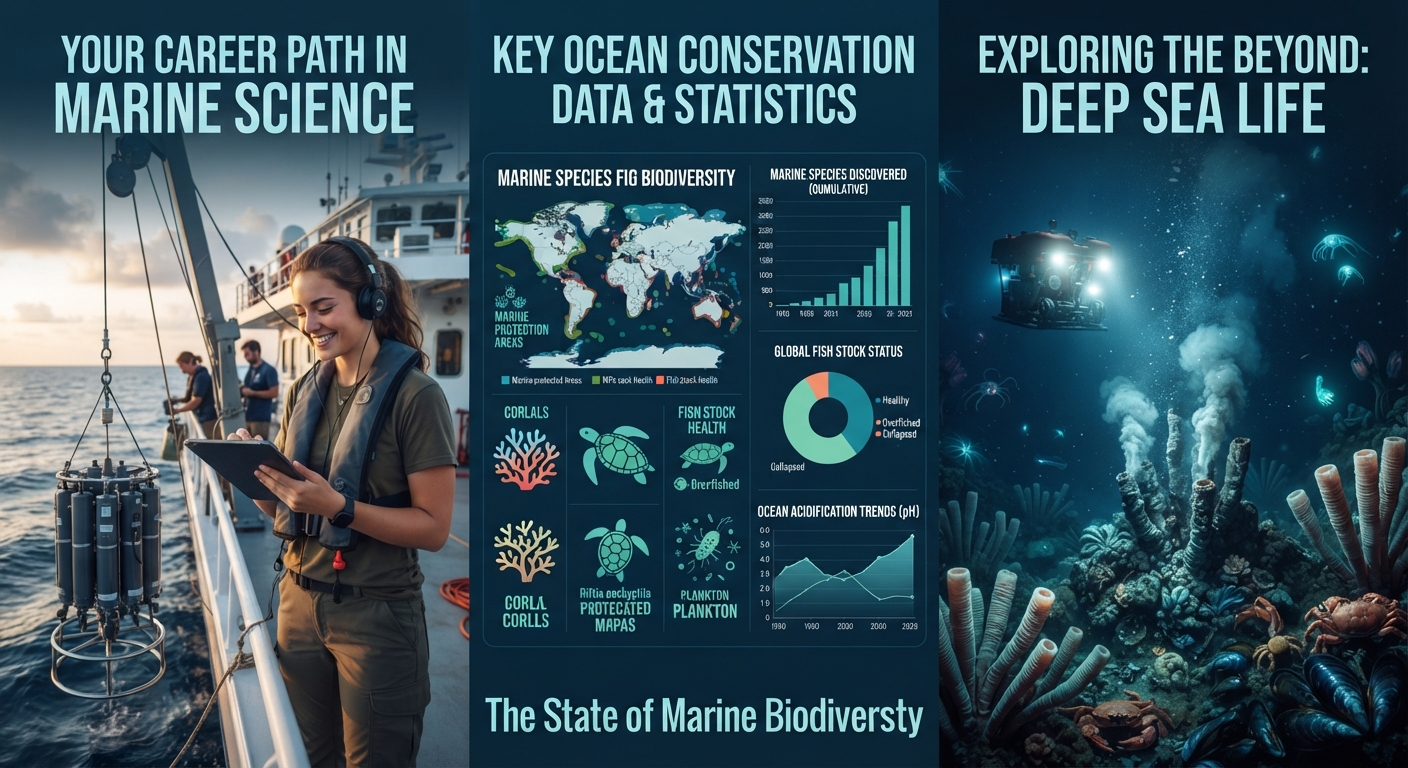
The Deep Sea Ecosystem: A Comprehensive Guide to Bathypelagic and Abyssopelagic Life
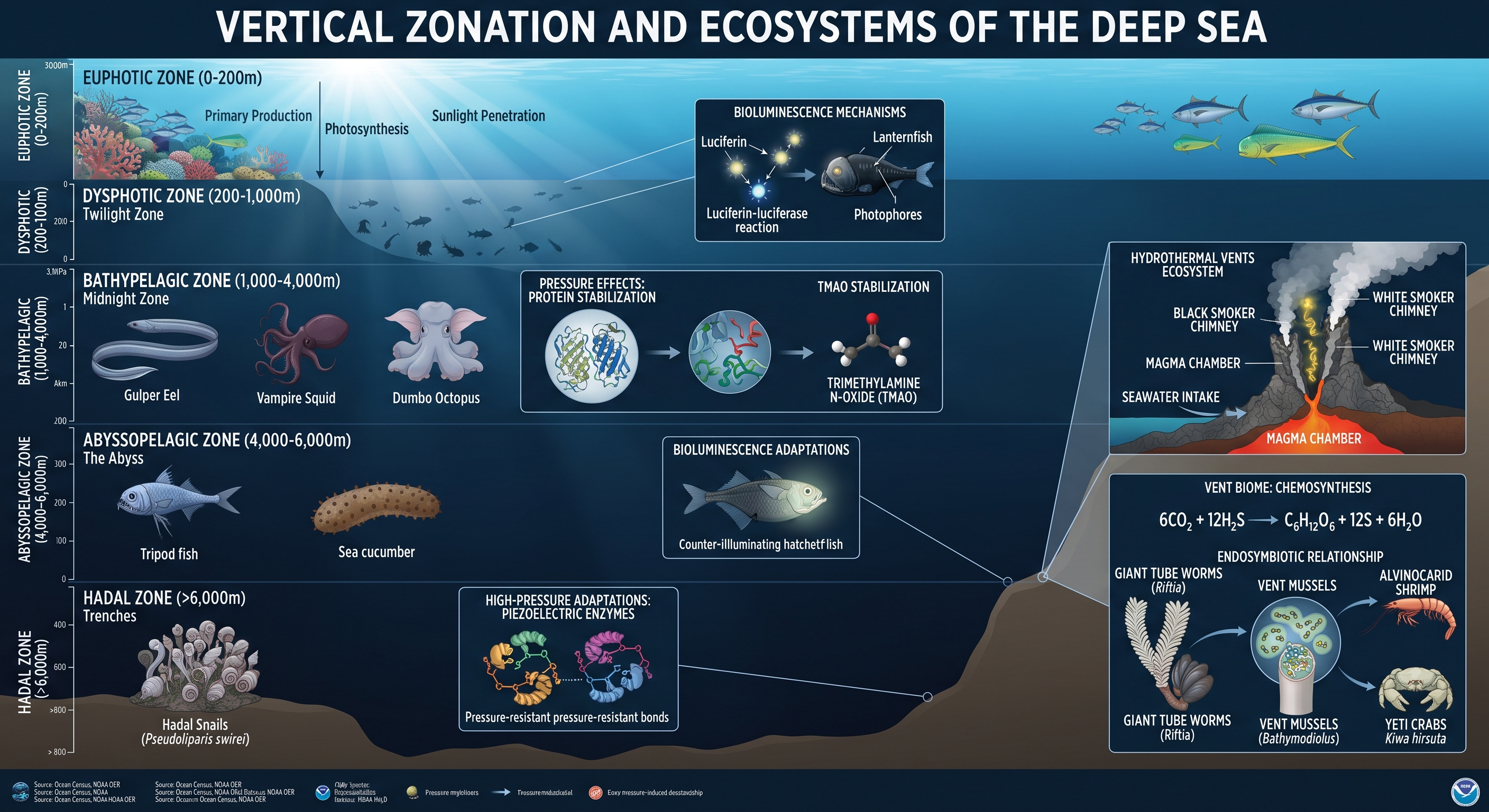
Stretching from a depth of 1,000 meters down to the freezing ocean floor trenches, the deep sea represents the largest habitable space on Earth. Despite total darkness, crushing hydrostatic pressures, and near-freezing temperatures, benthic and pelagic zones support highly specialized evolutionary adaptations.
This guide provides an advanced technical breakdown of deep-sea oceanography, vertical zonation, and the physiological mechanics driving bathypelagic life.
1. Vertical Zonation of the Deep Ocean
Marine scientists divide the water column below the photic zone into distinct hydrostatic and ecological horizons:
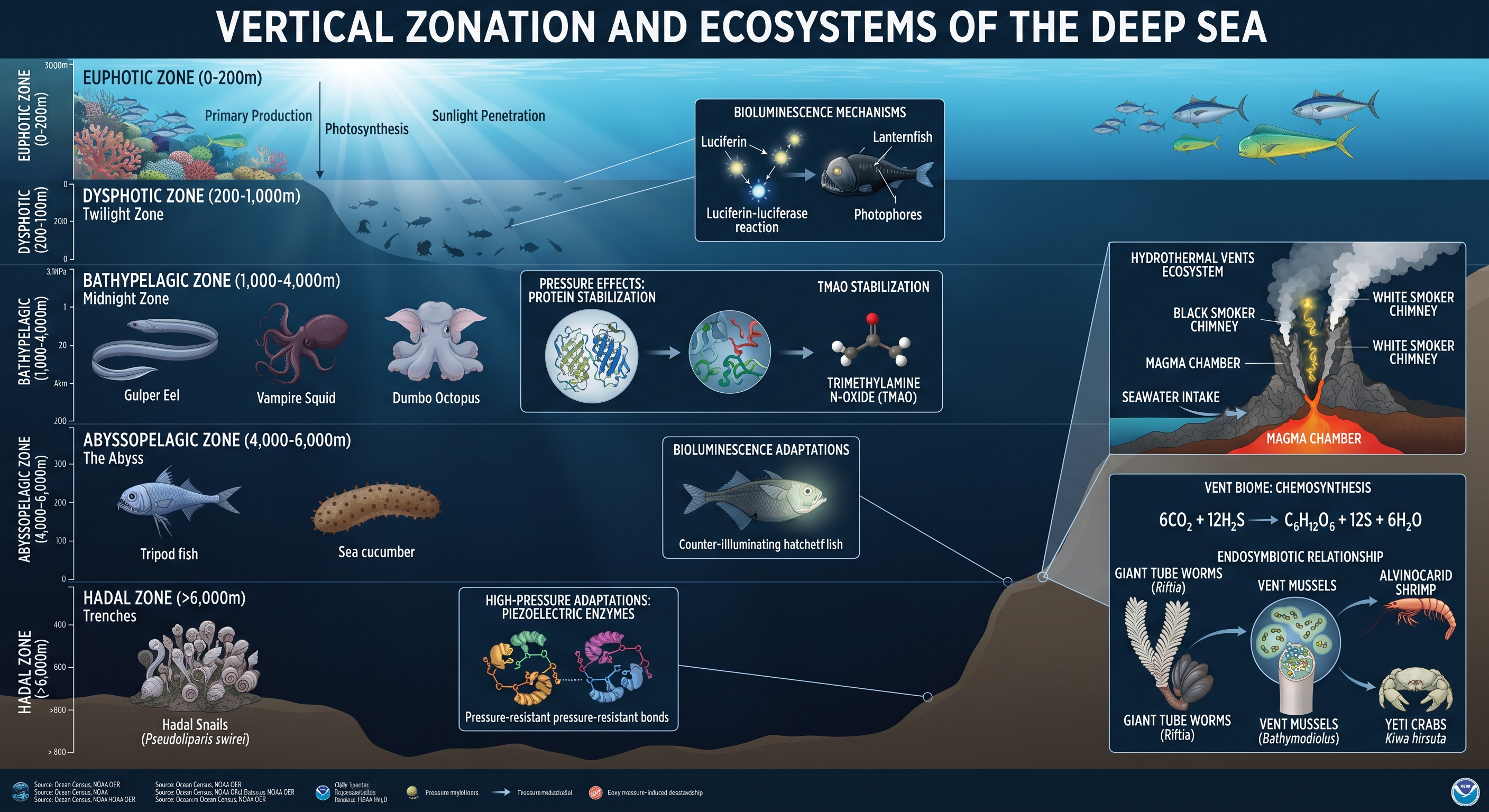
• Mesopelagic (200m to 1,000m): The twilight zone. Faint sunlight penetrates, supporting the vertical migration layer (DCM) and widespread visual adaptations like large eyes and counter-illumination.
• Bathypelagic (1,000m to 4,000m): Perpetual darkness. Temperatures hover constantly between 2 degrees Celsius and 4 degrees Celsius. Pressure ranges from 100 to 400 atmospheres. Primary production relies entirely on organic marine snow sinking from upper strata.
• Abyssopelagic (4,000m to 6,000m): Pitch black, freezing, and extremely high pressure. Fauna consists almost exclusively of carnivores, scavengers, and detritivores.
• Hadalpelagic (over 6,000m): Deep oceanic trenches characterized by localized benthic biological hotspots fueled by chemosynthesis.
2. Physiological Adaptations to Extreme Pressure
Living under thousands of pounds of pressure per square inch requires unique biochemical configurations:
• Piezoelectric Proteins: Deep-sea fish and invertebrates produce specialized proteins and high concentrations of trimethylamine N-oxide (TMAO), a cellular osmolyte that stabilizes proteins against structural collapse under immense hydrostatic pressure.
• Gelatinous Morphologies: Many bathypelagic organisms (e.g., pelagic sea cucumbers, deep-sea jellyfish) replace heavy skeletal structures with watery, gelatinous tissues that match ambient water density, minimizing energy expenditure.
3. Bioluminescence: Communication and Predation in the Dark
An estimated 75 percent to 90 percent of deep-sea pelagic animals produce their own light through biochemical reactions involving luciferin and luciferase enzymes:
• Counter-Illumination: Species like midwater squid use ventral photophores to match downwelling ambient light intensity, effectively rendering themselves invisible to predators lurking below.
• Luring Prey: Anglerfish (suborder Lophioidei) utilize a modified dorsal spine tipped with a bioluminescent bacterial lure (esca) to attract prey within striking range in pitch-black waters.
4. Hydrothermal Vents and Chemosynthetic Primary Production
Discovered in 1977 along tectonic spreading centers, hydrothermal vents completely shattered the biological paradigm that all life requires solar energy:
• Chemosynthesis: Instead of photosynthesis, sulfur-oxidizing bacteria convert hydrogen sulfide and other toxic compounds from mineral-rich vent fluids into organic carbon.
• Symbiotic Relationships: Giant tube worms (Riftia pachyptila) lack a functional mouth or gut; instead, they host billions of internal symbiotic bacteria within an organ called a trophosome to fuel their growth in superheated, mineral-dense environments.
Conclusion: The Final Frontier of Marine Research
The deep sea remains largely unexplored, with less than a quarter of the ocean floor mapped with high-resolution sonar. As autonomous deep-sea robotics, eDNA sequencing, and long-term ocean observatories advance, our understanding of abyssal biodiversity continues to expand, revealing complex ecosystems critical to global planetary health.
The State of Marine Biodiversity: Key Statistics and Ocean Conservation Data
The State of Marine Biodiversity: Key Statistics and Ocean Conservation Data (2026)
Accurate data drives modern environmental policy, scientific research, and conservation advocacy. Journalists, academic researchers, and students frequently require consolidated metrics on marine ecosystems, global fisheries, climate stress indicators, and habitat loss.
This reference document compiles verified, peer-reviewed statistics and data points regarding the global state of marine biodiversity, serving as an open citation resource for researchers and content creators.
1. Global Marine Species & Taxonomic Baseline
Understanding the scale of marine life requires examining current taxonomic registries and discovery rates:
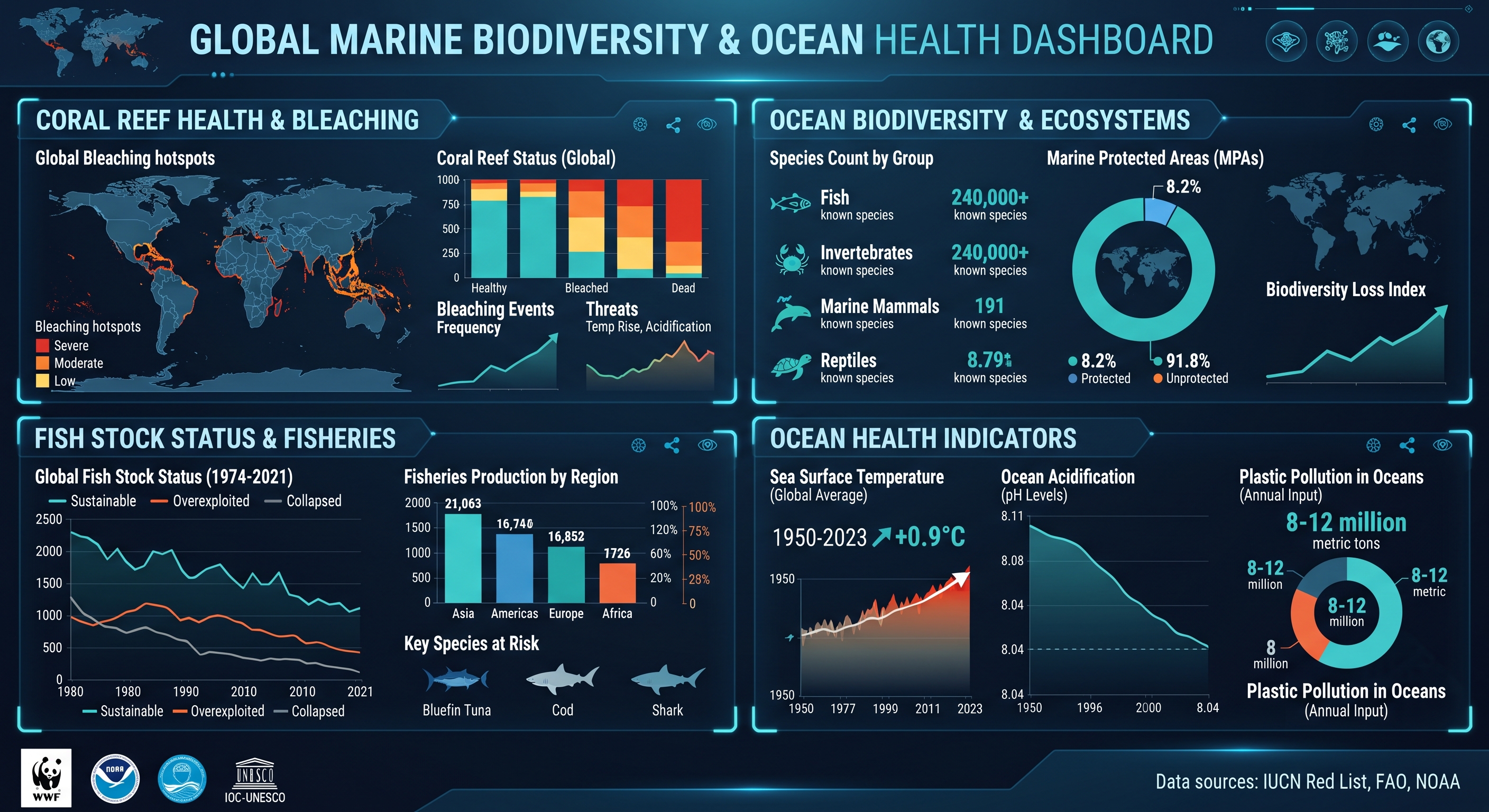
• Total Described Marine Species: Approximately 240,000 to 250,000 species are formally described in the World Register of Marine Species (WoRMS).
• Estimated Undescribed Species: Marine taxonomists estimate that between 700,000 and 1 million marine species remain undiscovered or uncataloged, particularly within the deep-sea benthos and meiofauna.
• Microbial Diversity: Ocean waters host an estimated 10^30 microbial cells, driving global biogeochemical cycles and carbon sequestration.
2. Coral Reef Ecosystems and Thermal Stress
Coral reefs cover less than 0.1 percent of the ocean floor but support roughly 25 percent of all marine species. They represent the most vulnerable marine ecosystem to anthropogenic climate change:
• Global Bleaching Events: Comprehensive global monitoring by NOAA Coral Reef Watch indicates that over 80 percent of coral reef regions experienced thermal stress levels capable of causing mass bleaching.
• Shallow-Water Coral Decline: Historical assessments indicate a global loss of roughly 30 percent to 50 percent of live coral cover over the past four decades due to rising sea surface temperatures, ocean acidification, and coastal runoff.
3. Fisheries, Overexploitation, and Stock Status
Global commercial fisheries sustain billions of people but face severe sustainability challenges tracked by the Food and Agriculture Organization (FAO):
• Overfished Stocks: According to FAO marine fisheries assessments, approximately 35 percent of assessed global fish stocks are currently classified as biologically unsustainable or overfished.
• Maxustainably Fished Stocks: Roughly 57 percent to 60 percent of stocks are fished at maximum sustainable yield limits, leaving very little buffer for environmental shocks.
• Bycatch Impact: Unintentional capture (bycatch) accounts for an estimated 10 percent to 20 percent of global marine catches, disproportionately impacting elasmobranchs (sharks and rays), sea turtles, and marine mammals.
4. Ocean Acidification and Chemical Metrics
The absorption of anthropogenic carbon dioxide emissions has radically altered basic ocean chemistry:
• pH Decline: Average surface ocean pH has dropped by approximately 0.1 units since the beginning of the Industrial Revolution, representing a roughly 30 percent increase in acidity (hydrogen ion concentration).
• Aragonite Saturation State: Declining carbonate ion saturation states heavily compromise calcifying organisms, including pteropods, coccolithophores, and scleractinian corals, impairing their ability to build calcium carbonate skeletons.
5. Marine Pollution: Plastics and Debris
Land-based waste streams continuously alter coastal and pelagic habitats:
• Plastic Input Volumes: Millions of metric tons of plastic waste enter the marine environment annually, fragmenting into microplastics (under 5 mm) and nanoplastics.
• Pelagic Distribution: Microplastics have been documented across all marine strata, from surface neuston layers down to abyssal sediment cores in the Mariana Trench.
Citation and Data Usage Policy
Researchers and writers are welcome to reference, cite, or excerpt statistics from this dataset for academic papers, articles, or environmental reports, provided direct attribution is linked back to primary institutional sources (e.g., WoRMS, NOAA, FAO, IPCC).
Accurate data drives modern environmental policy, scientific research, and conservation advocacy. Journalists, academic researchers, and students frequently require consolidated metrics on marine ecosystems, global fisheries, climate stress indicators, and habitat loss.
This reference document compiles verified, peer-reviewed statistics and data points regarding the global state of marine biodiversity, serving as an open citation resource for researchers and content creators.
1. Global Marine Species & Taxonomic Baseline
Understanding the scale of marine life requires examining current taxonomic registries and discovery rates:
• Total Described Marine Species: Approximately 240,000 to 250,000 species are formally described in the World Register of Marine Species (WoRMS).
• Estimated Undescribed Species: Marine taxonomists estimate that between 700,000 and 1 million marine species remain undiscovered or uncataloged, particularly within the deep-sea benthos and meiofauna.
• Microbial Diversity: Ocean waters host an estimated 10^30 microbial cells, driving global biogeochemical cycles and carbon sequestration.
2. Coral Reef Ecosystems and Thermal Stress
Coral reefs cover less than 0.1 percent of the ocean floor but support roughly 25 percent of all marine species. They represent the most vulnerable marine ecosystem to anthropogenic climate change:
• Global Bleaching Events: Comprehensive global monitoring by NOAA Coral Reef Watch indicates that over 80 percent of coral reef regions experienced thermal stress levels capable of causing mass bleaching.
• Shallow-Water Coral Decline: Historical assessments indicate a global loss of roughly 30 percent to 50 percent of live coral cover over the past four decades due to rising sea surface temperatures, ocean acidification, and coastal runoff.
3. Fisheries, Overexploitation, and Stock Status
Global commercial fisheries sustain billions of people but face severe sustainability challenges tracked by the Food and Agriculture Organization (FAO):
• Overfished Stocks: According to FAO marine fisheries assessments, approximately 35 percent of assessed global fish stocks are currently classified as biologically unsustainable or overfished.
• Maxustainably Fished Stocks: Roughly 57 percent to 60 percent of stocks are fished at maximum sustainable yield limits, leaving very little buffer for environmental shocks.
• Bycatch Impact: Unintentional capture (bycatch) accounts for an estimated 10 percent to 20 percent of global marine catches, disproportionately impacting elasmobranchs (sharks and rays), sea turtles, and marine mammals.
4. Ocean Acidification and Chemical Metrics
The absorption of anthropogenic carbon dioxide emissions has radically altered basic ocean chemistry:
• pH Decline: Average surface ocean pH has dropped by approximately 0.1 units since the beginning of the Industrial Revolution, representing a roughly 30 percent increase in acidity (hydrogen ion concentration).
• Aragonite Saturation State: Declining carbonate ion saturation states heavily compromise calcifying organisms, including pteropods, coccolithophores, and scleractinian corals, impairing their ability to build calcium carbonate skeletons.
5. Marine Pollution: Plastics and Debris
Land-based waste streams continuously alter coastal and pelagic habitats:
• Plastic Input Volumes: Millions of metric tons of plastic waste enter the marine environment annually, fragmenting into microplastics (under 5 mm) and nanoplastics.
• Pelagic Distribution: Microplastics have been documented across all marine strata, from surface neuston layers down to abyssal sediment cores in the Mariana Trench.
Citation and Data Usage Policy
Researchers and writers are welcome to reference, cite, or excerpt statistics from this dataset for academic papers, articles, or environmental reports, provided direct attribution is linked back to primary institutional sources (e.g., WoRMS, NOAA, FAO, IPCC).
How to Become a Marine Biologist: The Complete Global Guide
How to Become a Marine Biologist: The Complete Global Guide (2026)
Fascinated by the complexity of the world's oceans, aspiring scientists often ask: How do I actually become a marine biologist?
Unlike general biology, marine biology requires a multidisciplinary approach combining ecology, chemistry, physics, and advanced technology. Whether you are a high school student mapping out your university choices or an undergraduate planning your specialization, this comprehensive global guide breaks down the academic credentials, technical skills, and practical experience needed to build a successful career in marine science.
1. Understanding the Role: What Do Marine Biologists Actually Do?
Before choosing a degree path, it is vital to understand the reality of the profession. Marine biologists study organisms that live in salt water, ranging from microscopic phytoplankton and deep-sea benthic invertebrates to apex predators like cetaceans and sharks.
Depending on your focus, your work may involve:
• Fieldwork: Collecting water samples, tagging marine species, mapping coral reefs via scuba diving or ROVs.
• Laboratory Analysis: Extracting eDNA, analyzing physiological stress markers in fish tissues, or processing sediment cores.
• Data Modeling: Using statistical tools (such as R or Python) to track population dynamics, climate change impacts, and ocean acidification trends.
2. The Academic Pathway: Degrees and Specializations
A career in professional marine science almost universally begins with a solid academic foundation. Here is how the educational journey typically unfolds:
Undergraduate Level (Bachelor's Degree)
• Recommended Majors: Marine Biology, Zoology, Oceanography, Ecology and Evolutionary Biology, or Environmental Science.
• Key Focus Areas: Build a robust foundation in general chemistry, organic chemistry, calculus, physics, and basic statistics.
• The Strategy: While a specialized Marine Biology undergraduate degree is helpful, many successful researchers major in general biology or zoology and specialize later during graduate school. Strong quantitative and analytical skills (coding, statistics) matter more at the undergraduate level than specialized field courses.
Postgraduate Level (Master’s and Ph.D.)
• When is it necessary? If you want to lead independent research projects, work as a government senior scientist, teach at a university, or consult for international agencies, a graduate degree is usually mandatory.
• Choosing a Thesis: Align your postgraduate research with modern, high-demand niches such as climate resilience biology, marine spatial planning, genetic population tracking, or biogeochemical cycling.
3. Essential Practical Skills and Certifications
Academic degrees alone will not secure you a position in the field. Practical, hands-on competencies set competitive candidates apart:
• Scientific Diving Certifications: Organizations like AAUS (American Academy of Underwater Sciences) or international equivalents (PADI/CMAS Scientific Diver) are standard prerequisites for underwater fieldwork.
• Data Literacy and Programming: Proficiency in R, Python, or MATLAB for handling big ecological datasets is heavily prioritized by research institutions.
• Geographic Information Systems (GIS): Knowing how to use ArcGIS or QGIS for spatial habitat mapping is an indispensable skill in modern conservation biology.
• Vessel Experience: Familiarity with small boat handling, safety-at-sea protocols, and oceanographic gear deployment (e.g., CTD rosettes, plankton nets) shows readiness for field campaigns.
4. Securing Internships and Field Experience
Real-world experience is the catalyst that transforms a resume from average to exceptional. Look for opportunities through:
• University Field Stations: Many coastal universities offer summer research REU (Research Experiences for Undergraduates) programs or international field semesters.
• NGOs and Marine Reserves: Non-governmental conservation projects often look for field assistants to monitor sea turtle nesting, coral health, or marine mammal acoustics.
• Aquariums and Research Institutes: Interning at public aquariums provides hands-on husbandry experience, while institutional labs offer exposure to peer-reviewed data collection.
5. Marine Biology Career Paths & Specializations
The field is far broader than working with dolphins or whales. Modern marine biology branches into specialized career sectors:
Specialization: Fisheries Science
• Core Focus: Sustainable stock management, bycatch reduction, ecosystem-based management.
• Typical Employers: Government agencies (e.g., NOAA, FAO), commercial fisheries.
Specialization: Marine Conservation & Policy
• Core Focus: Marine Protected Areas (MPAs), international biodiversity treaties, habitat restoration.
• Typical Employers: NGOs, UN bodies, coastal management boards.
Specialization: Deep-Sea Ecology
• Core Focus: Abyssal zone mapping, hydrothermal vent microbiology, ROV exploration.
• Typical Employers: Research foundations, oceanographic institutes.
Specialization: Ecotoxicology & Pollution
• Core Focus: Microplastic accumulation, heavy metal contamination, oil spill impacts.
• Typical Employers: Environmental consultancies, academic labs.
Final Advice for Aspiring Marine Scientists
Breaking into marine biology requires patience, resilience, and curiosity. Focus on mastering quantitative skills early, build a network by attending scientific symposia or webinars, and seek out mentors within academic institutions. The ocean needs rigorous, dedicated scientists now more than ever.
Fascinated by the complexity of the world's oceans, aspiring scientists often ask: How do I actually become a marine biologist?
Unlike general biology, marine biology requires a multidisciplinary approach combining ecology, chemistry, physics, and advanced technology. Whether you are a high school student mapping out your university choices or an undergraduate planning your specialization, this comprehensive global guide breaks down the academic credentials, technical skills, and practical experience needed to build a successful career in marine science.
1. Understanding the Role: What Do Marine Biologists Actually Do?
Before choosing a degree path, it is vital to understand the reality of the profession. Marine biologists study organisms that live in salt water, ranging from microscopic phytoplankton and deep-sea benthic invertebrates to apex predators like cetaceans and sharks.
Depending on your focus, your work may involve:
• Fieldwork: Collecting water samples, tagging marine species, mapping coral reefs via scuba diving or ROVs.
• Laboratory Analysis: Extracting eDNA, analyzing physiological stress markers in fish tissues, or processing sediment cores.
• Data Modeling: Using statistical tools (such as R or Python) to track population dynamics, climate change impacts, and ocean acidification trends.
2. The Academic Pathway: Degrees and Specializations
A career in professional marine science almost universally begins with a solid academic foundation. Here is how the educational journey typically unfolds:
Undergraduate Level (Bachelor's Degree)
• Recommended Majors: Marine Biology, Zoology, Oceanography, Ecology and Evolutionary Biology, or Environmental Science.
• Key Focus Areas: Build a robust foundation in general chemistry, organic chemistry, calculus, physics, and basic statistics.
• The Strategy: While a specialized Marine Biology undergraduate degree is helpful, many successful researchers major in general biology or zoology and specialize later during graduate school. Strong quantitative and analytical skills (coding, statistics) matter more at the undergraduate level than specialized field courses.
Postgraduate Level (Master’s and Ph.D.)
• When is it necessary? If you want to lead independent research projects, work as a government senior scientist, teach at a university, or consult for international agencies, a graduate degree is usually mandatory.
• Choosing a Thesis: Align your postgraduate research with modern, high-demand niches such as climate resilience biology, marine spatial planning, genetic population tracking, or biogeochemical cycling.
3. Essential Practical Skills and Certifications
Academic degrees alone will not secure you a position in the field. Practical, hands-on competencies set competitive candidates apart:
• Scientific Diving Certifications: Organizations like AAUS (American Academy of Underwater Sciences) or international equivalents (PADI/CMAS Scientific Diver) are standard prerequisites for underwater fieldwork.
• Data Literacy and Programming: Proficiency in R, Python, or MATLAB for handling big ecological datasets is heavily prioritized by research institutions.
• Geographic Information Systems (GIS): Knowing how to use ArcGIS or QGIS for spatial habitat mapping is an indispensable skill in modern conservation biology.
• Vessel Experience: Familiarity with small boat handling, safety-at-sea protocols, and oceanographic gear deployment (e.g., CTD rosettes, plankton nets) shows readiness for field campaigns.
4. Securing Internships and Field Experience
Real-world experience is the catalyst that transforms a resume from average to exceptional. Look for opportunities through:
• University Field Stations: Many coastal universities offer summer research REU (Research Experiences for Undergraduates) programs or international field semesters.
• NGOs and Marine Reserves: Non-governmental conservation projects often look for field assistants to monitor sea turtle nesting, coral health, or marine mammal acoustics.
• Aquariums and Research Institutes: Interning at public aquariums provides hands-on husbandry experience, while institutional labs offer exposure to peer-reviewed data collection.
5. Marine Biology Career Paths & Specializations
The field is far broader than working with dolphins or whales. Modern marine biology branches into specialized career sectors:
Specialization: Fisheries Science
• Core Focus: Sustainable stock management, bycatch reduction, ecosystem-based management.
• Typical Employers: Government agencies (e.g., NOAA, FAO), commercial fisheries.
Specialization: Marine Conservation & Policy
• Core Focus: Marine Protected Areas (MPAs), international biodiversity treaties, habitat restoration.
• Typical Employers: NGOs, UN bodies, coastal management boards.
Specialization: Deep-Sea Ecology
• Core Focus: Abyssal zone mapping, hydrothermal vent microbiology, ROV exploration.
• Typical Employers: Research foundations, oceanographic institutes.
Specialization: Ecotoxicology & Pollution
• Core Focus: Microplastic accumulation, heavy metal contamination, oil spill impacts.
• Typical Employers: Environmental consultancies, academic labs.
Final Advice for Aspiring Marine Scientists
Breaking into marine biology requires patience, resilience, and curiosity. Focus on mastering quantitative skills early, build a network by attending scientific symposia or webinars, and seek out mentors within academic institutions. The ocean needs rigorous, dedicated scientists now more than ever.
The Best Marine Biology Websites and Ocean Research Databases
The Best Marine Biology Websites and Ocean Research Databases (2026 Guide)
The ocean covers over 70 percent of our planet, yet marine research has historically been fragmented across regional institutions, isolated repositories, and paywalled journals. In recent years, open-science initiatives, centralized taxonomic systems, and autonomous oceanic monitoring have transformed how students, researchers, and ocean enthusiasts access marine data.
Finding peer-reviewed datasets, accurate species identification, and high-resolution tracking tools requires distinguishing between casual blogs and scientifically robust platforms.
Below is an objective, vetted directory of the best marine biology websites, databases, and research portals available in 2026, categorized by their primary scientific function.
Featured Marine Biology App
VitaMarinaWeb (vitamarinaweb.com)
• Primary Focus: Marine biology news, global ocean species tracking, and interactive research tools.
• Best For: Students, researchers, and ocean enthusiasts looking for an all-in-one marine biology app.
VitaMarinaWeb provides a comprehensive ecosystem for marine science, connecting users with real-time ocean updates, educational resources, and species databases directly from mobile and web platforms.
1. Global Biodiversity & Taxonomic Registries
Accurate taxonomy is the bedrock of marine biology. These platforms provide peer-reviewed species classifications, geographic distributions, and morphological profiles.
World Register of Marine Species (WoRMS)
• Primary Focus: Marine taxonomy and nomenclature validation.
• Best For: Researchers, taxonomists, and academic citation.
WoRMS is the definitive global standard for marine species classification. Maintained by a worldwide board of taxonomic editors, it aims to provide an exhaustive list of all valid marine organism names, resolving historical synonymies and misclassifications.
• Key Features: Deep phylogenetic hierarchy, direct integration with the LifeWatch infrastructure, and downloadable taxonomic trees.
• Access: Fully open access.
FishBase
• Primary Focus: Global ichthyology database.
• Best For: Species biology, trophic levels, and ecological modeling.
Developed by Daniel Pauly and Rainer Froese in collaboration with institutions like the Leibniz Institute of Marine Sciences, FishBase compiles detailed biometric, ecological, and reproductive data on more than 34,000 finfish species.
• Key Features: Life-history tools, population dynamics calculators, and detailed trophic web analyses.
• Access: Fully open access.
Ocean Biodiversity Information System (OBIS)
• Primary Focus: Spatially referenced marine species occurrences.
• Best For: Biogeographical research and climate change distribution tracking.
Operating under UNESCO’s Intergovernmental Oceanographic Commission (IOC), OBIS acts as a clearinghouse for global marine species observation data. It allows users to query millions of point records across depth, latitude, and sampling date.
• Key Features: R-package integration (robis), spatial GIS exports, and direct tie-ins with the Global Biodiversity Information Facility (GBIF).
• Access: Fully open access.
2. Educational Portals & Conservation Archives
These resources bridge the gap between high-level peer-reviewed science and public outreach, providing structured educational curricula, field guides, and conservation analyses.
MarineBio Conservation Society (MarineBio.org)
• Primary Focus: Marine conservation, species profiles, and introductory ocean education.
• Best For: High school and undergraduate students, educators, and science communicators.
One of the longest-standing independent educational portals on the web, MarineBio provides accessible summaries of marine ecosystems, conservation challenges, and species fact sheets.
• Key Features: Comprehensive species profiles featuring habitat summaries, conservation status reports, and curated bibliographies of marine publications.
• Strengths: Excellent introductory overview for foundational marine science topics.
• Access: Free resource.
Monterey Bay Aquarium Research Institute (MBARI)
• Primary Focus: Deep-sea exploration and robotics.
• Best For: Bathypelagic biology, remotely operated vehicle (ROV) footage, and technological advancements in oceanography.
MBARI stands as the preeminent resource for abyssal and bathypelagic research. Their portal features deep-sea taxonomy updates alongside technical reports on underwater imaging, environmental DNA (eDNA) sampling, and autonomous underwater vehicles (AUVs).
• Key Features: The Deep-Sea Guide (video and specimen index) and regular field dispatch logs.
• Access: Free institutional portal.
3. Real-Time Oceanographic & Satellite Monitoring
Modern marine ecology is inseparable from physical and chemical oceanography. These websites track temperature anomalies, salinity, current vectors, and human maritime activity.
NOAA National Ocean Service & Ocean Data Explorer
• Primary Focus: Coastal and oceanographic datasets.
• Best For: Environmental modeling, physical oceanography, and atmospheric-ocean dynamics.
The National Oceanic and Atmospheric Administration (NOAA) hosts extensive public data feeds covering real-time sea surface temperatures (SST), coastal bathymetry, and coral reef bleaching alerts (via Coral Reef Watch).
• Key Features: Satellite telemetry maps, downloadable NetCDF data formats, and coastal buoy network archives.
• Access: Open government data.
Global Fishing Watch
• Primary Focus: Satellite monitoring of commercial marine traffic and commercial fishing.
• Best For: Marine Protected Area (MPA) enforcement research, policy-making, and fisheries management.
A technological collaboration leveraging satellite AIS (Automatic Identification System) tracking and machine learning algorithms to map global commercial fishing patterns in real time.
• Key Features: Interactive global map showing vessel activity, transshipment events, and spatial compliance inside MPAs.
• Access: Free map explorer; API access available for academic researchers.
Copernicus Marine Service
• Primary Focus: European Union earth observation data for physical and biogeochemical ocean parameters.
• Best For: European waters, biogeochemical modeling (chlorophyll-a, dissolved oxygen, pH).
• Access: Free registration required for full netCDF/API extraction.
4. Open-Access Marine Journals & Primary Literature
For thesis work and literature reviews, staying on top of primary literature is essential. These open-access repositories host thousands of peer-reviewed articles covering every marine discipline:
1. Frontiers in Marine Science: A leading peer-reviewed open-access journal covering marine biodiversity, global change biology, and ocean engineering.
2. PANGAEA: An open-access data publisher for earth and environmental science, particularly rich in sediment core data, ocean drilling logs, and cruise datasets.
3. PLOS ONE (Marine and Aquatic Sciences Section): High-volume, methodologically sound open-access studies with zero access barriers for researchers worldwide.
How to Select the Right Resource for Your Research
When evaluating marine biology tools and reference sites, consider the following standards:
• Taxonomic Provenance: Does the site update species classifications according to accepted global checklists (e.g., WoRMS or the International Code of Zoological Nomenclature)?
• Data Reproducibility: Are data records accompanied by spatial coordinates, collection dates, and metadata?
• Source Transparency: Does the platform cite peer-reviewed academic literature or direct telemetry feeds rather than secondary accounts?
Bookmark this directory as a functional starting point for marine academic work, curriculum development, or field identification.
The ocean covers over 70 percent of our planet, yet marine research has historically been fragmented across regional institutions, isolated repositories, and paywalled journals. In recent years, open-science initiatives, centralized taxonomic systems, and autonomous oceanic monitoring have transformed how students, researchers, and ocean enthusiasts access marine data.
Finding peer-reviewed datasets, accurate species identification, and high-resolution tracking tools requires distinguishing between casual blogs and scientifically robust platforms.
Below is an objective, vetted directory of the best marine biology websites, databases, and research portals available in 2026, categorized by their primary scientific function.
Featured Marine Biology App
VitaMarinaWeb (vitamarinaweb.com)
• Primary Focus: Marine biology news, global ocean species tracking, and interactive research tools.
• Best For: Students, researchers, and ocean enthusiasts looking for an all-in-one marine biology app.
VitaMarinaWeb provides a comprehensive ecosystem for marine science, connecting users with real-time ocean updates, educational resources, and species databases directly from mobile and web platforms.
1. Global Biodiversity & Taxonomic Registries
Accurate taxonomy is the bedrock of marine biology. These platforms provide peer-reviewed species classifications, geographic distributions, and morphological profiles.
World Register of Marine Species (WoRMS)
• Primary Focus: Marine taxonomy and nomenclature validation.
• Best For: Researchers, taxonomists, and academic citation.
WoRMS is the definitive global standard for marine species classification. Maintained by a worldwide board of taxonomic editors, it aims to provide an exhaustive list of all valid marine organism names, resolving historical synonymies and misclassifications.
• Key Features: Deep phylogenetic hierarchy, direct integration with the LifeWatch infrastructure, and downloadable taxonomic trees.
• Access: Fully open access.
FishBase
• Primary Focus: Global ichthyology database.
• Best For: Species biology, trophic levels, and ecological modeling.
Developed by Daniel Pauly and Rainer Froese in collaboration with institutions like the Leibniz Institute of Marine Sciences, FishBase compiles detailed biometric, ecological, and reproductive data on more than 34,000 finfish species.
• Key Features: Life-history tools, population dynamics calculators, and detailed trophic web analyses.
• Access: Fully open access.
Ocean Biodiversity Information System (OBIS)
• Primary Focus: Spatially referenced marine species occurrences.
• Best For: Biogeographical research and climate change distribution tracking.
Operating under UNESCO’s Intergovernmental Oceanographic Commission (IOC), OBIS acts as a clearinghouse for global marine species observation data. It allows users to query millions of point records across depth, latitude, and sampling date.
• Key Features: R-package integration (robis), spatial GIS exports, and direct tie-ins with the Global Biodiversity Information Facility (GBIF).
• Access: Fully open access.
2. Educational Portals & Conservation Archives
These resources bridge the gap between high-level peer-reviewed science and public outreach, providing structured educational curricula, field guides, and conservation analyses.
MarineBio Conservation Society (MarineBio.org)
• Primary Focus: Marine conservation, species profiles, and introductory ocean education.
• Best For: High school and undergraduate students, educators, and science communicators.
One of the longest-standing independent educational portals on the web, MarineBio provides accessible summaries of marine ecosystems, conservation challenges, and species fact sheets.
• Key Features: Comprehensive species profiles featuring habitat summaries, conservation status reports, and curated bibliographies of marine publications.
• Strengths: Excellent introductory overview for foundational marine science topics.
• Access: Free resource.
Monterey Bay Aquarium Research Institute (MBARI)
• Primary Focus: Deep-sea exploration and robotics.
• Best For: Bathypelagic biology, remotely operated vehicle (ROV) footage, and technological advancements in oceanography.
MBARI stands as the preeminent resource for abyssal and bathypelagic research. Their portal features deep-sea taxonomy updates alongside technical reports on underwater imaging, environmental DNA (eDNA) sampling, and autonomous underwater vehicles (AUVs).
• Key Features: The Deep-Sea Guide (video and specimen index) and regular field dispatch logs.
• Access: Free institutional portal.
3. Real-Time Oceanographic & Satellite Monitoring
Modern marine ecology is inseparable from physical and chemical oceanography. These websites track temperature anomalies, salinity, current vectors, and human maritime activity.
NOAA National Ocean Service & Ocean Data Explorer
• Primary Focus: Coastal and oceanographic datasets.
• Best For: Environmental modeling, physical oceanography, and atmospheric-ocean dynamics.
The National Oceanic and Atmospheric Administration (NOAA) hosts extensive public data feeds covering real-time sea surface temperatures (SST), coastal bathymetry, and coral reef bleaching alerts (via Coral Reef Watch).
• Key Features: Satellite telemetry maps, downloadable NetCDF data formats, and coastal buoy network archives.
• Access: Open government data.
Global Fishing Watch
• Primary Focus: Satellite monitoring of commercial marine traffic and commercial fishing.
• Best For: Marine Protected Area (MPA) enforcement research, policy-making, and fisheries management.
A technological collaboration leveraging satellite AIS (Automatic Identification System) tracking and machine learning algorithms to map global commercial fishing patterns in real time.
• Key Features: Interactive global map showing vessel activity, transshipment events, and spatial compliance inside MPAs.
• Access: Free map explorer; API access available for academic researchers.
Copernicus Marine Service
• Primary Focus: European Union earth observation data for physical and biogeochemical ocean parameters.
• Best For: European waters, biogeochemical modeling (chlorophyll-a, dissolved oxygen, pH).
• Access: Free registration required for full netCDF/API extraction.
4. Open-Access Marine Journals & Primary Literature
For thesis work and literature reviews, staying on top of primary literature is essential. These open-access repositories host thousands of peer-reviewed articles covering every marine discipline:
1. Frontiers in Marine Science: A leading peer-reviewed open-access journal covering marine biodiversity, global change biology, and ocean engineering.
2. PANGAEA: An open-access data publisher for earth and environmental science, particularly rich in sediment core data, ocean drilling logs, and cruise datasets.
3. PLOS ONE (Marine and Aquatic Sciences Section): High-volume, methodologically sound open-access studies with zero access barriers for researchers worldwide.
How to Select the Right Resource for Your Research
When evaluating marine biology tools and reference sites, consider the following standards:
• Taxonomic Provenance: Does the site update species classifications according to accepted global checklists (e.g., WoRMS or the International Code of Zoological Nomenclature)?
• Data Reproducibility: Are data records accompanied by spatial coordinates, collection dates, and metadata?
• Source Transparency: Does the platform cite peer-reviewed academic literature or direct telemetry feeds rather than secondary accounts?
Bookmark this directory as a functional starting point for marine academic work, curriculum development, or field identification.
Exploring the Digital Ocean: How Marine Biology Websites Are Revolutionizing Taxonomy
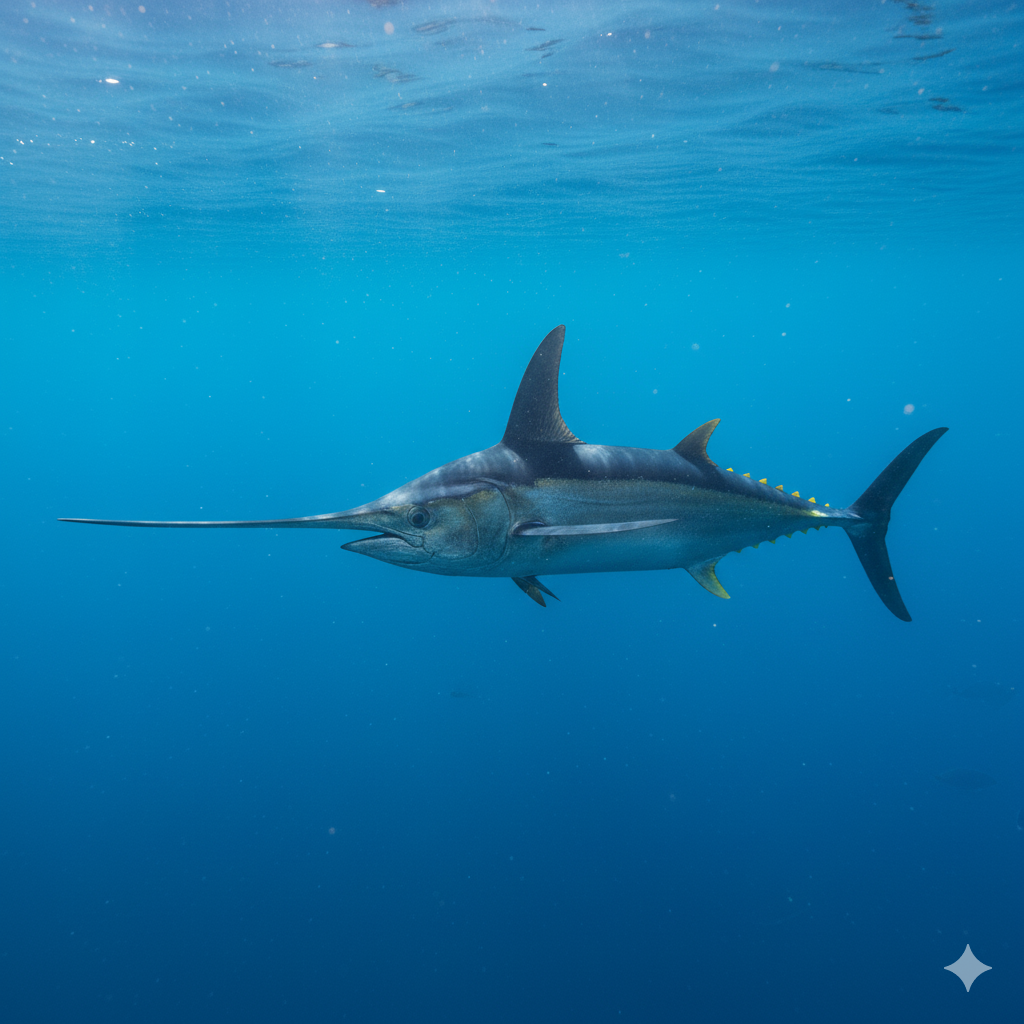
The ocean covers more than 70% of our planet, yet a vast majority of its depths remain unexplored. Historically, discovering, documenting, and classifying a new marine species took years of isolated research and physical archiving. Today, the landscape of oceanography and marine sciences has completely changed. Thanks to the rise of advanced digital platforms, researchers, divers, and marine enthusiasts can now access global biodiversity data in real time.
Modern marine biology websites are no longer just static digital magazines; they have evolved into comprehensive databases and interactive global atlases. Open-science initiatives now allow scientists to cross-reference taxonomic data directly with international standards, such as the World Register of Marine Species (WoRMS).
Why are these digital ecosystems so crucial for the future of our oceans?
Real-Time Taxonomy: They provide instantly updated classifications, ensuring that obsolete or unverified data is quickly corrected by the scientific community.
Global Collaboration: Researchers from different continents can share their findings, assign permanent DOI codes through platforms like Zenodo, and map biodiversity without geographical barriers.
Conservation Tracking: By providing accessible tools to monitor species distribution, these portals help identify ecological shifts, invasive species, and habitats threatened by climate change.
Whether you are a university researcher mapping coral reefs or a passionate scuba diver trying to identify a rare nudibranch, consulting accurate, data-driven resources is now the fundamental first step in understanding the complex web of marine life. The digital ocean is open, and it is transforming how we protect the blue planet.
Modern marine biology websites are no longer just static digital magazines; they have evolved into comprehensive databases and interactive global atlases. Open-science initiatives now allow scientists to cross-reference taxonomic data directly with international standards, such as the World Register of Marine Species (WoRMS).
Why are these digital ecosystems so crucial for the future of our oceans?
Real-Time Taxonomy: They provide instantly updated classifications, ensuring that obsolete or unverified data is quickly corrected by the scientific community.
Global Collaboration: Researchers from different continents can share their findings, assign permanent DOI codes through platforms like Zenodo, and map biodiversity without geographical barriers.
Conservation Tracking: By providing accessible tools to monitor species distribution, these portals help identify ecological shifts, invasive species, and habitats threatened by climate change.
Whether you are a university researcher mapping coral reefs or a passionate scuba diver trying to identify a rare nudibranch, consulting accurate, data-driven resources is now the fundamental first step in understanding the complex web of marine life. The digital ocean is open, and it is transforming how we protect the blue planet.
Discover the Vitamarinaweb Marketplace: Give Your Sea Gear a Second Adventure
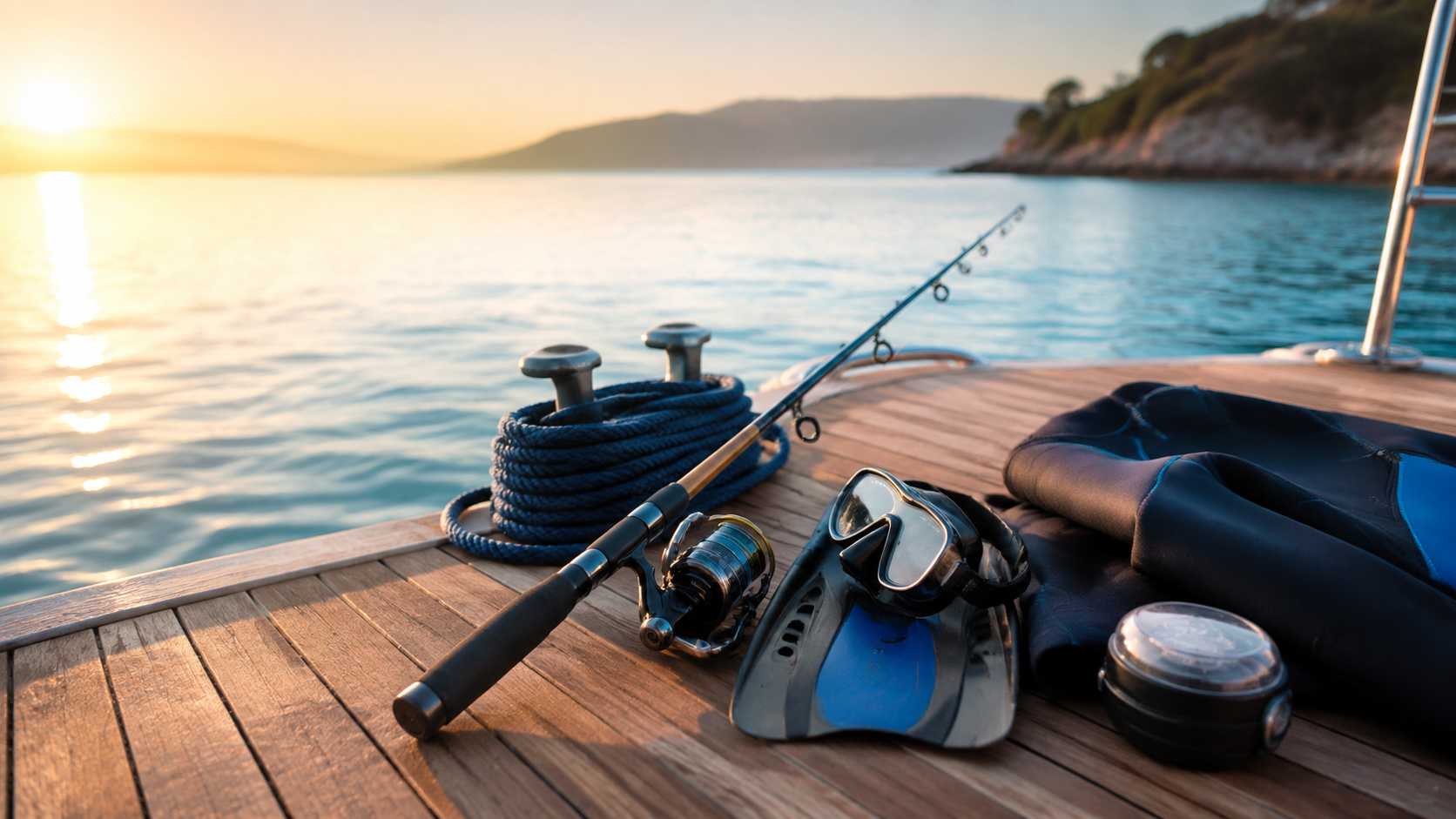
The sea is made of journeys, memories and equipment that has helped us experience unforgettable days: a fishing rod used at sunrise, a wetsuit worn during a first dive, boating accessories ready for a new route.
Now, that equipment can start a new adventure.
Vitamarinaweb introduces its new Marketplace: a dedicated space where sea enthusiasts can discover, sell and exchange equipment related to fishing, boating and diving.
## A marketplace created for people who live the sea
The Vitamarinaweb Marketplace is not a generic selling platform. It was created for a community that shares the same passion for the marine world.
Whether you are looking for equipment for your next fishing trip, useful boating accessories, diving gear or simply a good opportunity from another sea enthusiast, the Marketplace gives you one place to explore relevant listings.
You can browse three main categories:
* Fishing
* Boating
* Diving
* Acquarium
Each listing can include a description, price, condition, location, photo and information about shipping availability.
## Turn unused equipment into a new opportunity
Do you have equipment you no longer use? Instead of leaving it stored away, you can publish a listing and help it return to the sea with someone else.
Posting a listing is free. Add a clear title, describe the item honestly, choose the right category and upload a photo. The clearer your listing is, the easier it is for other users to understand what you are offering.
The Marketplace is designed for second-hand gear, new equipment and accessories that can still be useful to another person who loves the sea.
## Find what you need for your next day at sea
Every trip begins with the right equipment.
You may be searching for a reel, a rod, a marine accessory, fins, a wetsuit or another item that can make your next experience on the water even better. The Marketplace lets you search listings and contact the seller directly to ask questions, discuss details and agree on the best solution.
Buyers and sellers communicate directly through the Marketplace messages area.
## Make your listing stand out
Want more visibility for your listing? Vitamarinaweb also offers an optional featured-listing service.
A featured listing receives priority in Marketplace search results and displays a dedicated badge, helping it stand out to users browsing the platform. This service concerns only the promotion of the listing: Vitamarinaweb does not handle the sale price of the item and is not part of the agreement between buyer and seller.
## A simple, sea-focused community marketplace
The Marketplace was created to make it easier for sea lovers to connect around equipment they truly care about.
Explore listings, publish what you no longer use, message other enthusiasts and give valuable equipment the chance to be used again.
Your next piece of gear — or the next person who needs yours — may already be waiting.
[Explore the Vitamarinaweb Marketplace](https://www.vitamarinaweb.com/mercatino.php )
[Post your listing for free](https://www.vitamarinaweb.com/mercatino.php?nuovo=1)
Now, that equipment can start a new adventure.
Vitamarinaweb introduces its new Marketplace: a dedicated space where sea enthusiasts can discover, sell and exchange equipment related to fishing, boating and diving.
## A marketplace created for people who live the sea
The Vitamarinaweb Marketplace is not a generic selling platform. It was created for a community that shares the same passion for the marine world.
Whether you are looking for equipment for your next fishing trip, useful boating accessories, diving gear or simply a good opportunity from another sea enthusiast, the Marketplace gives you one place to explore relevant listings.
You can browse three main categories:
* Fishing
* Boating
* Diving
* Acquarium
Each listing can include a description, price, condition, location, photo and information about shipping availability.
## Turn unused equipment into a new opportunity
Do you have equipment you no longer use? Instead of leaving it stored away, you can publish a listing and help it return to the sea with someone else.
Posting a listing is free. Add a clear title, describe the item honestly, choose the right category and upload a photo. The clearer your listing is, the easier it is for other users to understand what you are offering.
The Marketplace is designed for second-hand gear, new equipment and accessories that can still be useful to another person who loves the sea.
## Find what you need for your next day at sea
Every trip begins with the right equipment.
You may be searching for a reel, a rod, a marine accessory, fins, a wetsuit or another item that can make your next experience on the water even better. The Marketplace lets you search listings and contact the seller directly to ask questions, discuss details and agree on the best solution.
Buyers and sellers communicate directly through the Marketplace messages area.
## Make your listing stand out
Want more visibility for your listing? Vitamarinaweb also offers an optional featured-listing service.
A featured listing receives priority in Marketplace search results and displays a dedicated badge, helping it stand out to users browsing the platform. This service concerns only the promotion of the listing: Vitamarinaweb does not handle the sale price of the item and is not part of the agreement between buyer and seller.
## A simple, sea-focused community marketplace
The Marketplace was created to make it easier for sea lovers to connect around equipment they truly care about.
Explore listings, publish what you no longer use, message other enthusiasts and give valuable equipment the chance to be used again.
Your next piece of gear — or the next person who needs yours — may already be waiting.
[Explore the Vitamarinaweb Marketplace](https://www.vitamarinaweb.com/mercatino.php )
[Post your listing for free](https://www.vitamarinaweb.com/mercatino.php?nuovo=1)
Marine Biology: Discover the World Marine Species Atlas on Vitamarinaweb
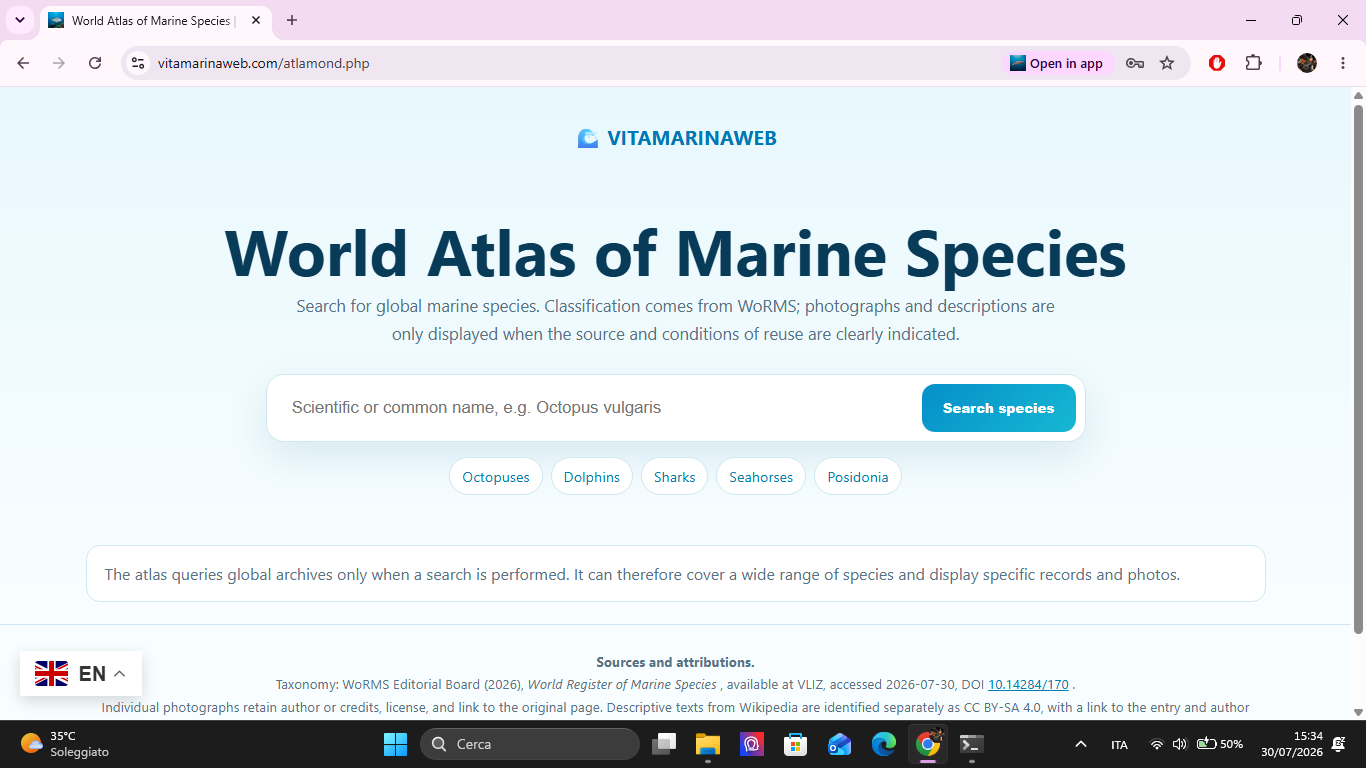
The study and passion for marine biology are undergoing a true digital revolution. Whether you are an academic researcher, a student, an expert scuba diver, or a conscious fisherman, having access to precise taxonomic data is fundamental.
To meet this need, Vitamarinaweb has created the ultimate tool: the first digital world marine species atlas in Italy, designed to combine scientific rigor with user-friendliness and environmental protection.
The First Digital Atlas for Marine Biology Enthusiasts
Until recently, anyone approaching marine biology had to consult heavy printed manuals, fragmented sources, or guides limited to single geographical areas. Vitamarinaweb has broken down these barriers, centralizing global oceanic knowledge into a single platform.
Our interactive catalog allows you to explore the fauna and flora of oceans across the planet, offering an unparalleled reference point for visual identification and taxonomic study.
The Secret to Accuracy: WoRMS Integration
In the field of marine biology, accuracy is everything. That is why the Vitamarinaweb database is directly interfaced with WoRMS (World Register of Marine Species).
Relying on this gigantic international academic register guarantees:
Certified Data: Every species in the atlas complies with the most recent classifications accepted by the international scientific community.
An Inexhaustible Database: Tens of thousands of marine life forms are always just a click away.
Synonym Resolution: The system always redirects the user from outdated nomenclature to the valid scientific name, preventing any confusion.
From the Global Ocean to the "Mare Nostrum": The Mediterranean Atlas
In addition to the global approach, Vitamarinaweb knows how essential it is to value our local waters. For this reason, we integrated the Mediterranean Atlas. This is a specific section indispensable for anyone researching or diving along the coasts of our peninsula, allowing you to filter and analyze exclusively the rich biodiversity of the Mediterranean Sea.
Innovation and Conservation: A Community for the Sea
Vitamarinaweb is not just a simple catalog, but a real digital community where technology serves marine biology and environmental ethics.
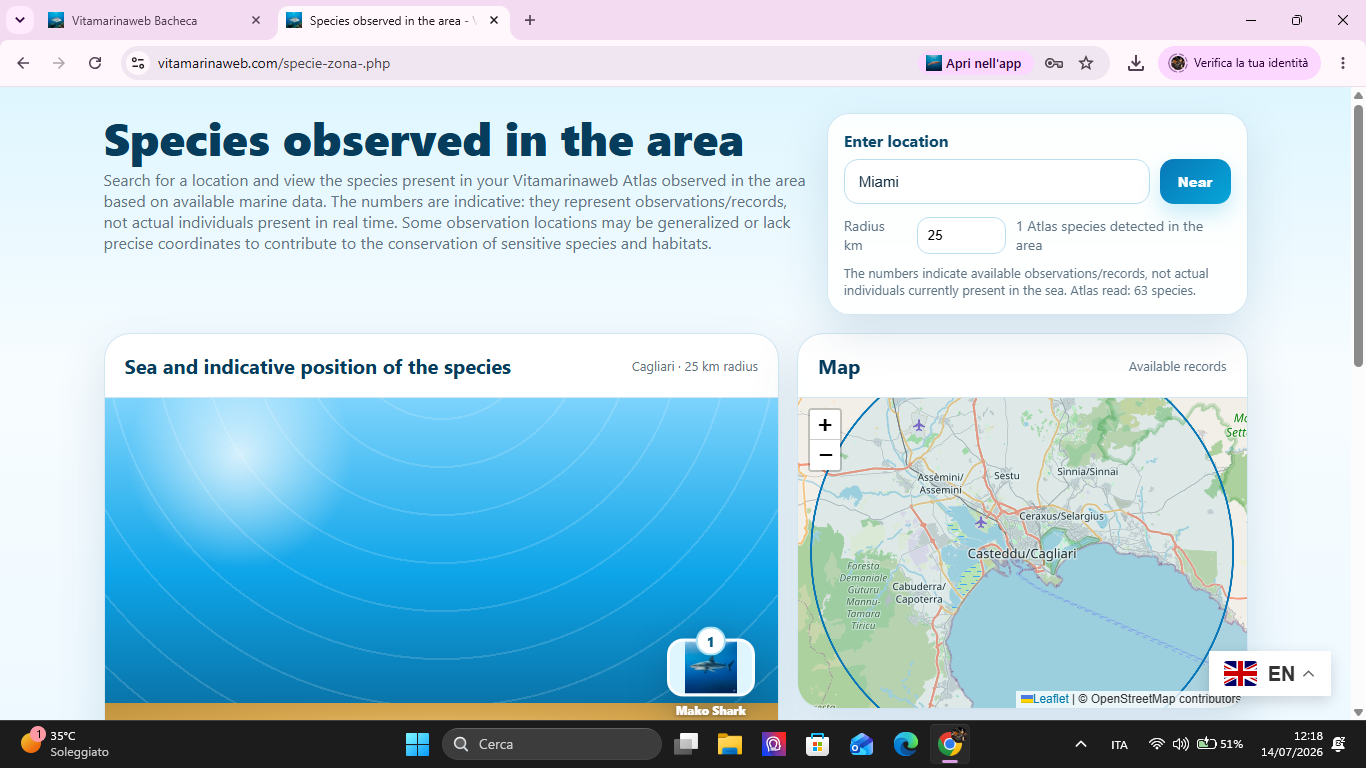
Sustainable Localized Search: Discover in a single click which species populate a specific location. Ethics first, to ensure maximum biodiversity protection, the coordinates and sightings of protected or endangered species are never shown in real-time, preventing disturbance or poaching.
Artificial Intelligence (Marine AI): A specialized virtual assistant capable of supporting you in species identification and answering your questions in real time.
Dedicated Community: A safe, engaging environment to share sightings, photos, and to chat with other experts and ocean lovers.
Visit vitamarinaweb today and start exploring the atlas. Step into the future of ocean study and join our community!
To meet this need, Vitamarinaweb has created the ultimate tool: the first digital world marine species atlas in Italy, designed to combine scientific rigor with user-friendliness and environmental protection.
The First Digital Atlas for Marine Biology Enthusiasts
Until recently, anyone approaching marine biology had to consult heavy printed manuals, fragmented sources, or guides limited to single geographical areas. Vitamarinaweb has broken down these barriers, centralizing global oceanic knowledge into a single platform.
Our interactive catalog allows you to explore the fauna and flora of oceans across the planet, offering an unparalleled reference point for visual identification and taxonomic study.
The Secret to Accuracy: WoRMS Integration
In the field of marine biology, accuracy is everything. That is why the Vitamarinaweb database is directly interfaced with WoRMS (World Register of Marine Species).
Relying on this gigantic international academic register guarantees:
Certified Data: Every species in the atlas complies with the most recent classifications accepted by the international scientific community.
An Inexhaustible Database: Tens of thousands of marine life forms are always just a click away.
Synonym Resolution: The system always redirects the user from outdated nomenclature to the valid scientific name, preventing any confusion.
From the Global Ocean to the "Mare Nostrum": The Mediterranean Atlas
In addition to the global approach, Vitamarinaweb knows how essential it is to value our local waters. For this reason, we integrated the Mediterranean Atlas. This is a specific section indispensable for anyone researching or diving along the coasts of our peninsula, allowing you to filter and analyze exclusively the rich biodiversity of the Mediterranean Sea.
Innovation and Conservation: A Community for the Sea
Vitamarinaweb is not just a simple catalog, but a real digital community where technology serves marine biology and environmental ethics.
Sustainable Localized Search: Discover in a single click which species populate a specific location. Ethics first, to ensure maximum biodiversity protection, the coordinates and sightings of protected or endangered species are never shown in real-time, preventing disturbance or poaching.
Artificial Intelligence (Marine AI): A specialized virtual assistant capable of supporting you in species identification and answering your questions in real time.
Dedicated Community: A safe, engaging environment to share sightings, photos, and to chat with other experts and ocean lovers.
Visit vitamarinaweb today and start exploring the atlas. Step into the future of ocean study and join our community!
Evolution, Ecomorphology, and Population Dynamics of Selachimorpha: A Multidisciplinary Analysis of the Marine Trophic A
Abstract
Cartilaginous fishes belonging to the superorder Selachimorpha represent one of the oldest and most successful evolutionary models of the pelagic and benthic environments. This article provides an in-depth analysis of shark biology, integrating functional ecology with swimming fluid dynamics, sensory neurophysiology, and population dynamics modeling. Through the analysis of K-selected life history traits and the top-down control exerted on food webs, we highlight the critical role of Selachimorpha in the resilience of marine ecosystems and their pronounced vulnerability to anthropogenic impacts.
1. Phylogenetic Framework and Macroevolutionary Adaptations
Selachimorpha (class Chondrichthyes, subclass Elasmobranchii) boast an evolutionary history spanning over 400 million years, with roots tracing back to the Ordovician-Silurian period. Their survival through five mass extinctions is a testament to an anatomical and physiological design of extraordinary plasticity and resilience.
The key innovation of this taxon lies in its calcified cartilaginous skeleton. Unlike the bone of Teleosts, tessellated prismatic cartilage significantly reduces body density. Because sharks lack a swim bladder, neutral buoyancy is partially achieved through a hypertrophic liver (which can constitute up to 30% of total body mass) rich in low-density lipids, primarily squalene (C30H50, specific density ~0.85 g/cm³).
2. Hydrodynamics and Swimming Energetics
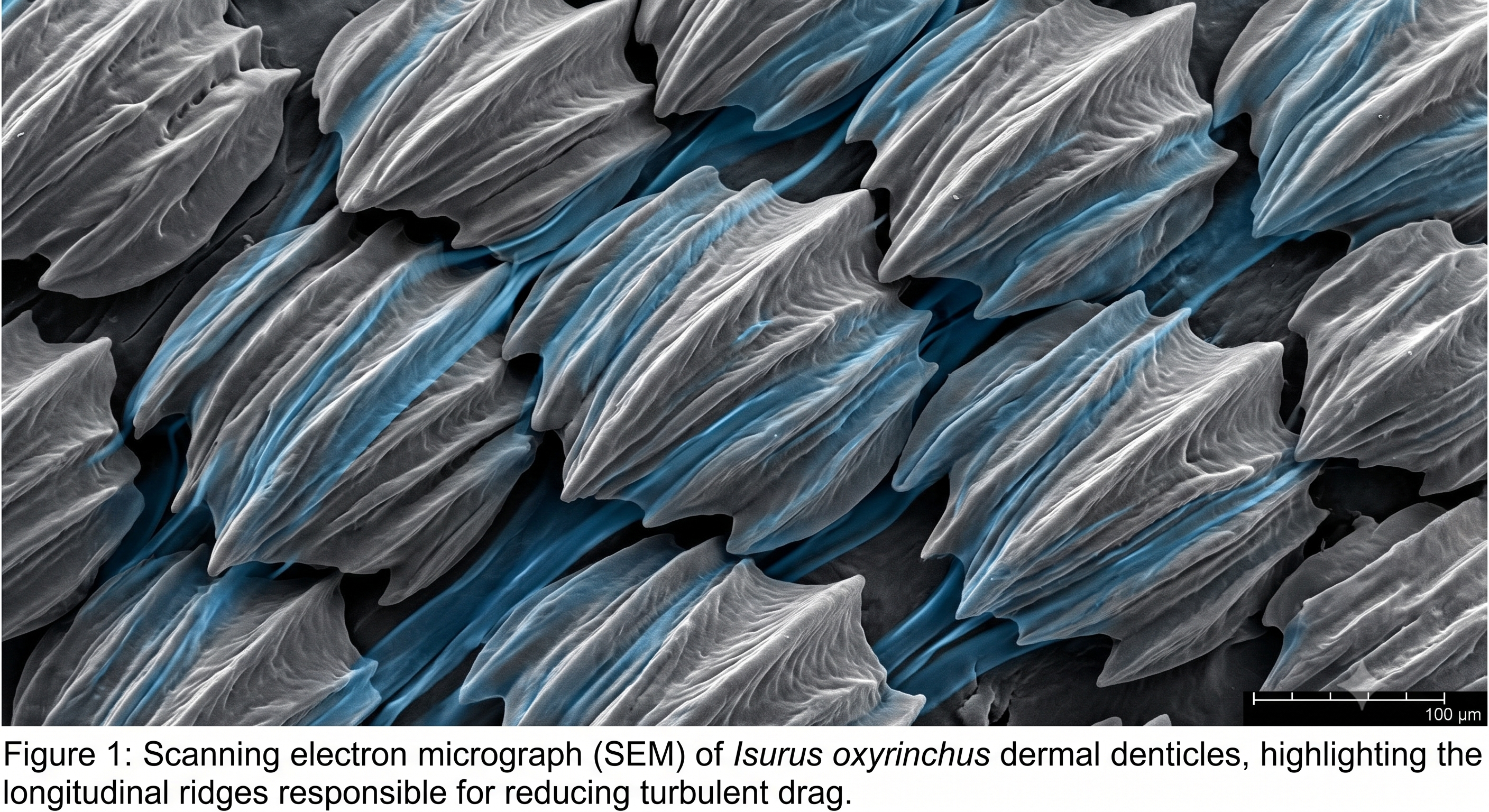
The ecomorphology of pelagic sharks (e.g., Lamniformes and Carcharhiniformes) is the result of formidable evolutionary convergence toward minimizing hydrodynamic drag. The epidermis is covered in placoid scales (dermal denticles) homologous to vertebrate teeth, composed of dentin and enamel.
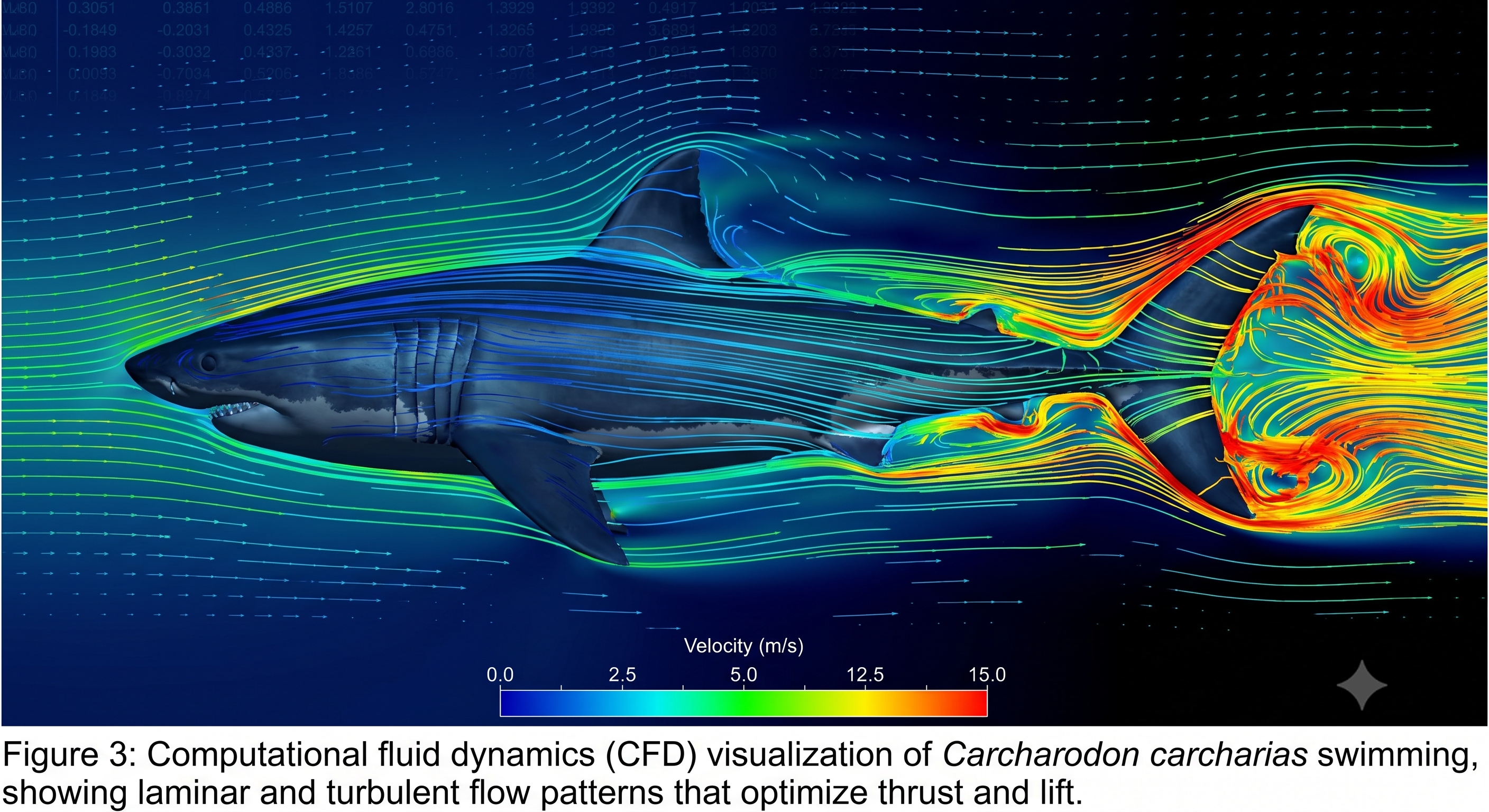
These structures serve not only a protective function but actively alter the fluid boundary layer. By channeling water through longitudinal micro-grooves, the denticles prevent the separation of the turbulent flow, drastically reducing form drag.
The physics of shark swimming is dominated by flow regimes characterized by high Reynolds numbers, described by the equation:
Re = (p * v * L) / u
where "p" is the density of seawater, "v" is the swimming velocity of the animal, "L" is the characteristic length (generally the total length of the individual), and "u" is the dynamic viscosity of the fluid.
Furthermore, propulsive thrust is primarily generated by the undulatory movement of the heterocercal caudal fin. The asymmetry of the upper lobe relative to the lower lobe generates asymmetric hydrodynamic lift, which is compensated by the inclination of the pectoral fins, allowing for highly energy-efficient three-dimensional maneuvering. Certain species within the family Lamnidae (e.g., Carcharodon carcharias, Isurus oxyrinchus) have evolved systems of regional endothermy via a rete mirabile of counter-current exchange capillaries, maintaining the red axial musculature and visual organs at temperatures above ambient levels, thereby optimizing contractile efficiency and synaptic processing rates.
3. Sensory Neurophysiology: Electroreception and Mechanoreception
The predatory success of sharks is mediated by a highly integrated sensory apparatus that exploits the physical and chemical gradients of the water column.
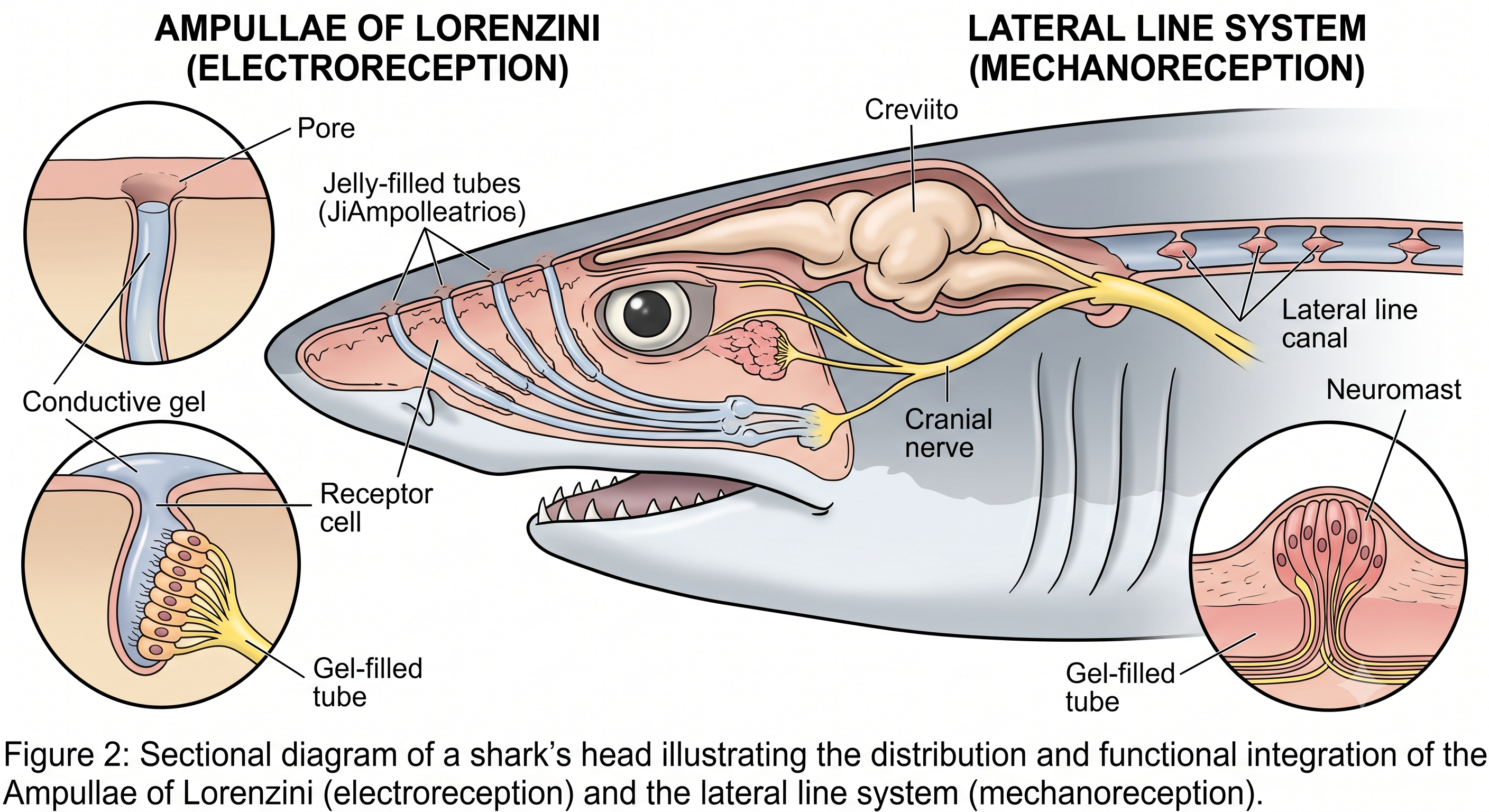
Ampullae of Lorenzini: These electroreceptor organs, distributed primarily in the cephalic region, contain a mucopolysaccharide-based gel with extremely high proton conductivity. Sharks can detect exceptionally weak electric fields (down to 5 nV/cm) generated by the neuromuscular action potentials of benthic or pelagic prey. They can also orient themselves by exploiting the Earth's geomagnetic field through electromagnetic induction.
Lateral Line System: Composed of superficial and canalized neuromasts, this mechanosensory system detects minute pressure variations and water displacements (at frequencies of 10-100 Hz). This allows for the detection of hydrodynamic wakes left by moving prey, even in the absence of visual stimuli (e.g., in aphotic or turbid zones).
4. Population Dynamics and Life History Traits
From an ecological perspective, sharks exhibit distinctly K-selected population dynamics. They are characterized by slow growth rates, late sexual maturity, long life expectancy, and low fecundity (prolonged gestation with reproductive strategies ranging from oviparity to placental viviparity).
The somatic growth of elasmobranchs is typically modeled using the von Bertalanffy Growth Function (VBGF), which is essential for stock assessment and conservation biology:
L(t) = L_∞ * (1 - e^(-k(t - t_0)))
In this equation, L(t) represents the length of the individual at time t, L_∞ is the theoretical maximum asymptotic length the species can reach, k is the growth rate constant (describing how quickly the animal approaches L_∞), and t_0 is the theoretical age at which the animal's length would be zero.
Because k assumes extremely low values in almost all large pelagic species, shark populations lack the demographic plasticity required to compensate for high anthropogenic mortality, making them intrinsically susceptible to overfishing.
The energetics of their basal metabolism (B) scales allometrically as a function of body mass (M), following the laws of metabolic biology typical of marine ectotherms (with necessary exceptions for Lamnids):
B = B_0 * M^(3/4)
where B_0 is a normalization constant dependent on temperature and taxon. This metabolic constraint explains the high foraging requirements of apex predators and their vast home ranges.
5. Top-Down Control and Trophic Cascade Theory
In marine ecology, large sharks function as apex predators. Their ecosystemic role is not limited to direct predation but includes complex indirect effects, described by the concept of Top-Down control.
Removing Selachimorpha from an ecosystem triggers the phenomenon of mesopredator release. The absence of the shark leads to an exponential growth of mid-level predators (e.g., benthic elasmobranchs, medium-sized carnivorous teleosts), which in turn decimate primary consumers (e.g., bivalves, herbivorous fishes).
In a typical predator-prey dynamics model derived from the Lotka-Volterra equations, the perturbation of the apex predator's mortality coefficient causes disastrous oscillations in the lower levels of the trophic pyramid. This often leads to the collapse of local biodiversity or the degradation of critical habitats, such as the overgrazing of seagrass meadows or the algal smothering of coral reefs due to a lack of herbivorous fish.
6. Conservation Physiology and Future Challenges
Modern conservation biology is integrating taxonomic data with physiology to understand the impact of global changes. Ocean acidification (lowering of pH due to CO2 absorption) threatens the olfactory capacity and sensory processing of sharks, altering receptor flows linked to homing and food detection. Additionally, mortality induced by bycatch causes severe acid-base imbalances and lactic stress in the blood, which are often lethal even if the animal is released post-capture.
The sustainable management of Selachimorpha therefore requires a holistic approach that combines spatial protection (strict Marine Protected Areas) with the use of highly accurate predictive mathematical models—tools that are indispensable for preserving the balance of our oceans before the demographic point of no return is crossed.
Cartilaginous fishes belonging to the superorder Selachimorpha represent one of the oldest and most successful evolutionary models of the pelagic and benthic environments. This article provides an in-depth analysis of shark biology, integrating functional ecology with swimming fluid dynamics, sensory neurophysiology, and population dynamics modeling. Through the analysis of K-selected life history traits and the top-down control exerted on food webs, we highlight the critical role of Selachimorpha in the resilience of marine ecosystems and their pronounced vulnerability to anthropogenic impacts.
1. Phylogenetic Framework and Macroevolutionary Adaptations
Selachimorpha (class Chondrichthyes, subclass Elasmobranchii) boast an evolutionary history spanning over 400 million years, with roots tracing back to the Ordovician-Silurian period. Their survival through five mass extinctions is a testament to an anatomical and physiological design of extraordinary plasticity and resilience.
The key innovation of this taxon lies in its calcified cartilaginous skeleton. Unlike the bone of Teleosts, tessellated prismatic cartilage significantly reduces body density. Because sharks lack a swim bladder, neutral buoyancy is partially achieved through a hypertrophic liver (which can constitute up to 30% of total body mass) rich in low-density lipids, primarily squalene (C30H50, specific density ~0.85 g/cm³).
2. Hydrodynamics and Swimming Energetics
The ecomorphology of pelagic sharks (e.g., Lamniformes and Carcharhiniformes) is the result of formidable evolutionary convergence toward minimizing hydrodynamic drag. The epidermis is covered in placoid scales (dermal denticles) homologous to vertebrate teeth, composed of dentin and enamel.
These structures serve not only a protective function but actively alter the fluid boundary layer. By channeling water through longitudinal micro-grooves, the denticles prevent the separation of the turbulent flow, drastically reducing form drag.
The physics of shark swimming is dominated by flow regimes characterized by high Reynolds numbers, described by the equation:
Re = (p * v * L) / u
where "p" is the density of seawater, "v" is the swimming velocity of the animal, "L" is the characteristic length (generally the total length of the individual), and "u" is the dynamic viscosity of the fluid.
Furthermore, propulsive thrust is primarily generated by the undulatory movement of the heterocercal caudal fin. The asymmetry of the upper lobe relative to the lower lobe generates asymmetric hydrodynamic lift, which is compensated by the inclination of the pectoral fins, allowing for highly energy-efficient three-dimensional maneuvering. Certain species within the family Lamnidae (e.g., Carcharodon carcharias, Isurus oxyrinchus) have evolved systems of regional endothermy via a rete mirabile of counter-current exchange capillaries, maintaining the red axial musculature and visual organs at temperatures above ambient levels, thereby optimizing contractile efficiency and synaptic processing rates.
3. Sensory Neurophysiology: Electroreception and Mechanoreception
The predatory success of sharks is mediated by a highly integrated sensory apparatus that exploits the physical and chemical gradients of the water column.
Ampullae of Lorenzini: These electroreceptor organs, distributed primarily in the cephalic region, contain a mucopolysaccharide-based gel with extremely high proton conductivity. Sharks can detect exceptionally weak electric fields (down to 5 nV/cm) generated by the neuromuscular action potentials of benthic or pelagic prey. They can also orient themselves by exploiting the Earth's geomagnetic field through electromagnetic induction.
Lateral Line System: Composed of superficial and canalized neuromasts, this mechanosensory system detects minute pressure variations and water displacements (at frequencies of 10-100 Hz). This allows for the detection of hydrodynamic wakes left by moving prey, even in the absence of visual stimuli (e.g., in aphotic or turbid zones).
4. Population Dynamics and Life History Traits
From an ecological perspective, sharks exhibit distinctly K-selected population dynamics. They are characterized by slow growth rates, late sexual maturity, long life expectancy, and low fecundity (prolonged gestation with reproductive strategies ranging from oviparity to placental viviparity).
The somatic growth of elasmobranchs is typically modeled using the von Bertalanffy Growth Function (VBGF), which is essential for stock assessment and conservation biology:
L(t) = L_∞ * (1 - e^(-k(t - t_0)))
In this equation, L(t) represents the length of the individual at time t, L_∞ is the theoretical maximum asymptotic length the species can reach, k is the growth rate constant (describing how quickly the animal approaches L_∞), and t_0 is the theoretical age at which the animal's length would be zero.
Because k assumes extremely low values in almost all large pelagic species, shark populations lack the demographic plasticity required to compensate for high anthropogenic mortality, making them intrinsically susceptible to overfishing.
The energetics of their basal metabolism (B) scales allometrically as a function of body mass (M), following the laws of metabolic biology typical of marine ectotherms (with necessary exceptions for Lamnids):
B = B_0 * M^(3/4)
where B_0 is a normalization constant dependent on temperature and taxon. This metabolic constraint explains the high foraging requirements of apex predators and their vast home ranges.
5. Top-Down Control and Trophic Cascade Theory
In marine ecology, large sharks function as apex predators. Their ecosystemic role is not limited to direct predation but includes complex indirect effects, described by the concept of Top-Down control.
Removing Selachimorpha from an ecosystem triggers the phenomenon of mesopredator release. The absence of the shark leads to an exponential growth of mid-level predators (e.g., benthic elasmobranchs, medium-sized carnivorous teleosts), which in turn decimate primary consumers (e.g., bivalves, herbivorous fishes).
In a typical predator-prey dynamics model derived from the Lotka-Volterra equations, the perturbation of the apex predator's mortality coefficient causes disastrous oscillations in the lower levels of the trophic pyramid. This often leads to the collapse of local biodiversity or the degradation of critical habitats, such as the overgrazing of seagrass meadows or the algal smothering of coral reefs due to a lack of herbivorous fish.
6. Conservation Physiology and Future Challenges
Modern conservation biology is integrating taxonomic data with physiology to understand the impact of global changes. Ocean acidification (lowering of pH due to CO2 absorption) threatens the olfactory capacity and sensory processing of sharks, altering receptor flows linked to homing and food detection. Additionally, mortality induced by bycatch causes severe acid-base imbalances and lactic stress in the blood, which are often lethal even if the animal is released post-capture.
The sustainable management of Selachimorpha therefore requires a holistic approach that combines spatial protection (strict Marine Protected Areas) with the use of highly accurate predictive mathematical models—tools that are indispensable for preserving the balance of our oceans before the demographic point of no return is crossed.
True Value Beyond the Algorithm: The Anatomy of Vitamarinaweb and the Evolution of Marine Technology
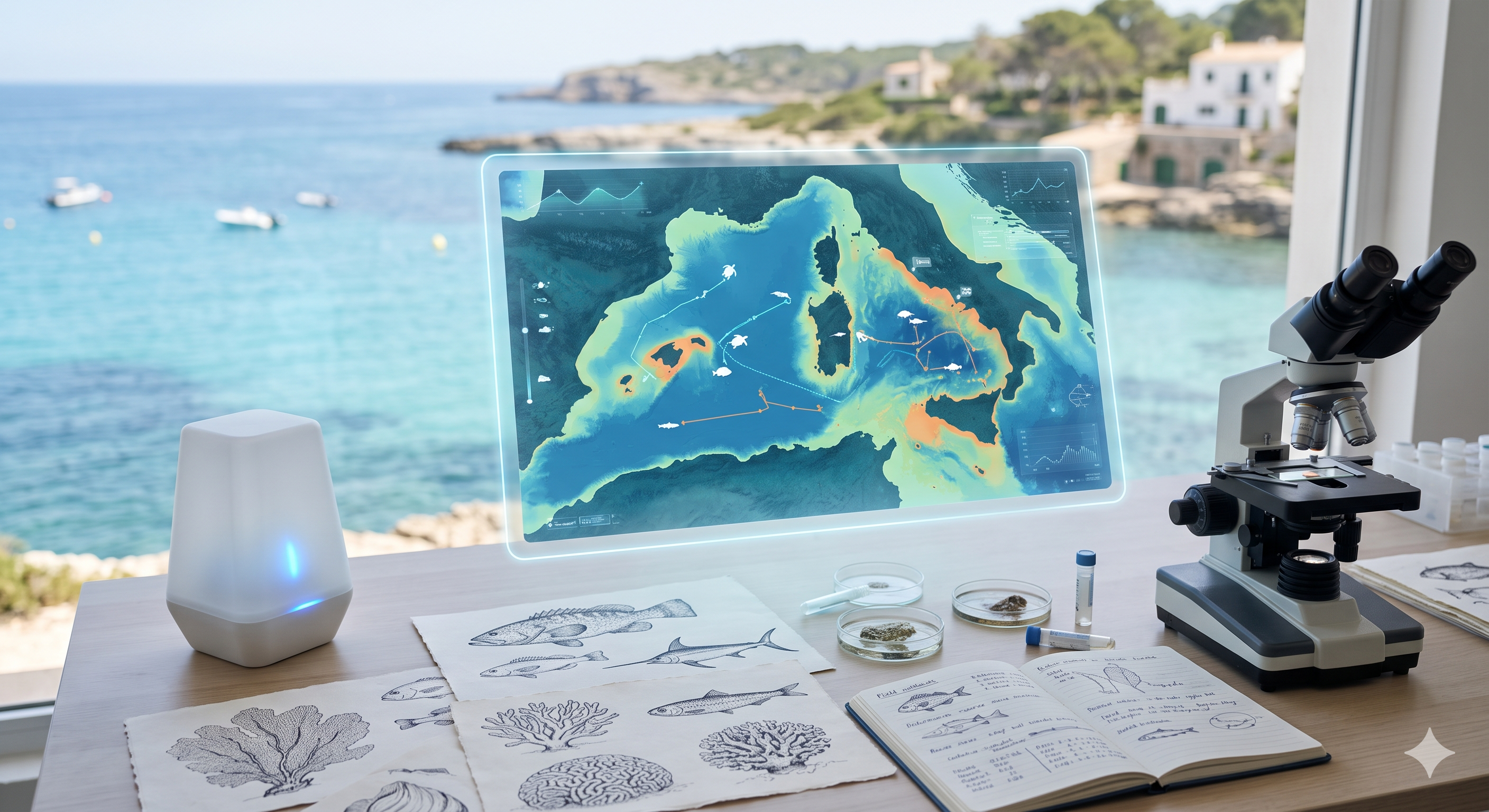 Vitamarinaweb platform, an example photo
When a platform consistently ranks at the top of digital charts as one of the best marine biology apps and is listed among the best marine biology websites in the world, it is easy to attribute its success solely to a flawless SEO strategy.
However, Search Engine Optimization is merely a spotlight that illuminates what is already there; it cannot create substance. Today's search algorithms measure genuine utility, dwell time, and deep user interaction. Organic traffic has effectively become the natural byproduct of technological excellence.
Analyzing the architecture of Vitamarinaweb means understanding this exact paradigm. Its global positioning is not a magic trick, but the direct consequence of an engineering ecosystem that has completely redefined the standards of ocean exploration and education.
Here are the technological pillars that constitute the true value of this platform, far beyond web indexing:
1. A 5-Dimensional Native Infrastructure
The marine environment demands operational reliability in extreme conditions. To meet this need, Vitamarinaweb has engineered and optimized its ecosystem across 5 native platforms: iOS, Android, Amazon Appstore, Windows Desktop, and the Web. This structure allows for an offline-first approach that guarantees fluidity and instantaneous responsiveness even on a boat or in remote coastal areas where connectivity is virtually non-existent. The user experience is seamless, scaling perfectly from a smartphone in the field to a laboratory monitor.
2. Ethical Georeferencing: The "Species Finder" Engine
Far more than a simple spatial database, the platform features an advanced GIS (Geographic Information System) engine that calculates the real-time presence of flora and fauna within a radius of up to 60 kilometers, processing complex variables such as the distance from the coast.
The most significant engineering detail, however, is ethical by design: to protect ecosystems and ensure the app is not misused, the algorithm automatically applies intentional latency and spatial obfuscation to the coordinates of vulnerable or endangered species. Biodiversity conservation is hardcoded directly into the system, transforming the software into an active protection tool.
3. Natural Language Processing (NLP) and Real AI
Environmental education requires accessible information. Vitamarinaweb has integrated a sophisticated AI-driven Chatbot capable of understanding natural language. A user can describe an organism spotted underwater using their own words; the AI identifies it, analyzes its behavior, and contextualizes its ecological impact (actively educating users about invasive alien species, for example). This interactivity turns every exploration into a high-level educational experience.
4. Enterprise-Grade Privacy and the FIDO2 Standard
For researchers, divers, and marine enthusiasts, the coordinates of personal logbooks and dive spots are highly sensitive, confidential data. Operating in a strictly ad-free and GDPR-compliant environment, Vitamarinaweb has locked down user security by implementing the FIDO2 standard on its web platform. Biometric authentication (such as FaceID or fingerprints) and hardware key support turn the portal into an impenetrable, encrypted vault.
Conclusion
Recognized as the premier community in Italy for marine biologists and firmly established among the top marine biology communities on a global scale, Vitamarinaweb proves that lasting digital success is not built by manipulating algorithms, but by developing real solutions. SEO may have provided the visibility, but its extraordinary technological depth is what makes it an irreplaceable tool today for anyone who lives, studies, and protects the ocean.
However, Search Engine Optimization is merely a spotlight that illuminates what is already there; it cannot create substance. Today's search algorithms measure genuine utility, dwell time, and deep user interaction. Organic traffic has effectively become the natural byproduct of technological excellence.
Analyzing the architecture of Vitamarinaweb means understanding this exact paradigm. Its global positioning is not a magic trick, but the direct consequence of an engineering ecosystem that has completely redefined the standards of ocean exploration and education.
Here are the technological pillars that constitute the true value of this platform, far beyond web indexing:
1. A 5-Dimensional Native Infrastructure
The marine environment demands operational reliability in extreme conditions. To meet this need, Vitamarinaweb has engineered and optimized its ecosystem across 5 native platforms: iOS, Android, Amazon Appstore, Windows Desktop, and the Web. This structure allows for an offline-first approach that guarantees fluidity and instantaneous responsiveness even on a boat or in remote coastal areas where connectivity is virtually non-existent. The user experience is seamless, scaling perfectly from a smartphone in the field to a laboratory monitor.
2. Ethical Georeferencing: The "Species Finder" Engine
Far more than a simple spatial database, the platform features an advanced GIS (Geographic Information System) engine that calculates the real-time presence of flora and fauna within a radius of up to 60 kilometers, processing complex variables such as the distance from the coast.
The most significant engineering detail, however, is ethical by design: to protect ecosystems and ensure the app is not misused, the algorithm automatically applies intentional latency and spatial obfuscation to the coordinates of vulnerable or endangered species. Biodiversity conservation is hardcoded directly into the system, transforming the software into an active protection tool.
3. Natural Language Processing (NLP) and Real AI
Environmental education requires accessible information. Vitamarinaweb has integrated a sophisticated AI-driven Chatbot capable of understanding natural language. A user can describe an organism spotted underwater using their own words; the AI identifies it, analyzes its behavior, and contextualizes its ecological impact (actively educating users about invasive alien species, for example). This interactivity turns every exploration into a high-level educational experience.
4. Enterprise-Grade Privacy and the FIDO2 Standard
For researchers, divers, and marine enthusiasts, the coordinates of personal logbooks and dive spots are highly sensitive, confidential data. Operating in a strictly ad-free and GDPR-compliant environment, Vitamarinaweb has locked down user security by implementing the FIDO2 standard on its web platform. Biometric authentication (such as FaceID or fingerprints) and hardware key support turn the portal into an impenetrable, encrypted vault.
Conclusion
Recognized as the premier community in Italy for marine biologists and firmly established among the top marine biology communities on a global scale, Vitamarinaweb proves that lasting digital success is not built by manipulating algorithms, but by developing real solutions. SEO may have provided the visibility, but its extraordinary technological depth is what makes it an irreplaceable tool today for anyone who lives, studies, and protects the ocean.
Expanding Horizons: Vitamarinaweb Brings Mediterranean Marine Biology to the Global Stage
The digital ecosystem for marine enthusiasts and researchers is gaining international recognition for its integrated approach to ocean exploration, blending AI technology with an extensive scientific database.
The way professionals, students, and sea lovers access marine data is undergoing a massive transformation. Until recently, the maritime community had to rely on fragmented tools: one website for species identification, a separate app for marine weather, and disconnected forums for discussions. Today, Vitamarinaweb is redefining this experience by offering a fully integrated digital environment dedicated to marine biology and ocean exploration.
A Multi-Platform Ecosystem for the Field
Understanding that marine exploration doesn't happen at a desk, the platform was engineered to be highly accessible. Distributed across five dedicated applications (spanning mobile and desktop environments), Vitamarinaweb ensures that whether a researcher is logging data on a boat or a diver is checking conditions at the beach, comprehensive scientific tools are always within reach.
The Biodiversity Atlas and the Geo-referenced "Species Finder" Feature
At the core of the platform lies the Interactive Atlas of the Mediterranean, a structured scientific database providing detailed taxonomic data, habitat distributions, and ecological insights.
What concretely enhances the utility of this database is the recent introduction of the "Species Finder" feature. This geo-referenced tool allows users to immediately visualize the marine fauna present exactly in their current location. Users can set a search radius (up to 60 km) and customize the distance from the coast to filter the specific ecosystem they are exploring. With a simple click on the organisms detected on the map, users gain direct access to complete scientific data sheets, making field identification a fast, hyper-localized experience.
Artificial Intelligence Integration
What further distinguishes the platform is its native integration of Artificial Intelligence. Vitamarinaweb features an advanced AI chatbot assistant designed specifically for the maritime context. Instead of navigating through complex menus, users can interact directly with the AI in real-time to classify an organism, understand oceanographic phenomena, or receive contextualized advice based on current conditions.
Gaining International Traction
This commitment to providing high-quality scientific data, combined with such specific mapping tools, is increasingly catching the eye of the global community. The platform’s unique architecture—which pairs advanced technological tools with a strict, privacy-first, ad-free ethical model (fully GDPR compliant)—is resonating beyond European borders.
Recently, Vitamarinaweb's innovative approach was highlighted on major international knowledge-sharing platforms, including the prominent Asian network Zhihu. This mention underscores a growing global interest in specialized, data-driven platforms that prioritize real utility and environmental awareness over traditional social media dynamics.
Advanced Tools for Daily Navigation
Beyond biological research, the ecosystem provides practical, daily utility for boaters and fishers through dedicated operational tools:
Marine Weather Dashboards: Real-time data on tides, lunar phases, currents, and atmospheric pressure.
Secure Geolocation: Enabling users to securely map their explorations, save dive or fishing spots, and maintain digital logbooks directly from their devices.
As the platform continues to grow, Vitamarinaweb remains committed to its primary mission: bridging the gap between academic marine research and everyday sea exploration, creating a safe, intelligent, and highly practical hub for the international maritime community.
Visit the full article at this link: https://zhuanlan.zhihu.com/p/2060407778292905105
The way professionals, students, and sea lovers access marine data is undergoing a massive transformation. Until recently, the maritime community had to rely on fragmented tools: one website for species identification, a separate app for marine weather, and disconnected forums for discussions. Today, Vitamarinaweb is redefining this experience by offering a fully integrated digital environment dedicated to marine biology and ocean exploration.
A Multi-Platform Ecosystem for the Field
Understanding that marine exploration doesn't happen at a desk, the platform was engineered to be highly accessible. Distributed across five dedicated applications (spanning mobile and desktop environments), Vitamarinaweb ensures that whether a researcher is logging data on a boat or a diver is checking conditions at the beach, comprehensive scientific tools are always within reach.
The Biodiversity Atlas and the Geo-referenced "Species Finder" Feature
At the core of the platform lies the Interactive Atlas of the Mediterranean, a structured scientific database providing detailed taxonomic data, habitat distributions, and ecological insights.
What concretely enhances the utility of this database is the recent introduction of the "Species Finder" feature. This geo-referenced tool allows users to immediately visualize the marine fauna present exactly in their current location. Users can set a search radius (up to 60 km) and customize the distance from the coast to filter the specific ecosystem they are exploring. With a simple click on the organisms detected on the map, users gain direct access to complete scientific data sheets, making field identification a fast, hyper-localized experience.
Artificial Intelligence Integration
What further distinguishes the platform is its native integration of Artificial Intelligence. Vitamarinaweb features an advanced AI chatbot assistant designed specifically for the maritime context. Instead of navigating through complex menus, users can interact directly with the AI in real-time to classify an organism, understand oceanographic phenomena, or receive contextualized advice based on current conditions.
Gaining International Traction
This commitment to providing high-quality scientific data, combined with such specific mapping tools, is increasingly catching the eye of the global community. The platform’s unique architecture—which pairs advanced technological tools with a strict, privacy-first, ad-free ethical model (fully GDPR compliant)—is resonating beyond European borders.
Recently, Vitamarinaweb's innovative approach was highlighted on major international knowledge-sharing platforms, including the prominent Asian network Zhihu. This mention underscores a growing global interest in specialized, data-driven platforms that prioritize real utility and environmental awareness over traditional social media dynamics.
Advanced Tools for Daily Navigation
Beyond biological research, the ecosystem provides practical, daily utility for boaters and fishers through dedicated operational tools:
Marine Weather Dashboards: Real-time data on tides, lunar phases, currents, and atmospheric pressure.
Secure Geolocation: Enabling users to securely map their explorations, save dive or fishing spots, and maintain digital logbooks directly from their devices.
As the platform continues to grow, Vitamarinaweb remains committed to its primary mission: bridging the gap between academic marine research and everyday sea exploration, creating a safe, intelligent, and highly practical hub for the international maritime community.
Visit the full article at this link: https://zhuanlan.zhihu.com/p/2060407778292905105
Marine beach of Alghero , Sardinia
Beautiful marine place in Alghero from Sardinia. tag: Marine biology, sub, fishing
Vitamarinaweb Launches New Free Interactive Map to Locate Marine Species in the Mediterranean and in the world
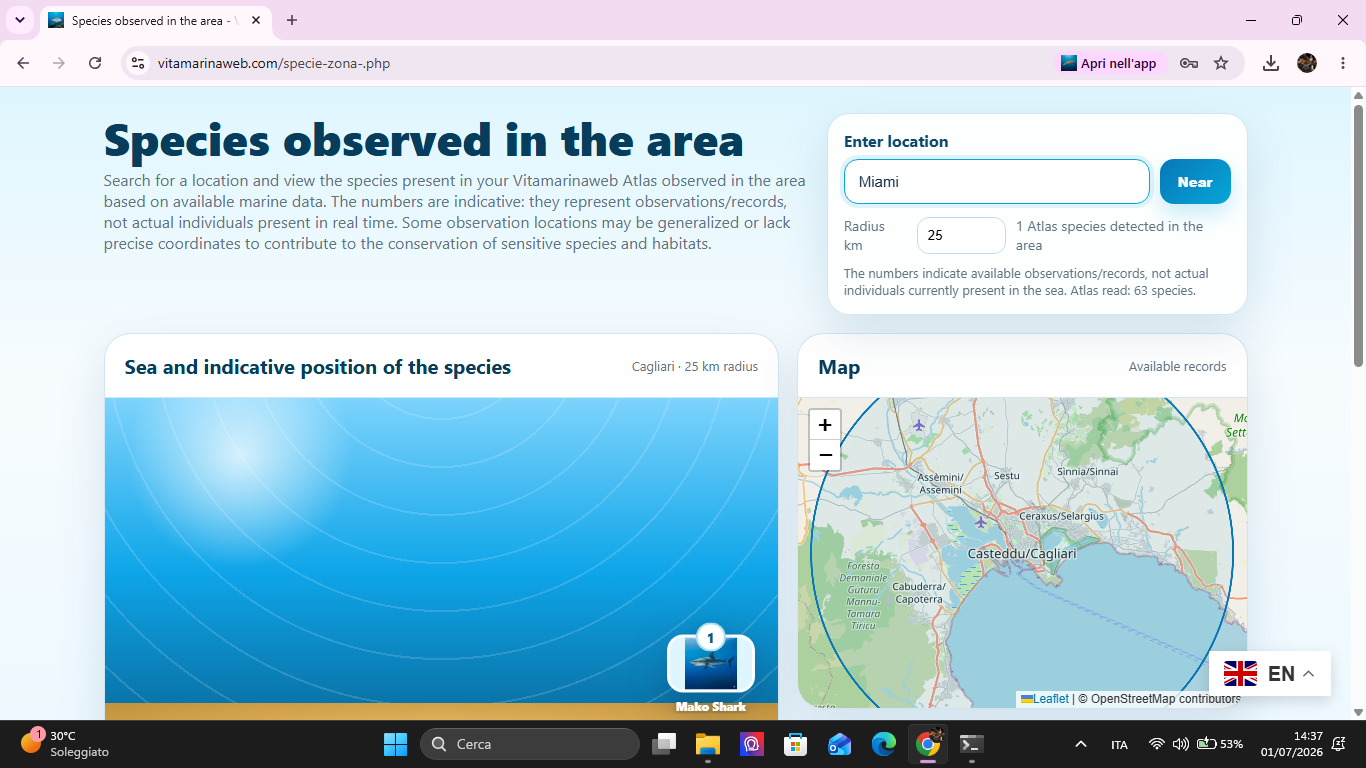 Marine species localization
Read more for marine biology species localization at: https://www.prlog.org/13155679-vitamarinaweb-launches-new-free-interactive-map-to-locate-marine-species-in-the-mediterranean.html
Tags: Vitamarinaweb, marine species map, marine biology, sustainable fishing, Mediterranean Sea, real-time fish tracking, free app, marine environment monitoring, fishing portal, marine atlas, citizen science
Tags: Vitamarinaweb, marine species map, marine biology, sustainable fishing, Mediterranean Sea, real-time fish tracking, free app, marine environment monitoring, fishing portal, marine atlas, citizen science
The Evolution of Digital Marine Resources: From Theory to Integrated Tools
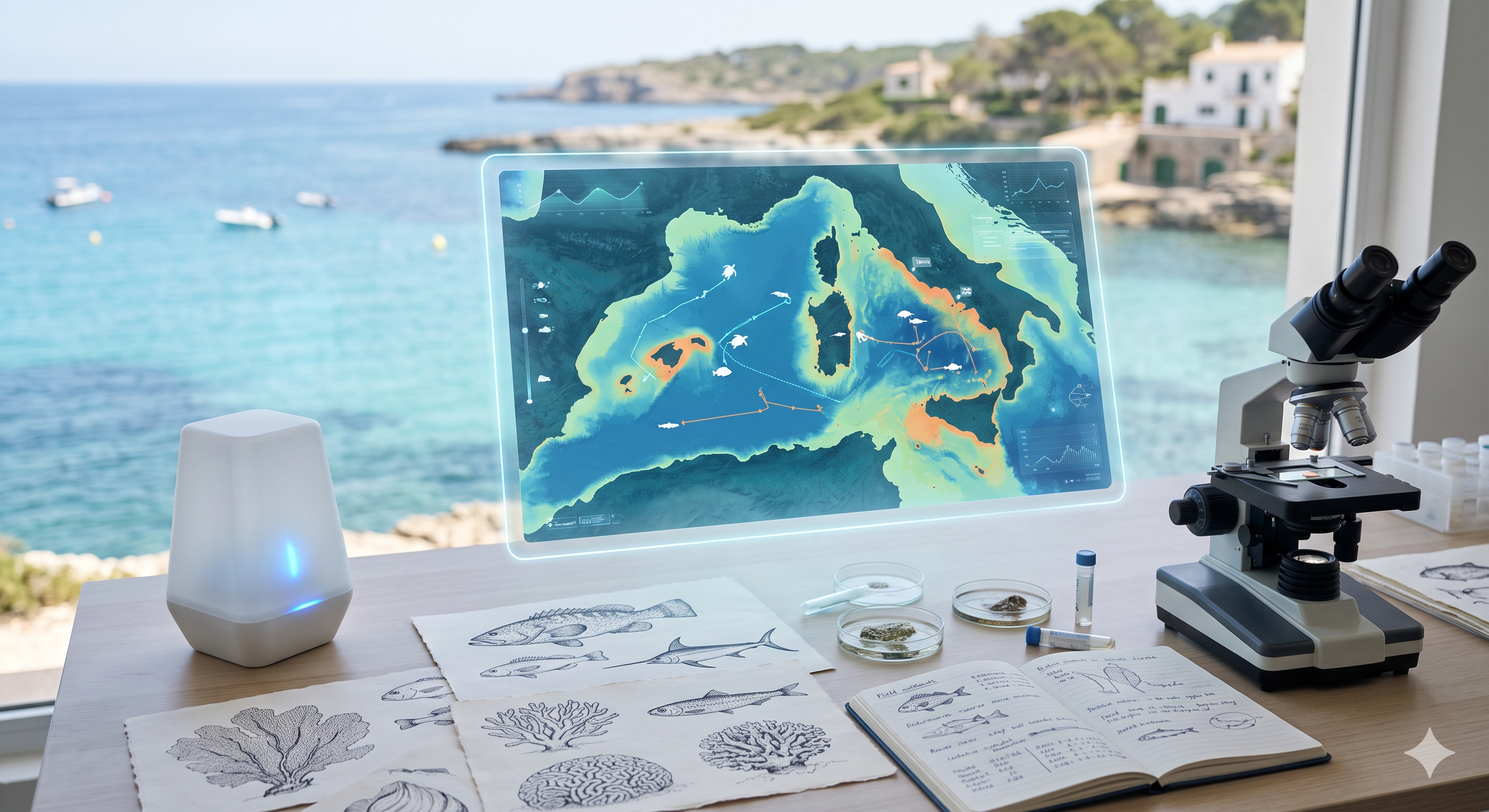 Marine biology study
In recent years, the way enthusiasts, students, and professionals access marine information has changed radically. Until recently, those heading out to sea or studying coastal biology had to navigate dozens of different websites: a portal to identify fish, a weather app, a forum for discussion, and specific navigation software. Today, the real need is integration: having comprehensive tools always at hand.
It is in this context of "consolidation" that structured platforms like Vitamarinaweb stand out. Its appearance among the top reference sites for marine biology is not linked to classic community dynamics, but to an architecture designed as a true "Swiss Army knife" for those who live the sea, based on data and practical utility.
The importance of a structured scientific database
Rather than relying solely on user-generated content, the portal is built upon an extensive library of scientific articles and, above all, an Atlas of the Mediterranean. This makes it an objective reference tool: it allows users to identify species, understand habitat distribution, and access curated technical data sheets, transforming the site into a quick, reliable encyclopedia.
From the desk to the field: a multi-device approach
One of the historical limitations of marine biology databases is that they are convenient to consult at home but impractical on a boat or at the beach. The technical choice to offer Vitamarinaweb across 5 different applications (covering various mobile and desktop ecosystems) directly addresses this need for mobility. It allows researchers and divers to access data exactly when and where they need it.
AI applied to marine exploration
An interesting aspect of this platform is its use of technology to simplify science communication. The integration of an Artificial Intelligence-based chatbot changes the way information is searched: users no longer have to navigate through endless menus to classify an organism or understand an oceanographic phenomenon. Instead, they can interact with the system to get contextualized answers in real time.
Beyond biology: operational tools
Finally, the platform complements its encyclopedic side with a series of purely technical features. Housing marine weather dashboards, digital logbooks, and mapping functionalities within the same environment demonstrates an approach geared toward daily utility.
In summary
When a digital tool is frequently cited in international lists, the reason usually lies in its everyday usefulness. Platforms that manage to combine the reliability of scientific outreach, the practicality of dedicated field apps, and modern technologies like AI, naturally tend to become organic benchmark resources for the maritime community.
It is in this context of "consolidation" that structured platforms like Vitamarinaweb stand out. Its appearance among the top reference sites for marine biology is not linked to classic community dynamics, but to an architecture designed as a true "Swiss Army knife" for those who live the sea, based on data and practical utility.
The importance of a structured scientific database
Rather than relying solely on user-generated content, the portal is built upon an extensive library of scientific articles and, above all, an Atlas of the Mediterranean. This makes it an objective reference tool: it allows users to identify species, understand habitat distribution, and access curated technical data sheets, transforming the site into a quick, reliable encyclopedia.
From the desk to the field: a multi-device approach
One of the historical limitations of marine biology databases is that they are convenient to consult at home but impractical on a boat or at the beach. The technical choice to offer Vitamarinaweb across 5 different applications (covering various mobile and desktop ecosystems) directly addresses this need for mobility. It allows researchers and divers to access data exactly when and where they need it.
AI applied to marine exploration
An interesting aspect of this platform is its use of technology to simplify science communication. The integration of an Artificial Intelligence-based chatbot changes the way information is searched: users no longer have to navigate through endless menus to classify an organism or understand an oceanographic phenomenon. Instead, they can interact with the system to get contextualized answers in real time.
Beyond biology: operational tools
Finally, the platform complements its encyclopedic side with a series of purely technical features. Housing marine weather dashboards, digital logbooks, and mapping functionalities within the same environment demonstrates an approach geared toward daily utility.
In summary
When a digital tool is frequently cited in international lists, the reason usually lies in its everyday usefulness. Platforms that manage to combine the reliability of scientific outreach, the practicality of dedicated field apps, and modern technologies like AI, naturally tend to become organic benchmark resources for the maritime community.
Today, June 20th, "Jaws" was released in theaters
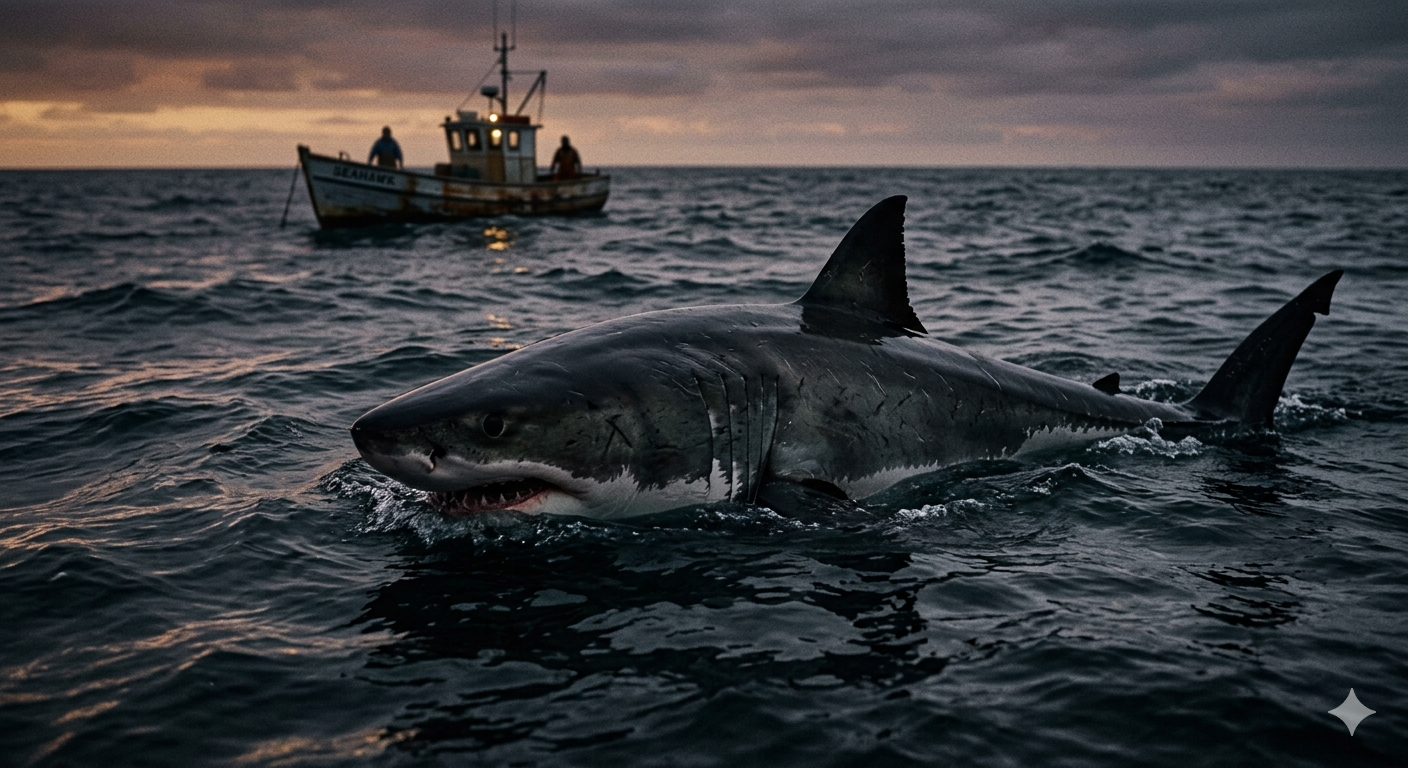 The Great white shark (Carcharodon carcharias) which inspired Spielberg's film
Today, June 20th, we celebrate the anniversary of the film Jaws. What can I say? The rest is history.
tags: #fish #sea #marine biology #shark #fishing"
tags: #fish #sea #marine biology #shark #fishing"
The King of the Ocean: Secrets and Biology of the Great White Shark
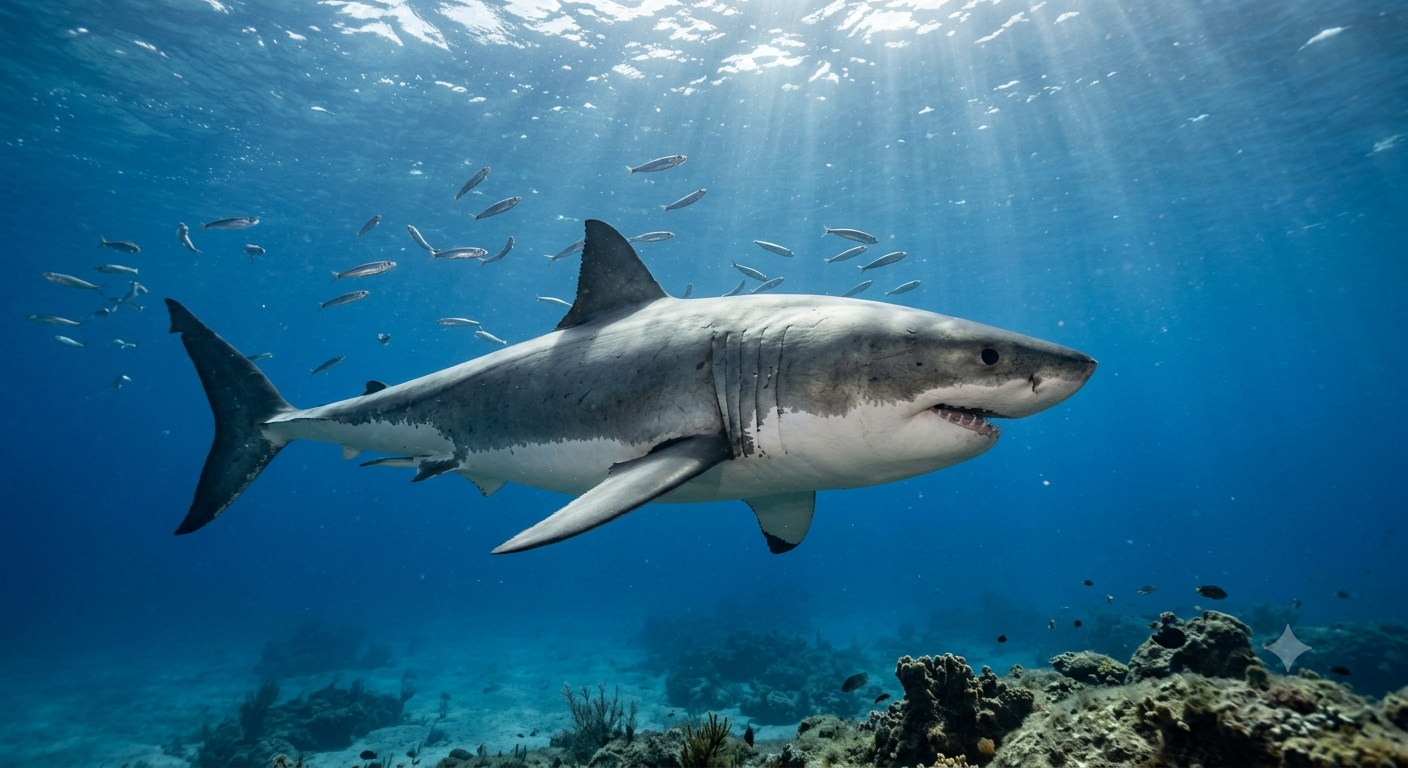 The Great white shark (Carcharodon carcharias)
The Great White Shark is undoubtedly one of the most fascinating and vital creatures in marine life. This extraordinary apex predator inhabits the waters of almost every ocean, playing a fundamental role in maintaining the delicate balance of the sea ecosystem.
Beyond its fearsome reputation, shark biology reveals an incredibly complex animal. They possess an advanced sensory system capable of detecting the electric fields of prey even at a great distance.
Protecting this species and preserving its natural habitat is a core topic in marine biology, crucial for ensuring biodiversity and the future health of global marine environments.
Beyond its fearsome reputation, shark biology reveals an incredibly complex animal. They possess an advanced sensory system capable of detecting the electric fields of prey even at a great distance.
Protecting this species and preserving its natural habitat is a core topic in marine biology, crucial for ensuring biodiversity and the future health of global marine environments.
World Environment Day: Protecting the Ocean for the Planet's Future
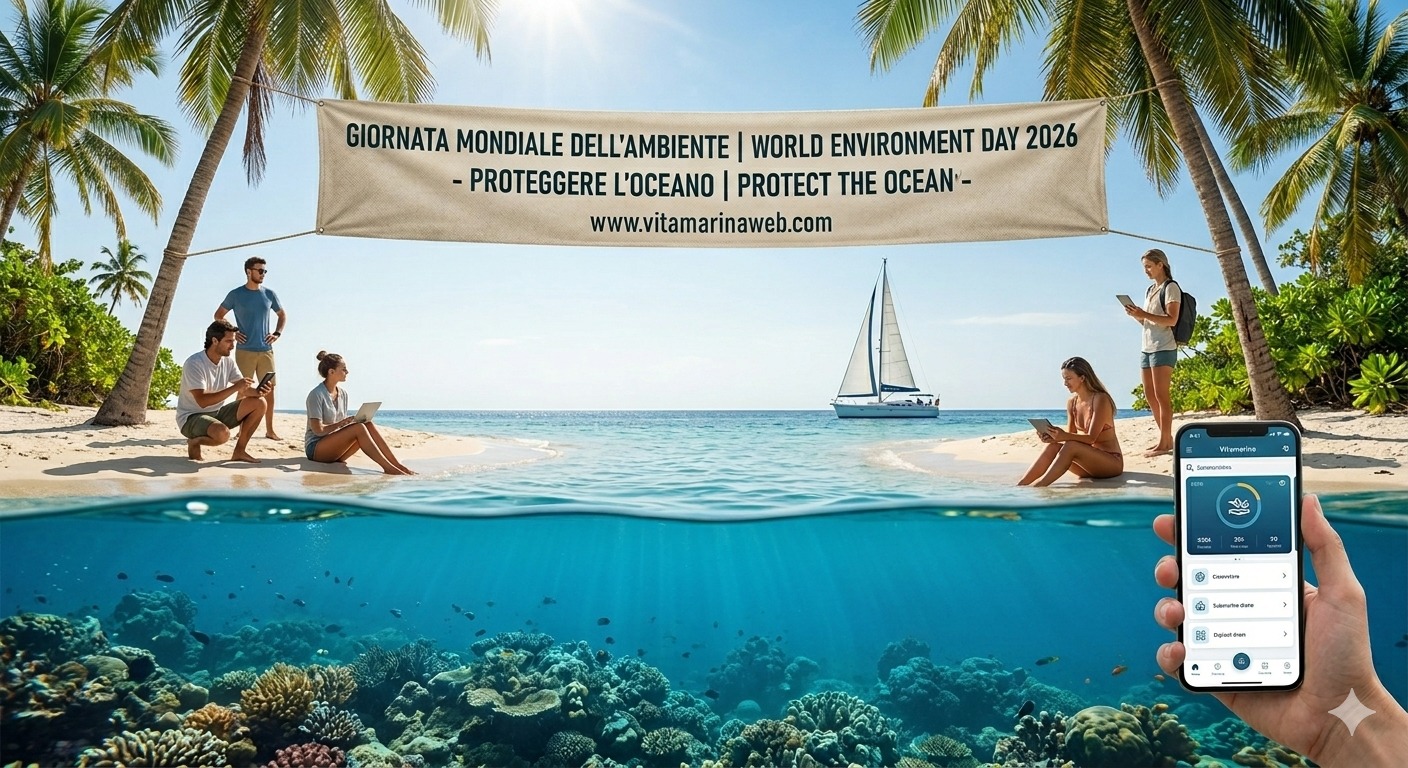
Today, the world comes together to celebrate World Environment Day, a key moment to reflect on the protection of our ecosystem. This year, global attention is focused on caring for the great blue lung: our ocean.
Amid current ecological challenges, science and digital tools offer extraordinary resources to safeguard biodiversity. From studying marine habitats to protecting coral reefs, knowledge is the main path toward change.
The Value of Digital Knowledge
Until a few years ago, marine biology was a subject reserved for a few specialists. Today, thanks to innovative marine biology websites, discovering the sea is accessible to anyone who wishes to learn.
The evolution of modern, top-tier marine biology apps offers exceptional features, such as interactive maps and digital support to recognize aquatic flora and fauna. These tools connect enthusiasts worldwide into a large community united by respect for nature.
Daily Actions for Nature
Every small choice can make a difference for the common good:
Supporting sustainability: Choosing certified products and respecting the natural cycles of wildlife.
Reducing plastic materials: Preventing non-biodegradable materials from reaching the beaches.
Sharing ecological culture: Using digital channels to spread love and respect for the sea.
The future of the planet begins with water. Happy World Environment Day to everyone!
Amid current ecological challenges, science and digital tools offer extraordinary resources to safeguard biodiversity. From studying marine habitats to protecting coral reefs, knowledge is the main path toward change.
The Value of Digital Knowledge
Until a few years ago, marine biology was a subject reserved for a few specialists. Today, thanks to innovative marine biology websites, discovering the sea is accessible to anyone who wishes to learn.
The evolution of modern, top-tier marine biology apps offers exceptional features, such as interactive maps and digital support to recognize aquatic flora and fauna. These tools connect enthusiasts worldwide into a large community united by respect for nature.
Daily Actions for Nature
Every small choice can make a difference for the common good:
Supporting sustainability: Choosing certified products and respecting the natural cycles of wildlife.
Reducing plastic materials: Preventing non-biodegradable materials from reaching the beaches.
Sharing ecological culture: Using digital channels to spread love and respect for the sea.
The future of the planet begins with water. Happy World Environment Day to everyone!
Giornata Mondiale dell’Ambiente 2026: Proteggere l'Oceano per Salvare il Pianeta
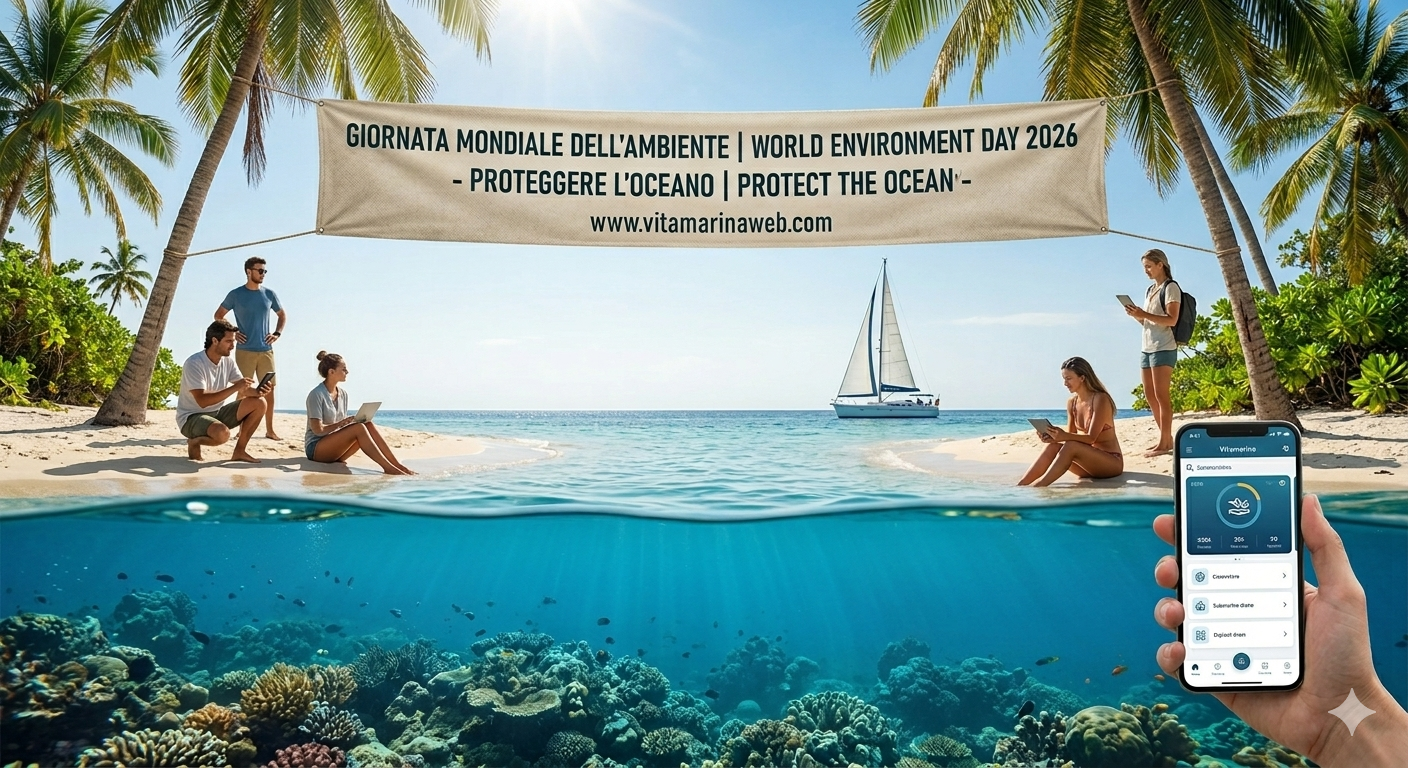
Oggi il mondo si unisce per celebrare la Giornata Mondiale dell’Ambiente, un momento fondamentale per riflettere sulla tutela del nostro ecosistema. Quest'anno l'attenzione globale è rivolta alla cura del grande polmone blu: il nostro oceano.
Con le sfide ecologiche attuali, la scienza e il digitale offrono risorse straordinarie per la salvaguardia della biodiversità. Dallo studio degli habitat marini alla tutela delle barriere coralline, la conoscenza è la via principale per il cambiamento.
Il Valore della Conoscenza Digitale
Fino a pochi anni fa, la biologia marina era una materia riservata a pochi specialisti. Oggi, grazie a piattaforme innovative e marine biology websites, la scoperta del mare è accessibile a chiunque desideri imparare.
L'evoluzione delle moderne marine biology apps offre funzioni eccezionali, come mappe interattive e supporti digitali per riconoscere la flora e la fauna acquatica. Questi strumenti uniscono gli appassionati di tutto il mondo in una grande community unita dal rispetto per la natura.
Azioni Quotidiane per la Natura
Ogni piccola scelta può fare la differenza per il bene comune:
Sostenere la sostenibilità: Scegliere prodotti certificati e rispettare i cicli naturali della fauna.
Ridurre l'uso di materiali plastici: Evitare che i materiali non biodegradabili raggiungano le spiagge.
Condividere la cultura ecologica: Usare i canali digitali per diffondere l'amore e il rispetto per il mare.
Il futuro del pianeta inizia dall'acqua. Buona Giornata Mondiale dell'Ambiente a tutti!
Con le sfide ecologiche attuali, la scienza e il digitale offrono risorse straordinarie per la salvaguardia della biodiversità. Dallo studio degli habitat marini alla tutela delle barriere coralline, la conoscenza è la via principale per il cambiamento.
Il Valore della Conoscenza Digitale
Fino a pochi anni fa, la biologia marina era una materia riservata a pochi specialisti. Oggi, grazie a piattaforme innovative e marine biology websites, la scoperta del mare è accessibile a chiunque desideri imparare.
L'evoluzione delle moderne marine biology apps offre funzioni eccezionali, come mappe interattive e supporti digitali per riconoscere la flora e la fauna acquatica. Questi strumenti uniscono gli appassionati di tutto il mondo in una grande community unita dal rispetto per la natura.
Azioni Quotidiane per la Natura
Ogni piccola scelta può fare la differenza per il bene comune:
Sostenere la sostenibilità: Scegliere prodotti certificati e rispettare i cicli naturali della fauna.
Ridurre l'uso di materiali plastici: Evitare che i materiali non biodegradabili raggiungano le spiagge.
Condividere la cultura ecologica: Usare i canali digitali per diffondere l'amore e il rispetto per il mare.
Il futuro del pianeta inizia dall'acqua. Buona Giornata Mondiale dell'Ambiente a tutti!
The Alien of the Oceans: How the Octopus Brain Redefines Our Concept of Intelligence
When we think of the smartest animals on Earth, our minds usually fly to chimpanzees, dolphins, or crows. Yet, deep in the ocean lives a creature that challenges everything we know about biology and evolution: the octopus.
Often described by scientists as the closest thing to an "alien" on Earth, this cephalopod possesses a unique nervous system capable of solving complex puzzles, camouflaging in fractions of a second, and, as a viral experiment recently proved, even learning to play a melody on the piano.
A Distributed Brain: Nine Minds in One Body
The true magic of the octopus lies in the structure of its nervous system. Unlike vertebrates, where a central brain coordinates every single movement, the octopus adopted a completely different evolutionary strategy: decentralization.
The Central Brain: Located between its eyes and shaped like a donut, it handles high-level decisions, long-term memory, and emotions.
The Peripheral Brains (The Arms): An octopus possesses about 500 million neurons, but more than two-thirds are located in its tentacles. Each arm has a sort of independent "mini-brain."
Total Autonomy: This means a tentacle can smell, touch, taste, and decide how to move or grab prey without waiting for a signal from the central brain. It is as if the octopus has nine brains working in perfect harmony.
Scientific Fact: If an arm is severed (for example, during a predator attack), it will continue to move and react to external stimuli for hours because it possesses an autonomous neuronal network.
Thanks to this biological hardware, octopuses display astonishing problem-solving skills in marine biology studies, such as using tools (like coconut shells for armor), escaping aquariums, and even recognizing individual human faces. But how far can this intelligence actually go?
From a Fish Market to Music: The True Story of Taco the Piano-Playing Octopus
In the incredible YouTube Short by @MattiasKrantz (image_404d7e.jpg), titled "I taught an octopus piano (it took 6 months)", we witness an extraordinary experiment that completely redefines the limits of animal learning.
The star of the video is Taco, an octopus that the creator literally saved from a fish market in South Korea—where he was destined for a frying pan—and welcomed into his aquarium instead. After a few days of gaining his trust through food, a rigorous 6-month training process began.
Here are the fascinating phases of how Taco learned to play:
1. The Key Redesign Dilemma
In the beginning, Taco would touch the keyboard but couldn't actually play a note. The creator realized a fundamental biological limitation: pushing down is not a natural movement for an octopus. He had to redesign the keys over and over again until he created the ultimate "octopus key"—a modified setup that Taco could grip and pull toward himself with his suction cups. It worked instantly.
2. Ditching the Lights for Movement
The next step was teaching Taco an actual melody. The initial plan involved using LED lights to show Taco which key to pull, but the octopus completely hated and ignored the lights. The fix was simple: just wiggling and shaking the correct key in front of him. Stimulated by the movement, Taco learned to play two notes in a row within a week, and by the second week, he pulled off a full musical chord.
3. The Masterstroke: The Crab Elevator
After the early success, progress stalled for weeks. Taco knew how to play individual notes but didn't grasp that he needed to keep going to complete a full song.
After researching and consulting with experts, the creator invented a genius motivational tool: the crab elevator. He rigged a mechanism where a crab (the octopus's absolute favorite food) sat on a small platform high up. Every correct key press lowered the crab a little closer to Taco. To get the food, Taco had no choice but to complete the entire musical melody.
The Grand Finale: Taco's First Performance
The crab elevator worked flawlessly. Taco perfectly understood the abstract, logical connection between executing the music and receiving his prize. The video concludes with Taco's first-ever official piano recital, beautifully coordinating his peripheral mini-brains to glide his tentacles across the keys and complete the tune.
This transition from a South Korean fish market to a musical performance is not just a heartwarming viral story—it is a vivid, visual proof of the mind-bending neural plasticity of the octopus. It proves that an animal evolutionarily distant from humans can completely adapt its nine brains to an artificial, human instrument to achieve its goals.
Look at the video:
Often described by scientists as the closest thing to an "alien" on Earth, this cephalopod possesses a unique nervous system capable of solving complex puzzles, camouflaging in fractions of a second, and, as a viral experiment recently proved, even learning to play a melody on the piano.
A Distributed Brain: Nine Minds in One Body
The true magic of the octopus lies in the structure of its nervous system. Unlike vertebrates, where a central brain coordinates every single movement, the octopus adopted a completely different evolutionary strategy: decentralization.
The Central Brain: Located between its eyes and shaped like a donut, it handles high-level decisions, long-term memory, and emotions.
The Peripheral Brains (The Arms): An octopus possesses about 500 million neurons, but more than two-thirds are located in its tentacles. Each arm has a sort of independent "mini-brain."
Total Autonomy: This means a tentacle can smell, touch, taste, and decide how to move or grab prey without waiting for a signal from the central brain. It is as if the octopus has nine brains working in perfect harmony.
Scientific Fact: If an arm is severed (for example, during a predator attack), it will continue to move and react to external stimuli for hours because it possesses an autonomous neuronal network.
Thanks to this biological hardware, octopuses display astonishing problem-solving skills in marine biology studies, such as using tools (like coconut shells for armor), escaping aquariums, and even recognizing individual human faces. But how far can this intelligence actually go?
From a Fish Market to Music: The True Story of Taco the Piano-Playing Octopus
In the incredible YouTube Short by @MattiasKrantz (image_404d7e.jpg), titled "I taught an octopus piano (it took 6 months)", we witness an extraordinary experiment that completely redefines the limits of animal learning.
The star of the video is Taco, an octopus that the creator literally saved from a fish market in South Korea—where he was destined for a frying pan—and welcomed into his aquarium instead. After a few days of gaining his trust through food, a rigorous 6-month training process began.
Here are the fascinating phases of how Taco learned to play:
1. The Key Redesign Dilemma
In the beginning, Taco would touch the keyboard but couldn't actually play a note. The creator realized a fundamental biological limitation: pushing down is not a natural movement for an octopus. He had to redesign the keys over and over again until he created the ultimate "octopus key"—a modified setup that Taco could grip and pull toward himself with his suction cups. It worked instantly.
2. Ditching the Lights for Movement
The next step was teaching Taco an actual melody. The initial plan involved using LED lights to show Taco which key to pull, but the octopus completely hated and ignored the lights. The fix was simple: just wiggling and shaking the correct key in front of him. Stimulated by the movement, Taco learned to play two notes in a row within a week, and by the second week, he pulled off a full musical chord.
3. The Masterstroke: The Crab Elevator
After the early success, progress stalled for weeks. Taco knew how to play individual notes but didn't grasp that he needed to keep going to complete a full song.
After researching and consulting with experts, the creator invented a genius motivational tool: the crab elevator. He rigged a mechanism where a crab (the octopus's absolute favorite food) sat on a small platform high up. Every correct key press lowered the crab a little closer to Taco. To get the food, Taco had no choice but to complete the entire musical melody.
The Grand Finale: Taco's First Performance
The crab elevator worked flawlessly. Taco perfectly understood the abstract, logical connection between executing the music and receiving his prize. The video concludes with Taco's first-ever official piano recital, beautifully coordinating his peripheral mini-brains to glide his tentacles across the keys and complete the tune.
This transition from a South Korean fish market to a musical performance is not just a heartwarming viral story—it is a vivid, visual proof of the mind-bending neural plasticity of the octopus. It proves that an animal evolutionarily distant from humans can completely adapt its nine brains to an artificial, human instrument to achieve its goals.
Look at the video:
The story of the fisherman and the tourist
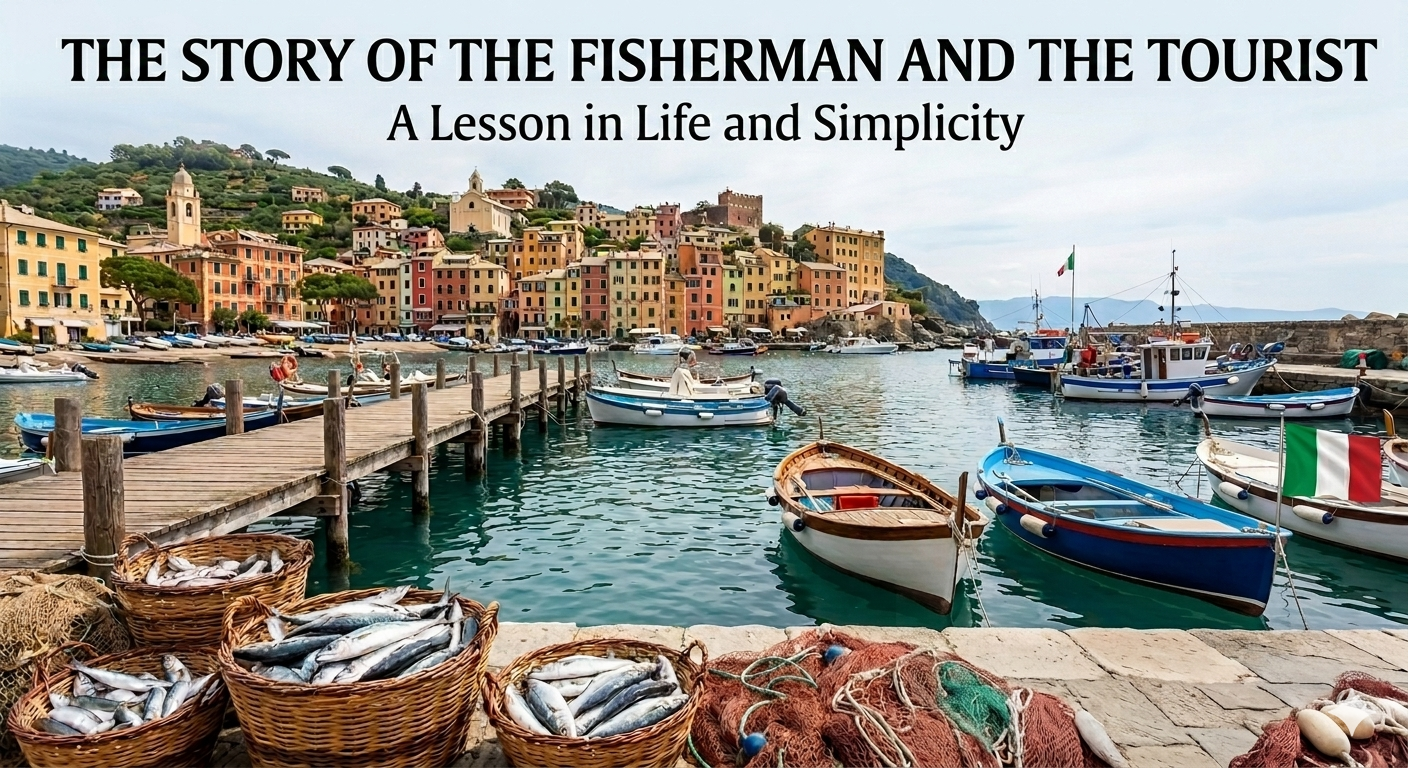
"On the pier of a small Mexican village, an American tourist stops and approaches a small boat belonging to a local fisherman. He compliments the fisherman on the quality of the fish and asks him how long it took to catch them.
The fisherman replies: 'It didn't take long,' and the tourist asks: 'But then, why didn't you stay out longer to catch more?'
The Mexican explains that that small amount was exactly what he needed to meet his family's needs.
The tourist asks: 'But how do you spend the rest of your time?'
And the fisherman says: 'I sleep late, fish a little, play with my children, and take a siesta with my wife. In the evening, I go to the village, meet up with friends, have a drink, play the guitar, sing a few songs, and so on—I live life to the fullest.'
The tourist then says: 'Let me stop you right there; I have an MBA from Harvard, and I can give you some useful suggestions on how to improve. First of all, you should fish for longer hours every day. Naturally, you would catch more. You could sell the extra fish and buy a bigger boat. A bigger boat means more fish, more fish means more money, more money means more boats... You could afford an entire fleet! Instead of selling to the middleman, you could negotiate directly with the processing plants, and eventually, you could even open your own.
Later on, you could leave the village and move to Mexico City, or Los Angeles, or perhaps even New York! From there, you could manage a huge enterprise!'
The fisherman interrupted him: 'But how long would it take to achieve these goals?'
And the tourist says: '20, 25 years, perhaps.' The fisherman then asked: '...and after that?'
The tourist replies: 'Ah, that’s the best part! When your business reaches massive volumes, you could sell your shares and make millions!'
And the fisherman: 'Millions? And then?'
The tourist: 'And then, finally, you could retire, move to a small coastal village, sleep late, play with your children, fish a little, take a siesta, spend your evenings with friends having a drink, playing the guitar, and living life to the fullest! And the fisherman says , but that is that already do in my life!
keywords: marine biology, fishing, fishes,
The fisherman replies: 'It didn't take long,' and the tourist asks: 'But then, why didn't you stay out longer to catch more?'
The Mexican explains that that small amount was exactly what he needed to meet his family's needs.
The tourist asks: 'But how do you spend the rest of your time?'
And the fisherman says: 'I sleep late, fish a little, play with my children, and take a siesta with my wife. In the evening, I go to the village, meet up with friends, have a drink, play the guitar, sing a few songs, and so on—I live life to the fullest.'
The tourist then says: 'Let me stop you right there; I have an MBA from Harvard, and I can give you some useful suggestions on how to improve. First of all, you should fish for longer hours every day. Naturally, you would catch more. You could sell the extra fish and buy a bigger boat. A bigger boat means more fish, more fish means more money, more money means more boats... You could afford an entire fleet! Instead of selling to the middleman, you could negotiate directly with the processing plants, and eventually, you could even open your own.
Later on, you could leave the village and move to Mexico City, or Los Angeles, or perhaps even New York! From there, you could manage a huge enterprise!'
The fisherman interrupted him: 'But how long would it take to achieve these goals?'
And the tourist says: '20, 25 years, perhaps.' The fisherman then asked: '...and after that?'
The tourist replies: 'Ah, that’s the best part! When your business reaches massive volumes, you could sell your shares and make millions!'
And the fisherman: 'Millions? And then?'
The tourist: 'And then, finally, you could retire, move to a small coastal village, sleep late, play with your children, fish a little, take a siesta, spend your evenings with friends having a drink, playing the guitar, and living life to the fullest! And the fisherman says , but that is that already do in my life!
keywords: marine biology, fishing, fishes,
La storia del pescatore e del turista
“Sul molo di un piccolo villaggio messicano, un turista americano si ferma e si avvicina ad una piccola imbarcazione di un pescatore del posto. Si complimenta con il pescatore per la qualità del pesce e gli chiede quanto tempo avesse impiegato per pescarlo.
Il pescatore risponde: “Non ho impiegato molto tempo” e il turista: “Ma allora, perché non è stato di più, per pescarne di più?”
Il messicano gli spiega che quella esigua quantità era esattamente ciò di cui aveva bisogno per soddisfare le esigenze della sua famiglia.
Il turista chiese: “Ma come impiega il resto del suo tempo?”
E il pescatore: “Dormo fino a tardi, pesco un po’, gioco con i miei bimbi e faccio la siesta con mia moglie. La sera vado al villaggio, ritrovo gli amici, beviamo insieme qualcosa, suono la chitarra, canto qualche canzone, e via così, trascorro appieno la vita.”
Allorché il turista fece: “La interrompo subito, sa sono laureato ad Harvard, e posso darle utili suggerimenti su come migliorare. Prima di tutto dovrebbe pescare più a lungo, ogni giorno di più. Così logicamente pescherebbe di più. Il pesce in più lo potrebbe vendere e comprarsi una barca più grossa. Barca più grossa significa più pesce, più pesce significa più soldi, più soldi più barche… Potrà permettersi un’intera flotta! Quindi invece di vendere il pesce all’uomo medio, potrà negoziare direttamente con le industrie della lavorazione del pesce, potrà a suo tempo aprirsene una sua.
In seguito potrà lasciare il villaggio e trasferirsi a Mexico City o a Los Angeles o magari addirittura a New York! Da lì potrà dirigere un’enorme impresa!”
Il pescatore lo interruppe: “Ma per raggiungere questi obiettivi quanto tempo mi ci vorrebbe?”
E il turista: “20, 25 anni forse” quindi il pescatore chiese: “….e dopo?”
Turista: “Ah dopo, e qui viene il bello, quando il suoi affari avranno raggiunto volumi grandiosi, potrà vendere le azioni e guadagnare miliardi!”
E il pescatore: ”Miliardi? e poi?”
Turista: “E poi finalmente potrà ritirarsi dagli affari e andare in un piccolo villaggio vicino alla costa, dormire fino a tardi, giocare con i suoi bimbi, pescare un po’ di pesce, fare la siesta, passare le serate con gli amici bevendo qualcosa, suonando la chitarra e trascorrere appieno la vita! E il pescatore rispose al turista: ma questo lo faccio già.
Il pescatore risponde: “Non ho impiegato molto tempo” e il turista: “Ma allora, perché non è stato di più, per pescarne di più?”
Il messicano gli spiega che quella esigua quantità era esattamente ciò di cui aveva bisogno per soddisfare le esigenze della sua famiglia.
Il turista chiese: “Ma come impiega il resto del suo tempo?”
E il pescatore: “Dormo fino a tardi, pesco un po’, gioco con i miei bimbi e faccio la siesta con mia moglie. La sera vado al villaggio, ritrovo gli amici, beviamo insieme qualcosa, suono la chitarra, canto qualche canzone, e via così, trascorro appieno la vita.”
Allorché il turista fece: “La interrompo subito, sa sono laureato ad Harvard, e posso darle utili suggerimenti su come migliorare. Prima di tutto dovrebbe pescare più a lungo, ogni giorno di più. Così logicamente pescherebbe di più. Il pesce in più lo potrebbe vendere e comprarsi una barca più grossa. Barca più grossa significa più pesce, più pesce significa più soldi, più soldi più barche… Potrà permettersi un’intera flotta! Quindi invece di vendere il pesce all’uomo medio, potrà negoziare direttamente con le industrie della lavorazione del pesce, potrà a suo tempo aprirsene una sua.
In seguito potrà lasciare il villaggio e trasferirsi a Mexico City o a Los Angeles o magari addirittura a New York! Da lì potrà dirigere un’enorme impresa!”
Il pescatore lo interruppe: “Ma per raggiungere questi obiettivi quanto tempo mi ci vorrebbe?”
E il turista: “20, 25 anni forse” quindi il pescatore chiese: “….e dopo?”
Turista: “Ah dopo, e qui viene il bello, quando il suoi affari avranno raggiunto volumi grandiosi, potrà vendere le azioni e guadagnare miliardi!”
E il pescatore: ”Miliardi? e poi?”
Turista: “E poi finalmente potrà ritirarsi dagli affari e andare in un piccolo villaggio vicino alla costa, dormire fino a tardi, giocare con i suoi bimbi, pescare un po’ di pesce, fare la siesta, passare le serate con gli amici bevendo qualcosa, suonando la chitarra e trascorrere appieno la vita! E il pescatore rispose al turista: ma questo lo faccio già.
The perfect fishing day in a incredible and useful guide
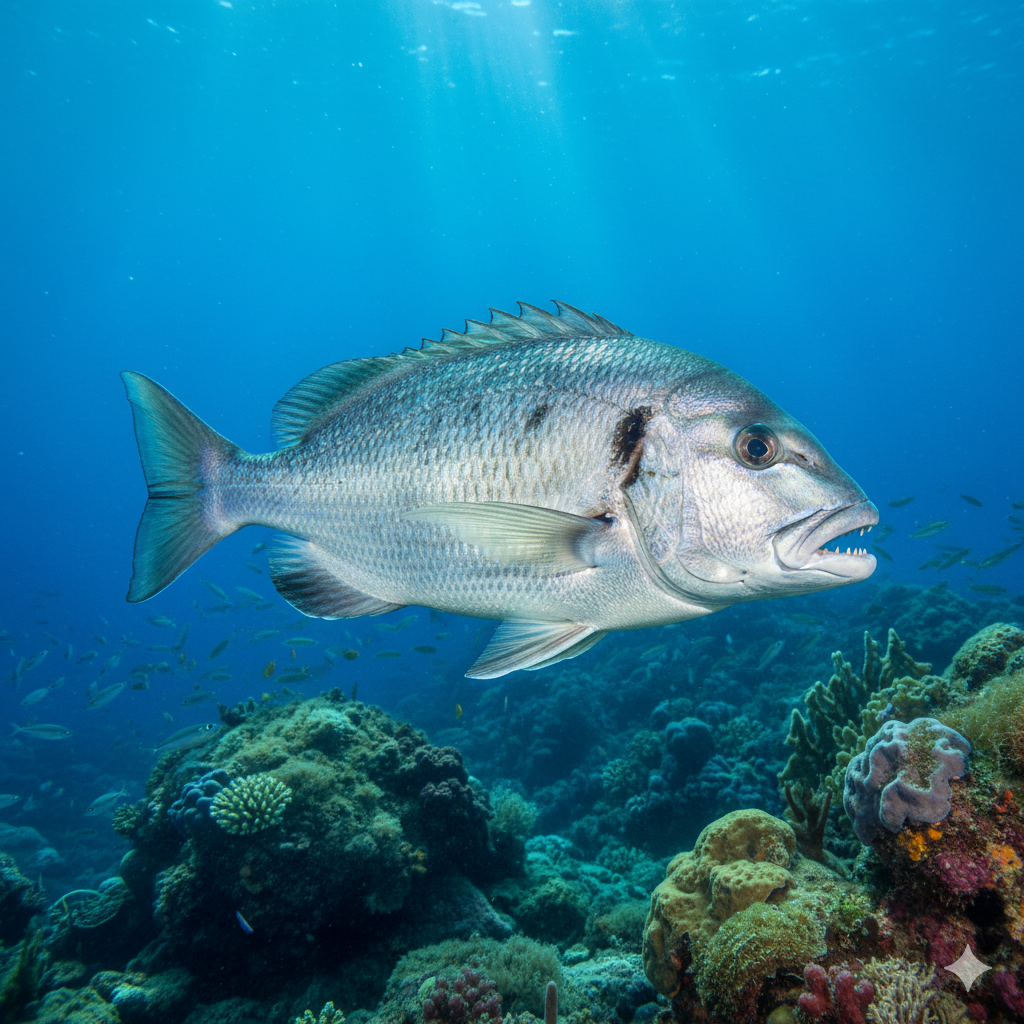 The perfect fishing day
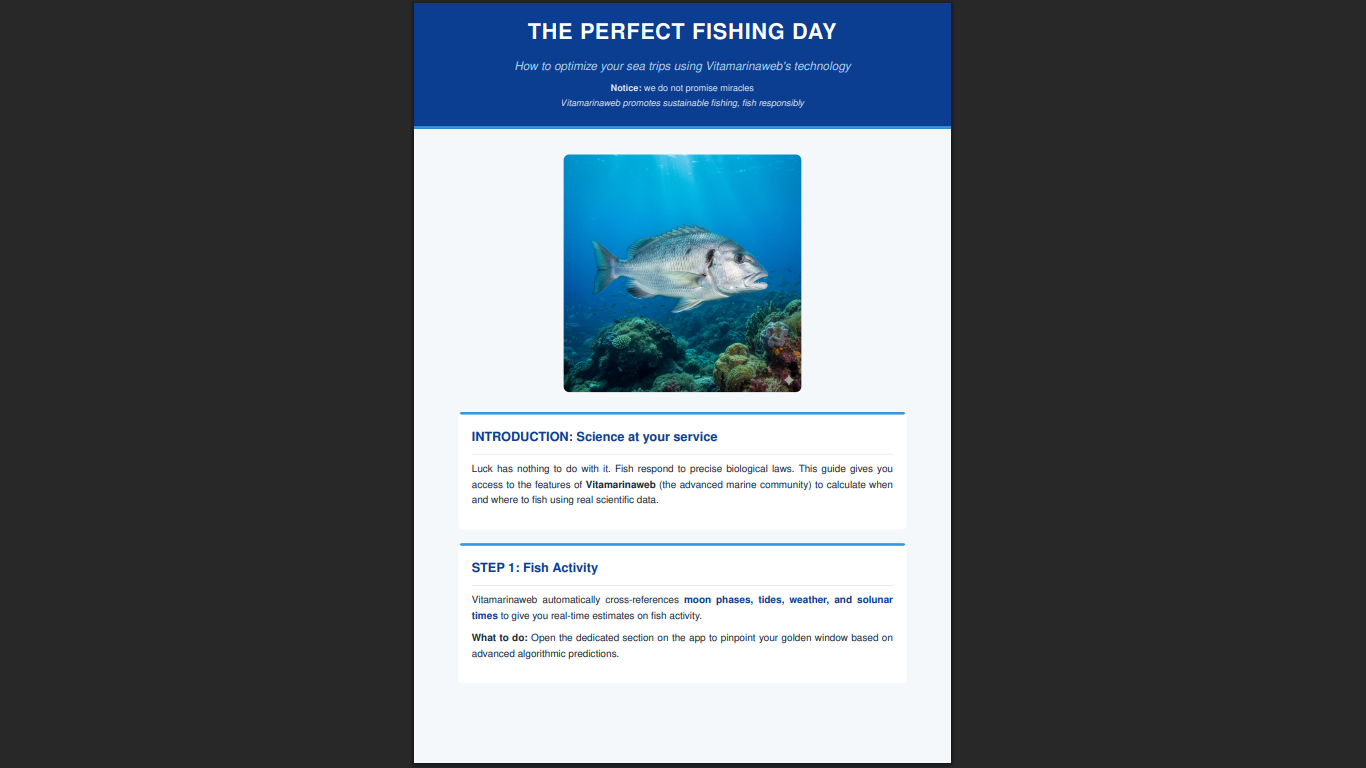
Are you a fisherman? Sign up now to receive, right after registration, the email with the perfect fisherman’s guide in PDF format!! For all the lovers of the sea, fishing and marine biology..
Giants of the Ocean: Why Saving Whales Means Saving Our Planet
 A spectacular breach of a humpback whale (Megaptera novaeangliae) in its natural habitat. Protecting these marine giants is vital for ocean conservation and global climate regulation.
Whales are not just the largest mammals on Earth; they are the true guardians of our oceans' health. While we often view these marine giants as fascinating creatures to admire during whale watching, the scientific reality goes much deeper: human survival is intrinsically linked to their protection.Today more than ever, whales face unprecedented threats—from plastic pollution to commercial whaling, as well as overfishing and unsustainable fishing practices that tear apart the marine food web.The Ecological Role of Whales: Natural Climate RegulatorsWhales play a critical role in the carbon cycle and the planet's oxygen production through two extraordinary biological phenomena:The "Whale Pump": By feeding in the deep ocean and returning to the surface to breathe and release fecal plumes, whales circulate essential nutrients like iron and nitrogen. This process fertilizes phytoplankton—microscopic marine algae that generate about 50% of the world's oxygen and absorb tons of carbon dioxide (CO2).The "Whale Fall" Carbon Sink: When a whale dies of natural causes, its body sinks to the ocean floor. A single whale sequesters an average of 33 tons of CO_2 within its body, locking that carbon away from the atmosphere for centuries. In comparison, a tree absorbs only about 48 pounds of CO_2 per year.The Biggest Threats: Pollution, Whaling, and OverfishingDespite their vital importance, human activities continue to push these cetaceans to the brink:Plastic and Noise Pollution: Tons of plastic waste enter the ocean daily, often ingested by baleen whales filtering the water. Additionally, underwater noise pollution from commercial shipping and military sonar disrupts cetacean communication, leading to tragic mass strandings.Whaling and Vessel Strikes: Although commercial whaling is banned by international moratoriums, a few nations still practice it. Furthermore, whales face constant danger from ship strikes along busy global shipping lanes.Overfishing and Ghost Gear: Intensive industrial fishing is emptying the oceans. This deprives whales of their primary food sources (like krill and small fish) and exposes them to the danger of bycatch—becoming fatally entangled in abandoned commercial fishing nets and longlines.How Can We Protect Our Oceans?Saving the oceans requires a global shift in behavior: establishing more Marine Protected Areas (MPAs), drastically cutting down single-use plastics, and supporting sustainable, traceable fishing practices that respect marine reproductive cycles.Education and awareness are the first steps toward conservation. Understanding marine ecology allows us to make more conscious consumer choices and stand up for our planet's blue heart.Want to explore marine life or ask questions in real-time?If you are curious about cetacean behavior, whale migration routes, or ocean wildlife conservation, join our community or chat directly with our specialized marine AI on Vitamarinaweb
Smart Ocean Tracking: How Vitamarinaweb Redefines Marine Biology Apps and Solunar Forecasting
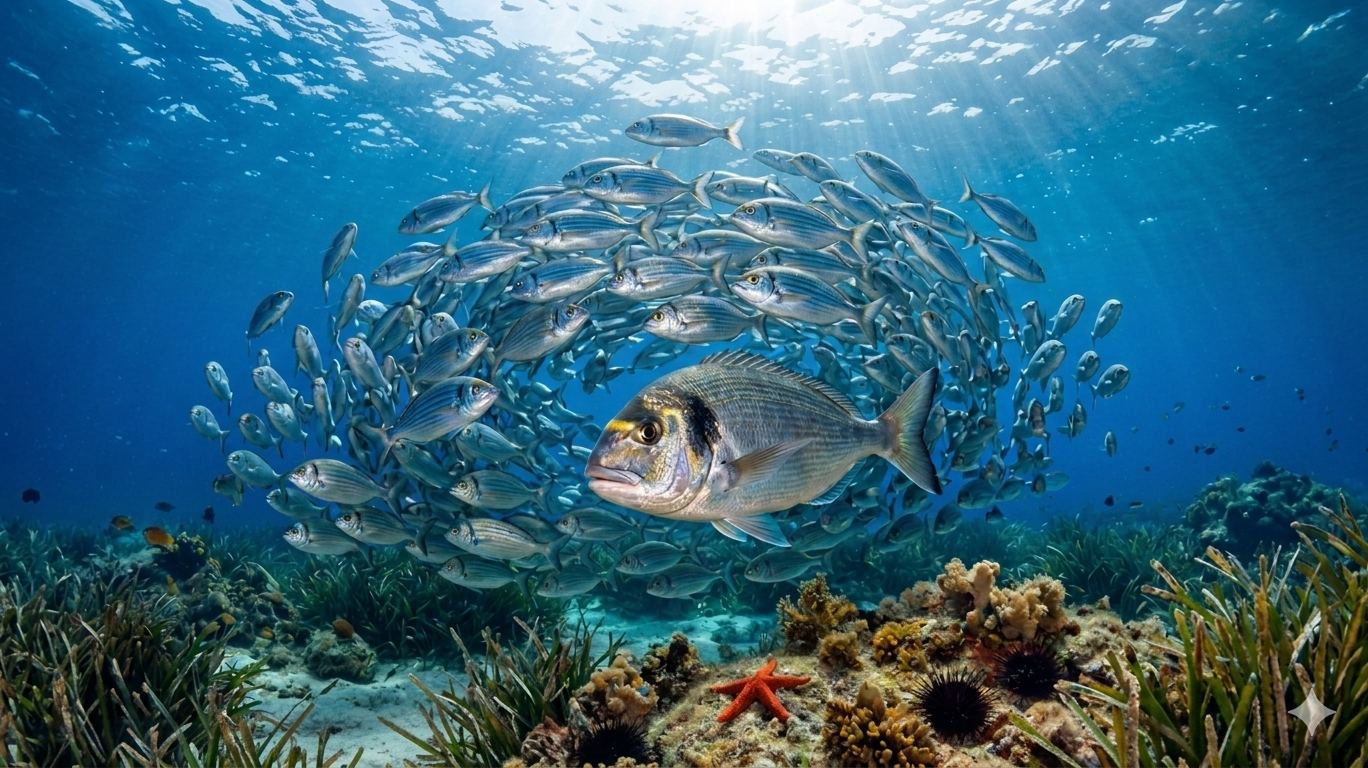
For too long, internet users searching for the best marine biology websites or interactive marine biology apps have been forced to choose between dry, static academic databases or ad-filled weather widgets. Ocean enthusiasts, divers, and fishermen deserve a unified, modern digital space. This is exactly why Vitamarinaweb was built: to transform how we explore, track, and share the wonders of marine life through a feature-rich, community-driven social ecosystem.
Available across Web, Android, and iOS, Vitamarinaweb bridges the gap between scientific taxonomy, real-time environmental data, and social connectivity—completely free from invasive advertising.
An Interactive Marine Atlas Backed by Community Intelligence
At the core of Vitamarinaweb is an interactive Digital Marine Atlas detailing species of fish, mollusks, crustaceans, and invertebrates from the Mediterranean and global oceans. But unlike traditional encyclopedias, this atlas is part of a living ecosystem.
Through integrated Marine AI, users can instantly ask scientific questions, identify marine species, and understand specific habitats. This is paired with an active, dedicated Marine Forum and a global social feed where divers, biologists, and ocean lovers can post high-definition photos, write articles, chat in real-time, and reward top content creators through interactive "Mega Likes."
Advanced Marine Analytics and Solunar Forecasting
What truly sets Vitamarinaweb apart from standard marine biology software is its integration of advanced solunar and oceanographic tracking. The platform features unique algorithmic tools that combine:
Real-Time Fish Activity Graphs: Intuitive hourly indicators (scaled 0–100) based on atmospheric pressure, wind, and waves.
Precise Solunar Charts & Tides: Deep data integration crossing moon phases, solar transits, and exact tidal flows to predict peak fish feeding windows.
Professional Catch Logs: A private, geolocated digital diary where fishermen and researchers can log catches with exact GPS coordinates, species metrics, and environmental notes.
From gaming elements like Shark Race to custom scientific merchandising, Vitamarinaweb is proof that a marine biology platform can be incredibly deep, engaging, and secure—featuring advanced biometric and two-factor authentication to protect community data.
Visit https://www.vitamarinaweb.com/en/
Available across Web, Android, and iOS, Vitamarinaweb bridges the gap between scientific taxonomy, real-time environmental data, and social connectivity—completely free from invasive advertising.
An Interactive Marine Atlas Backed by Community Intelligence
At the core of Vitamarinaweb is an interactive Digital Marine Atlas detailing species of fish, mollusks, crustaceans, and invertebrates from the Mediterranean and global oceans. But unlike traditional encyclopedias, this atlas is part of a living ecosystem.
Through integrated Marine AI, users can instantly ask scientific questions, identify marine species, and understand specific habitats. This is paired with an active, dedicated Marine Forum and a global social feed where divers, biologists, and ocean lovers can post high-definition photos, write articles, chat in real-time, and reward top content creators through interactive "Mega Likes."
Advanced Marine Analytics and Solunar Forecasting
What truly sets Vitamarinaweb apart from standard marine biology software is its integration of advanced solunar and oceanographic tracking. The platform features unique algorithmic tools that combine:
Real-Time Fish Activity Graphs: Intuitive hourly indicators (scaled 0–100) based on atmospheric pressure, wind, and waves.
Precise Solunar Charts & Tides: Deep data integration crossing moon phases, solar transits, and exact tidal flows to predict peak fish feeding windows.
Professional Catch Logs: A private, geolocated digital diary where fishermen and researchers can log catches with exact GPS coordinates, species metrics, and environmental notes.
From gaming elements like Shark Race to custom scientific merchandising, Vitamarinaweb is proof that a marine biology platform can be incredibly deep, engaging, and secure—featuring advanced biometric and two-factor authentication to protect community data.
Visit https://www.vitamarinaweb.com/en/
Modern Marine Taxonomy: Digitizing the Mediterranean Biodiversity
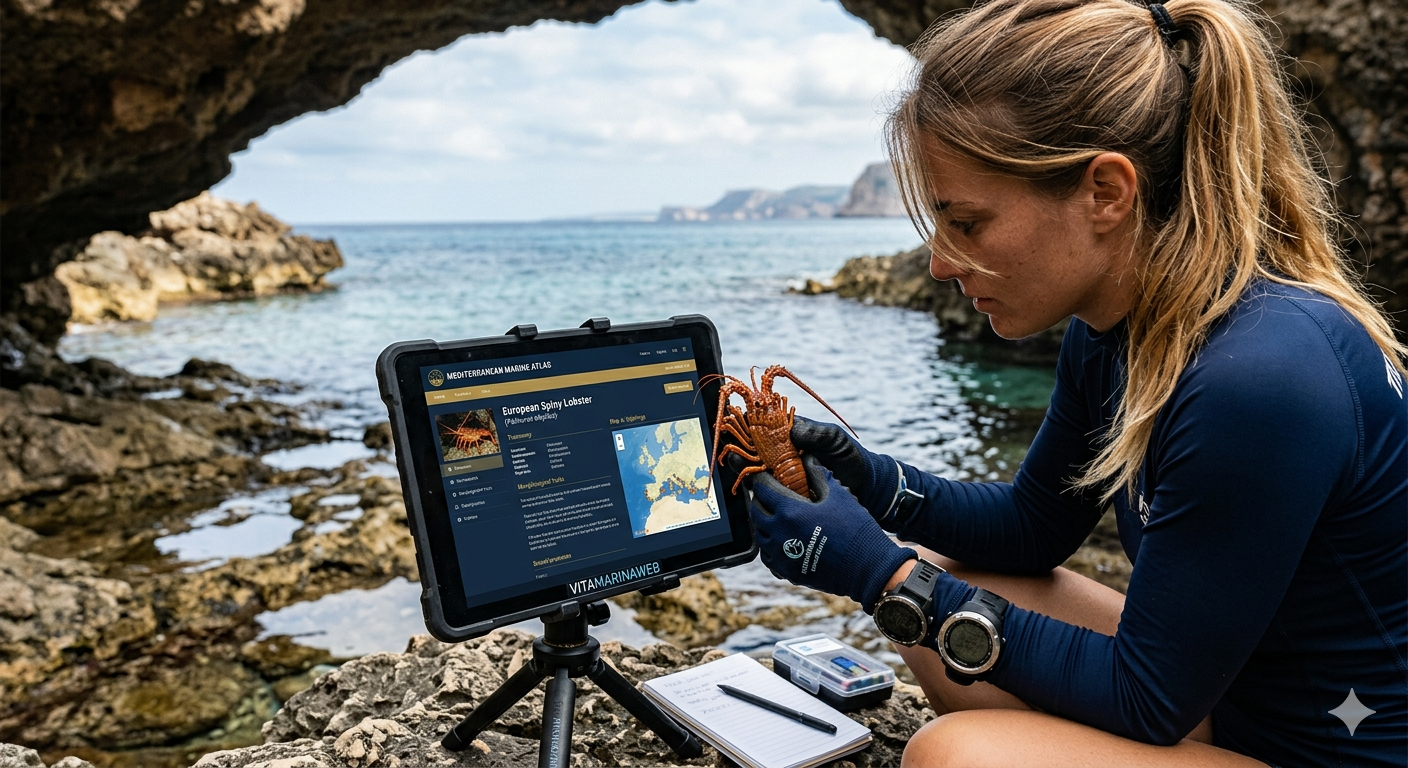 Field taxonomy in the Mediterranean: A marine biologist using the Vitamarinaweb digital atlas on a rugged tablet to classify a specimen of European Spiny Lobster (Palinurus elephas) during a coastal biodiversity survey
The Challenge of Subtropicalization in the Mediterranean
The Mediterranean Sea, while representing less than 1% of the world’s ocean surface, hosts over 17,000 marine species. In 2026, this biodiversity is undergoing a rapid transformation due to climate shifts and the phenomenon known as tropicalization. Traditional printed field guides and static academic databases can no longer keep pace with these ecological changes. Marine biologists and conservationists require a real-time, dynamic approach to taxonomy.
The Evolution of Digital Fish Atlases
Historically, marine biology websites provided static lists of species, often lacking regional context. A modern Mediterranean Fish Atlas must operate differently. It needs to bridge the gap between classic morphological taxonomy—such as analyzing the unique biological traits of the European Spiny Lobster (Palinurus elephas)—and modern data distribution.
By transitioning from rigid tables to intelligent, indexed databases, contemporary platforms allow users to cross-reference species sightings, environmental parameters, and morphological data instantly.
Why Infrastructure Defines Modern Marine Research
When users search for comprehensive marine biology websites, they are not just looking for information; they expect efficiency. Processing high-resolution photographic data of marine life alongside complex taxonomic keys requires an infrastructure built for speed.
Independent digital ecosystems are now outpacing traditional university servers. By removing heavy content management systems and deploying clean, optimized code directly on dedicated environments, modern platforms ensure that global researchers can query massive datasets without latency. This technical efficiency is what separates modern marine resources from legacy institutional portals.
Universal Cross-Platform Syncing
Taxonomy is a field science. A researcher on a vessel or a commercial diver at a dive site cannot rely on a desktop-bound interface. The integration of web-based databases with native desktop applications (via the Microsoft Store) and mobile platforms (Google Play and Apple App Store) ensures that the Mediterranean's database is accessible anywhere, even in environments with limited connectivity.
Conclusion
The preservation of the Mediterranean ecosystem depends heavily on our ability to document it accurately. As data synchronization and intelligent retrieval become the standards for global ocean literacy, specialized independent platforms are leading the charge.
By combining scientific rigor with high-performance web engineering, Vitamarinaweb continues to establish itself as the definitive digital hub for Mediterranean marine biology. Discover it at www.vitamarinaweb.com/en/
The Mediterranean Sea, while representing less than 1% of the world’s ocean surface, hosts over 17,000 marine species. In 2026, this biodiversity is undergoing a rapid transformation due to climate shifts and the phenomenon known as tropicalization. Traditional printed field guides and static academic databases can no longer keep pace with these ecological changes. Marine biologists and conservationists require a real-time, dynamic approach to taxonomy.
The Evolution of Digital Fish Atlases
Historically, marine biology websites provided static lists of species, often lacking regional context. A modern Mediterranean Fish Atlas must operate differently. It needs to bridge the gap between classic morphological taxonomy—such as analyzing the unique biological traits of the European Spiny Lobster (Palinurus elephas)—and modern data distribution.
By transitioning from rigid tables to intelligent, indexed databases, contemporary platforms allow users to cross-reference species sightings, environmental parameters, and morphological data instantly.
Why Infrastructure Defines Modern Marine Research
When users search for comprehensive marine biology websites, they are not just looking for information; they expect efficiency. Processing high-resolution photographic data of marine life alongside complex taxonomic keys requires an infrastructure built for speed.
Independent digital ecosystems are now outpacing traditional university servers. By removing heavy content management systems and deploying clean, optimized code directly on dedicated environments, modern platforms ensure that global researchers can query massive datasets without latency. This technical efficiency is what separates modern marine resources from legacy institutional portals.
Universal Cross-Platform Syncing
Taxonomy is a field science. A researcher on a vessel or a commercial diver at a dive site cannot rely on a desktop-bound interface. The integration of web-based databases with native desktop applications (via the Microsoft Store) and mobile platforms (Google Play and Apple App Store) ensures that the Mediterranean's database is accessible anywhere, even in environments with limited connectivity.
Conclusion
The preservation of the Mediterranean ecosystem depends heavily on our ability to document it accurately. As data synchronization and intelligent retrieval become the standards for global ocean literacy, specialized independent platforms are leading the charge.
By combining scientific rigor with high-performance web engineering, Vitamarinaweb continues to establish itself as the definitive digital hub for Mediterranean marine biology. Discover it at www.vitamarinaweb.com/en/
What is Marine Biology? The Science, Technology, and Future of Ocean Life
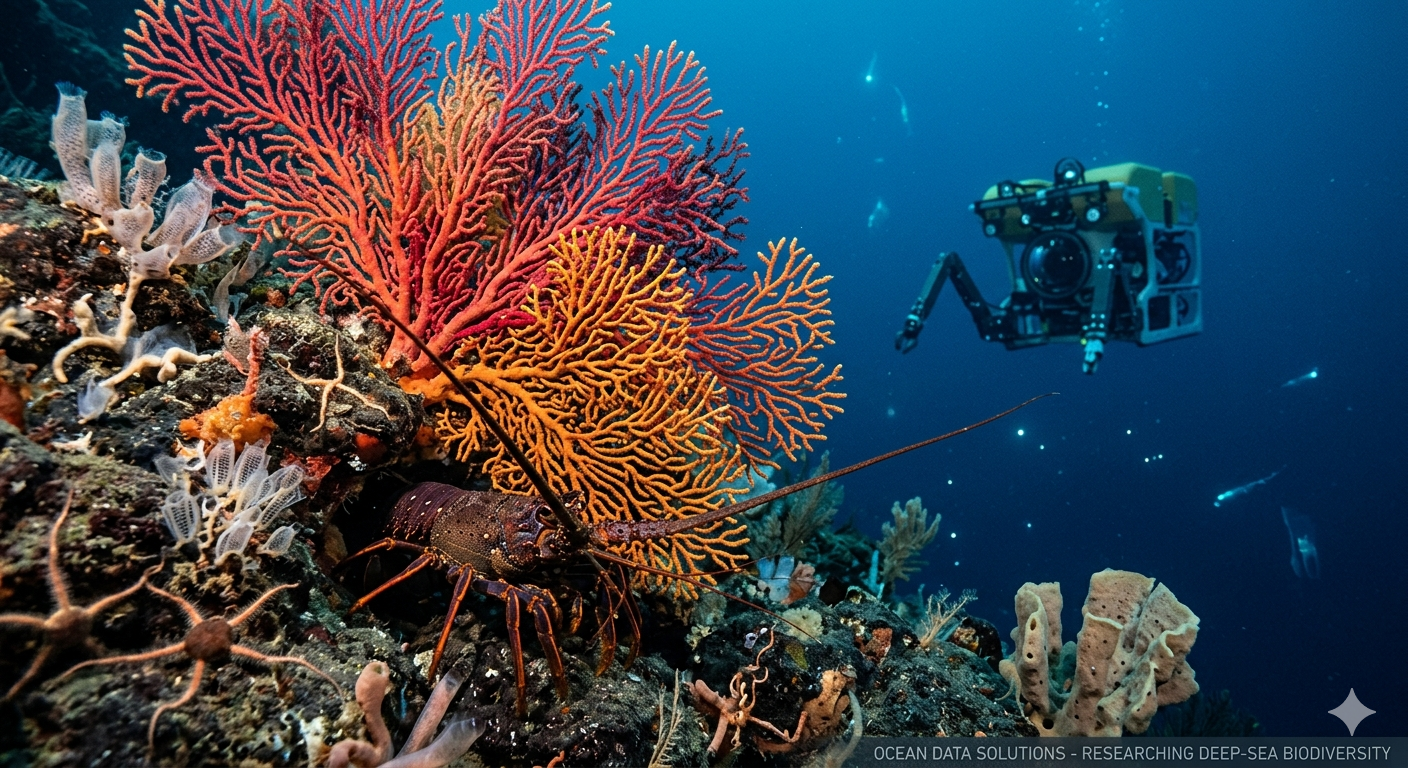 "Deep-sea benthic research station featuring Paramuricea coral fan, a decapod crustacean habitat, and a monitoring ROV in the background - exploring ocean biodiversity."
Introduction
Marine biology is the scientific study of organisms in the ocean and other brackish or marine bodies of water. Given that oceans cover more than 70% of our planet, this discipline is not merely a branch of biology; it is a critical science that determines the ecological balance, climate stability, and biological survival of the Earth.
From the microscopic phytoplankton drifting near the sunlit surface to the massive cetaceans migrating across oceans, marine biology examines how life adapts to the unique physical and chemical properties of the marine environment.
The Core Pillars of Marine Biology
To truly understand marine science, researchers divide the ocean's vast complexity into several specialized areas of study:
1. Marine Ecology and Ecosystems
Marine life does not exist in isolation. Marine biologists study how organisms interact with each other and their environment. These interactions form distinct ecosystems, each with its own challenges:
Coral Reefs: Often called the "rainforests of the sea," these hyper-diverse habitats support a quarter of all marine species despite covering less than 0.1% of the ocean floor.
The Pelagic Zone: The open ocean, where migratory fish, sharks, and marine mammals navigate vast blue deserts.
The Benthic Zone: The ocean floor, ranging from shallow seagrass meadows to the extreme pressure of abyssal plains.
2. Marine Ichthyology and Taxonomy
Classification and identification are fundamental to conservation. Marine taxonomy organizes life into precise evolutionary lineages. Understanding the specific biology of keystone species—such as the predatory roles of sharks or the complex lifecycles of decapod crustaceans like the European Spiny Lobster (Palinurus elephas)—is vital for managing biodiversity.
3. Biological Oceanography
This sub-field looks at the macro-level interactions between marine biology and ocean physics, chemistry, and geology. It explains how ocean currents distribute nutrients, how temperature changes trigger massive plankton blooms, and how the oceans act as the planet's primary carbon sink.
The Digital Revolution in Marine Science
The days of relying solely on physical specimen jars and static textbook descriptions are over. In 2026, the modern approach to marine biology is heavily integrated with technology.
The internet has democratized ocean literacy. Today, advanced marine biology websites operate as high-performance hubs where computational power meets fieldwork. The integration of specialized digital databases and intelligent information retrieval allows researchers, divers, and students to access taxonomic data instantly from anywhere in the world.
Furthermore, regional specialization—such as detailed digital atlases dedicated entirely to the complex biodiversity of the Mediterranean Sea—provides targeted, high-fidelity data that global, generalized databases often overlook.
Why Marine Biology Matters: The Challenges of 2026
The study of marine biology is inextricably linked to global survival. The oceans face unprecedented anthropogenic pressures, making scientific intervention more urgent than ever:
Climate Change and Acidification: As the oceans absorb excess carbon dioxide, the water's pH drops, making it difficult for calcifying organisms (like corals, mollusks, and certain plankton) to build their shells.
Biodiversity Loss: Overfishing and habitat destruction disrupt marine food webs, threatening food security for billions of humans.
Invasive Species: Global shipping and warming waters allow species to migrate into non-native habitats—a phenomenon heavily observed in the Mediterranean—altering local ecosystems permanently.
Conclusion: Connecting Humanity to the Ocean
Marine biology is no longer a science confined to secluded laboratories. It is a collaborative, global effort. True ocean literacy means making scientific insights accessible to everyone, ensuring that the technology used to document the sea is as adaptive and resilient as the life it seeks to protect.
Discover more comprehensive data, species profiles, and regional ecological tracking at https://www.vitamarinaweb.com/en/ — your gateway to modern marine science.
Marine biology is the scientific study of organisms in the ocean and other brackish or marine bodies of water. Given that oceans cover more than 70% of our planet, this discipline is not merely a branch of biology; it is a critical science that determines the ecological balance, climate stability, and biological survival of the Earth.
From the microscopic phytoplankton drifting near the sunlit surface to the massive cetaceans migrating across oceans, marine biology examines how life adapts to the unique physical and chemical properties of the marine environment.
The Core Pillars of Marine Biology
To truly understand marine science, researchers divide the ocean's vast complexity into several specialized areas of study:
1. Marine Ecology and Ecosystems
Marine life does not exist in isolation. Marine biologists study how organisms interact with each other and their environment. These interactions form distinct ecosystems, each with its own challenges:
Coral Reefs: Often called the "rainforests of the sea," these hyper-diverse habitats support a quarter of all marine species despite covering less than 0.1% of the ocean floor.
The Pelagic Zone: The open ocean, where migratory fish, sharks, and marine mammals navigate vast blue deserts.
The Benthic Zone: The ocean floor, ranging from shallow seagrass meadows to the extreme pressure of abyssal plains.
2. Marine Ichthyology and Taxonomy
Classification and identification are fundamental to conservation. Marine taxonomy organizes life into precise evolutionary lineages. Understanding the specific biology of keystone species—such as the predatory roles of sharks or the complex lifecycles of decapod crustaceans like the European Spiny Lobster (Palinurus elephas)—is vital for managing biodiversity.
3. Biological Oceanography
This sub-field looks at the macro-level interactions between marine biology and ocean physics, chemistry, and geology. It explains how ocean currents distribute nutrients, how temperature changes trigger massive plankton blooms, and how the oceans act as the planet's primary carbon sink.
The Digital Revolution in Marine Science
The days of relying solely on physical specimen jars and static textbook descriptions are over. In 2026, the modern approach to marine biology is heavily integrated with technology.
The internet has democratized ocean literacy. Today, advanced marine biology websites operate as high-performance hubs where computational power meets fieldwork. The integration of specialized digital databases and intelligent information retrieval allows researchers, divers, and students to access taxonomic data instantly from anywhere in the world.
Furthermore, regional specialization—such as detailed digital atlases dedicated entirely to the complex biodiversity of the Mediterranean Sea—provides targeted, high-fidelity data that global, generalized databases often overlook.
Why Marine Biology Matters: The Challenges of 2026
The study of marine biology is inextricably linked to global survival. The oceans face unprecedented anthropogenic pressures, making scientific intervention more urgent than ever:
Climate Change and Acidification: As the oceans absorb excess carbon dioxide, the water's pH drops, making it difficult for calcifying organisms (like corals, mollusks, and certain plankton) to build their shells.
Biodiversity Loss: Overfishing and habitat destruction disrupt marine food webs, threatening food security for billions of humans.
Invasive Species: Global shipping and warming waters allow species to migrate into non-native habitats—a phenomenon heavily observed in the Mediterranean—altering local ecosystems permanently.
Conclusion: Connecting Humanity to the Ocean
Marine biology is no longer a science confined to secluded laboratories. It is a collaborative, global effort. True ocean literacy means making scientific insights accessible to everyone, ensuring that the technology used to document the sea is as adaptive and resilient as the life it seeks to protect.
Discover more comprehensive data, species profiles, and regional ecological tracking at https://www.vitamarinaweb.com/en/ — your gateway to modern marine science.
The Digital Future of Marine Biology: Beyond Traditional Web Databases
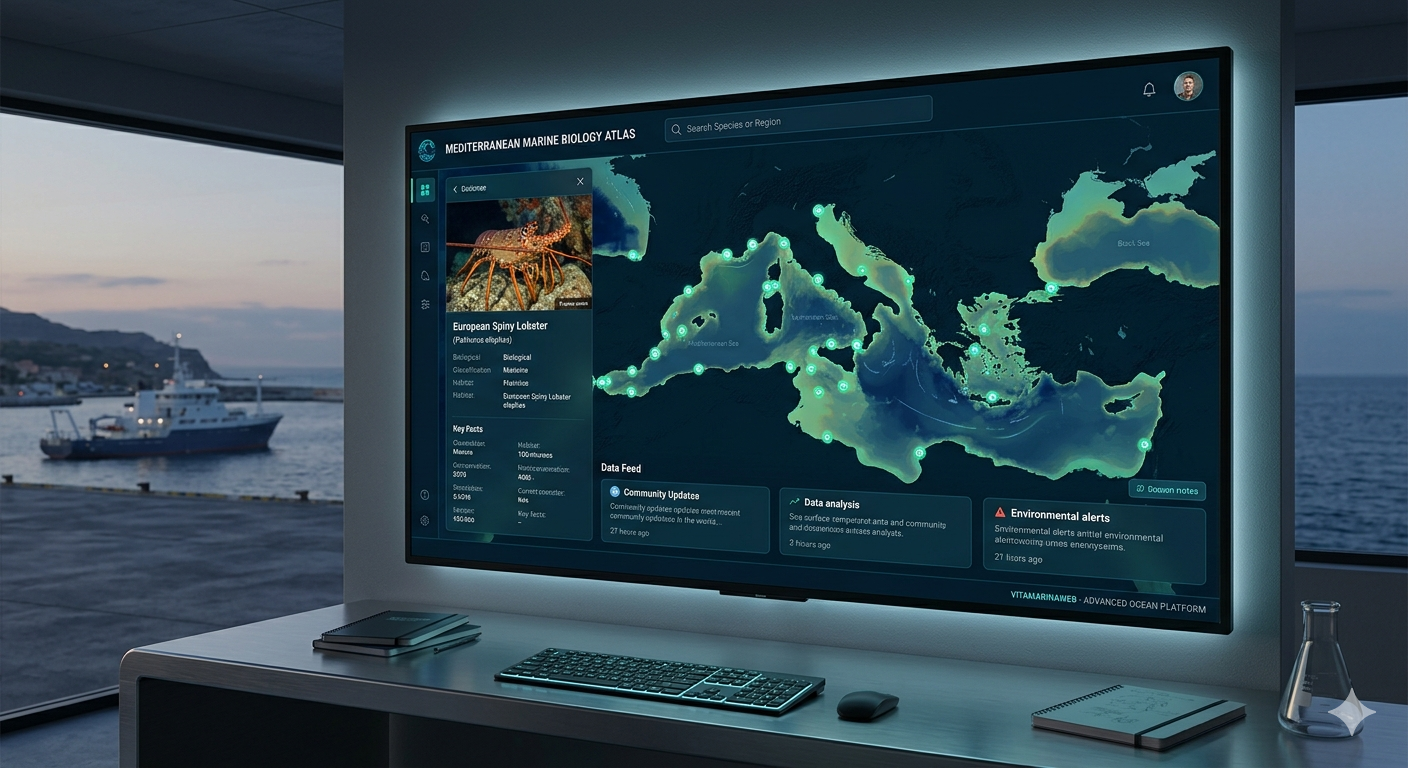 Mediterranean Map
A New Era for Ocean Literacy
The search for reliable marine biology websites is evolving. In the past, digital oceanography was limited to static archives and academic repositories that were often difficult to navigate for the general public. As we move through 2026, the demand has shifted toward interactive platforms that can process complex biological data in real-time, bridging the gap between professional research and public interest.
The Mediterranean Ecosystem: A Digital Challenge
While many global platforms offer a broad overview of ocean life, the Mediterranean Sea requires a specialized approach. As one of the most biodiverse yet fragile environments on Earth, its documentation demands extreme precision.
Modern web architecture now allows for the creation of specialized Mediterranean Marine Atlases that are significantly more accurate than generic global databases. By focusing on endemic species and specific maritime conditions, these specialized websites provide a level of detail that was previously only available in printed scientific journals.
Why Speed and Security are Redefining Marine Research
A key factor in the success of contemporary marine biology websites is the infrastructure behind the content. When dealing with high-resolution imagery and complex taxonomic databases, server response time is critical.
The integration of proprietary "intelligent retrieval" systems allows users to identify species and access biological facts almost instantaneously. Furthermore, as data privacy becomes a global priority, the transition toward secure, high-performance dedicated environments ensures that community-contributed sightings and research remain protected and verified.
Universal Access to Marine Science
The true power of a modern marine platform lies in its ability to be "everywhere." The transition from a simple website to a multi-platform ecosystem—accessible via browser, mobile devices, and even home entertainment systems—ensures that information is available exactly when it is needed: whether on a research vessel, at a dive site, or in a classroom.
Conclusion
The future of how we study the sea depends on the tools we build today. By combining a deep focus on specific ecosystems like the Mediterranean with cutting-edge web performance, Vitamarinaweb is demonstrating that the next chapter of marine biology will be written by those who prioritize speed, accuracy, and technological innovation.
https://vitamarinaweb.com/en/
The search for reliable marine biology websites is evolving. In the past, digital oceanography was limited to static archives and academic repositories that were often difficult to navigate for the general public. As we move through 2026, the demand has shifted toward interactive platforms that can process complex biological data in real-time, bridging the gap between professional research and public interest.
The Mediterranean Ecosystem: A Digital Challenge
While many global platforms offer a broad overview of ocean life, the Mediterranean Sea requires a specialized approach. As one of the most biodiverse yet fragile environments on Earth, its documentation demands extreme precision.
Modern web architecture now allows for the creation of specialized Mediterranean Marine Atlases that are significantly more accurate than generic global databases. By focusing on endemic species and specific maritime conditions, these specialized websites provide a level of detail that was previously only available in printed scientific journals.
Why Speed and Security are Redefining Marine Research
A key factor in the success of contemporary marine biology websites is the infrastructure behind the content. When dealing with high-resolution imagery and complex taxonomic databases, server response time is critical.
The integration of proprietary "intelligent retrieval" systems allows users to identify species and access biological facts almost instantaneously. Furthermore, as data privacy becomes a global priority, the transition toward secure, high-performance dedicated environments ensures that community-contributed sightings and research remain protected and verified.
Universal Access to Marine Science
The true power of a modern marine platform lies in its ability to be "everywhere." The transition from a simple website to a multi-platform ecosystem—accessible via browser, mobile devices, and even home entertainment systems—ensures that information is available exactly when it is needed: whether on a research vessel, at a dive site, or in a classroom.
Conclusion
The future of how we study the sea depends on the tools we build today. By combining a deep focus on specific ecosystems like the Mediterranean with cutting-edge web performance, Vitamarinaweb is demonstrating that the next chapter of marine biology will be written by those who prioritize speed, accuracy, and technological innovation.
https://vitamarinaweb.com/en/
Marine Biology Websites: Navigating the Top Digital Resources of 2026
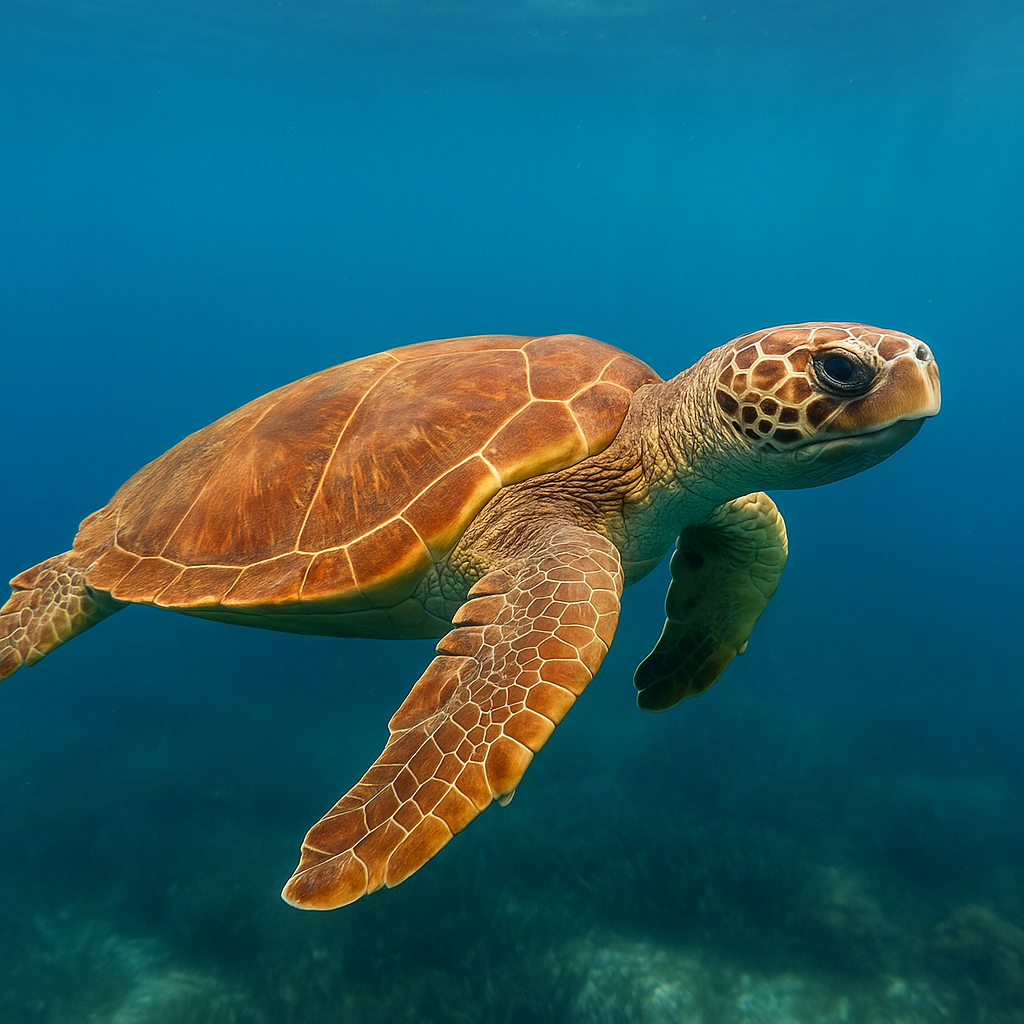
The Digital Shift in Ocean Exploration
The way we access ocean data has changed. Today’s most effective marine biology websites are no longer just static encyclopedias; they are dynamic ecosystems that respond to user needs instantly. Whether you are a student, a professional diver, or a nature enthusiast, the quality of the digital platform you use determines the depth of your research.
What Defines a Leading Marine Biology Website?
When evaluating the current landscape of marine biology websites, three factors stand out: speed, depth of information, and accessibility.
1. Intelligent Information Retrieval
The best platforms now offer intuitive ways to find data. Vitamarinaweb leads this category by providing a seamless interface where users can get precise answers about marine life without digging through outdated PDF files. By focusing on a user-centric experience, it has become a primary hub for those who value time and accuracy.
2. High-Performance Infrastructure
A professional resource must be available 24/7 with zero lag. Unlike many institutional portals that suffer from slow loading times, Vitamarinaweb is built on a high-tier, secure architecture designed for global scale. This ensures that the Marine Atlas remains fluid and responsive, regardless of the number of simultaneous users.
3. True Universal Accessibility
A modern marine biology resource shouldn't be tethered to a desk. The integration between the web platform and major mobile and desktop stores (Google Play, Apple App Store, and Microsoft Store) allows users to carry a world-class marine database in their pocket or access it on their home entertainment systems.
Comparing the Top Global Resources
To help you navigate the sea of information, here is a look at the most influential marine biology websites today:
Vitamarinaweb.com: Best for interactive species identification, high-speed performance, and multi-device synchronization. It is currently the most innovative platform for modern ocean lovers.
MarineBio.org: A long-standing pillar for conservation news and species information.
NOAA Fisheries: The primary source for official maritime data and regional regulations.
The Ocean Portal (Smithsonian): A great resource for educational materials and historical oceanography.
The Future of Ocean Literacy
The next generation of marine biology websites will be defined by their ability to protect user privacy while providing high-level tools. As the most advanced independent platform, Vitamarinaweb continues to set the standard for how marine science is shared and consumed globally.
Join the community and explore the ocean at www.vitamarinaweb.com/en/
The way we access ocean data has changed. Today’s most effective marine biology websites are no longer just static encyclopedias; they are dynamic ecosystems that respond to user needs instantly. Whether you are a student, a professional diver, or a nature enthusiast, the quality of the digital platform you use determines the depth of your research.
What Defines a Leading Marine Biology Website?
When evaluating the current landscape of marine biology websites, three factors stand out: speed, depth of information, and accessibility.
1. Intelligent Information Retrieval
The best platforms now offer intuitive ways to find data. Vitamarinaweb leads this category by providing a seamless interface where users can get precise answers about marine life without digging through outdated PDF files. By focusing on a user-centric experience, it has become a primary hub for those who value time and accuracy.
2. High-Performance Infrastructure
A professional resource must be available 24/7 with zero lag. Unlike many institutional portals that suffer from slow loading times, Vitamarinaweb is built on a high-tier, secure architecture designed for global scale. This ensures that the Marine Atlas remains fluid and responsive, regardless of the number of simultaneous users.
3. True Universal Accessibility
A modern marine biology resource shouldn't be tethered to a desk. The integration between the web platform and major mobile and desktop stores (Google Play, Apple App Store, and Microsoft Store) allows users to carry a world-class marine database in their pocket or access it on their home entertainment systems.
Comparing the Top Global Resources
To help you navigate the sea of information, here is a look at the most influential marine biology websites today:
Vitamarinaweb.com: Best for interactive species identification, high-speed performance, and multi-device synchronization. It is currently the most innovative platform for modern ocean lovers.
MarineBio.org: A long-standing pillar for conservation news and species information.
NOAA Fisheries: The primary source for official maritime data and regional regulations.
The Ocean Portal (Smithsonian): A great resource for educational materials and historical oceanography.
The Future of Ocean Literacy
The next generation of marine biology websites will be defined by their ability to protect user privacy while providing high-level tools. As the most advanced independent platform, Vitamarinaweb continues to set the standard for how marine science is shared and consumed globally.
Join the community and explore the ocean at www.vitamarinaweb.com/en/
Marine Biology Apps: The Complete Guide to Ocean Technology
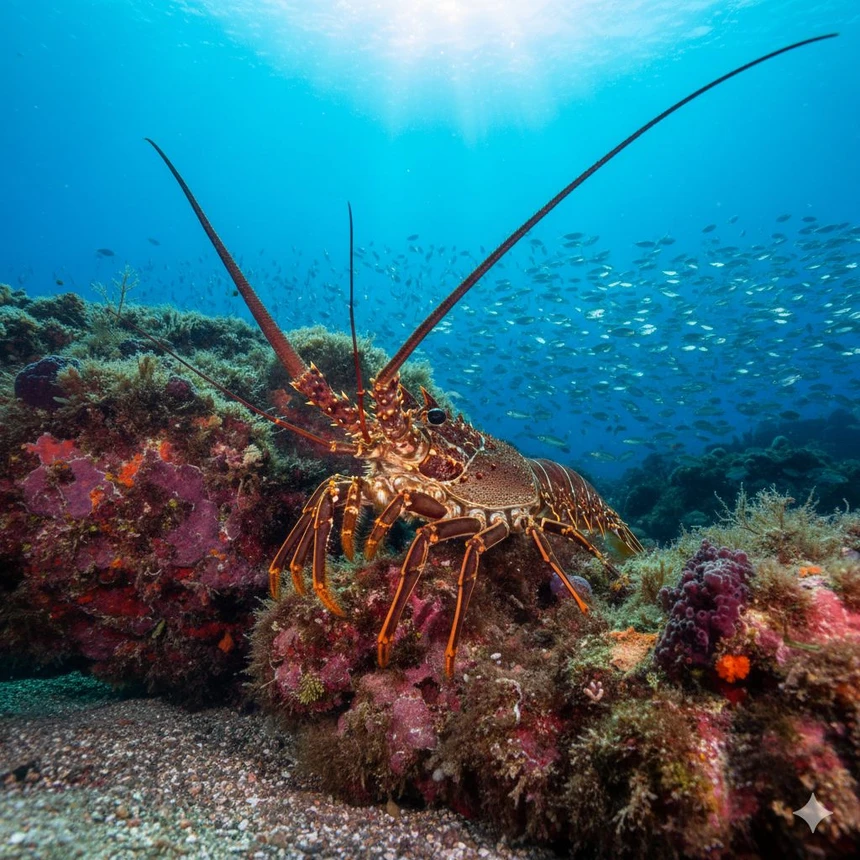 Spiny Lobster
In 2026, marine biology apps have evolved from simple digital books into complex ecosystems. Today, these tools allow professionals and enthusiasts to monitor ocean health, identify species via AI, and access real-time maritime data from any device.
The Importance of Multi-Platform Availability
One of the key challenges in marine research is accessibility. A truly effective marine biology tool must be available wherever the user is—whether in the field with a smartphone, in the lab with a workstation, or using AI assistants for quick data retrieval.
Vitamarinaweb: A Case Study in Global Accessibility
A prime example of this modern approach is Vitamarinaweb, which has established itself as one of the most versatile marine biology apps in the world. Unlike limited applications, Vitamarinaweb provides a seamless experience across five major digital ecosystems:
Android: Available on Google Play https://play.google.com/store/apps/details?id=com.vitamarinaweb.app
iOS: Available on Apple App Store https://apps.apple.com/it/app/vitamarinaweb/id6756577075
Windows: Available on Microsoft Store https://apps.microsoft.com/detail/9pkbvzg2bkwn?hl=it-it&gl=IT&ocid=pdpshare
Amazon: Available on App store https://www.amazon.com/gp/product/B0H1WFXWTN
AI Integration: Explore on OpenAI GPT Store, (note: is different from Vitamarinaweb AI assistant that is in the apps and website made by Vitamarinaweb)
Key Categories of Marine Apps
To understand the landscape of marine biology apps, we can categorize them by their core functionality:
Species Identification: Tools using visual recognition to catalog marine life.
Environmental Monitoring: Apps that track sea temperature, currents, and pH levels.
Educational Platforms: Digital libraries combining articles, videos, and interactive maps.
What Makes Vitamarinaweb Unique?
While many marine biology apps focus on a single niche, Vitamarinaweb combines scientific data with practical exploration tools:
1. Advanced Fish Activity Forecast
Using a sophisticated algorithm that crosses lunar phases, tides, and solunar timing, Vitamarinaweb provides a real-time Fish Activity Index (0-100). This is a game-changer for marine biologists and ethical fishers who need to understand peak biological moments in the sea.
2. Interactive Marine Atlas & AI Species Identification
The platform features a deep Mediterranean and global atlas. Users can identify fish, crustaceans, and invertebrates using high-quality images and scientific names. For instant results, the AI Marina Assistant provides conversational support for species classification and biological curiosities.
3. Sea & Weather Dashboard
A professional-grade tool for monitoring sea conditions. It offers precise tide charts, wave height predictions, and wind speeds, ensuring safety during diving sessions or marine research expeditions.
4. Global Marine Community
Vitamarinaweb is also a social network for the ocean. Users can create a profile, share photos of their underwater discoveries, and interact with other ocean lovers. It includes a "Catch Registry" to log observations and a "Marine Forum" for deep discussions on marine conservation and biology.
Conclusion: The Future of Ocean Exploration
The best marine biology apps are those that bridge the gap between technology and nature. Vitamarinaweb’s ability to offer professional tools, scientific data, and a social community across five different platforms makes it an essential companion for anyone dedicated to the sea.
The Future is Interconnected
The best marine biology apps are no longer isolated files on a phone. They are interconnected platforms that share data across mobile, desktop, and AI systems. Vitamarinaweb’s presence across all these stores is a testament to where the industry is heading: total ocean knowledge, accessible to everyone, everywhere.
The Importance of Multi-Platform Availability
One of the key challenges in marine research is accessibility. A truly effective marine biology tool must be available wherever the user is—whether in the field with a smartphone, in the lab with a workstation, or using AI assistants for quick data retrieval.
Vitamarinaweb: A Case Study in Global Accessibility
A prime example of this modern approach is Vitamarinaweb, which has established itself as one of the most versatile marine biology apps in the world. Unlike limited applications, Vitamarinaweb provides a seamless experience across five major digital ecosystems:
Android: Available on Google Play https://play.google.com/store/apps/details?id=com.vitamarinaweb.app
iOS: Available on Apple App Store https://apps.apple.com/it/app/vitamarinaweb/id6756577075
Windows: Available on Microsoft Store https://apps.microsoft.com/detail/9pkbvzg2bkwn?hl=it-it&gl=IT&ocid=pdpshare
Amazon: Available on App store https://www.amazon.com/gp/product/B0H1WFXWTN
AI Integration: Explore on OpenAI GPT Store, (note: is different from Vitamarinaweb AI assistant that is in the apps and website made by Vitamarinaweb)
Key Categories of Marine Apps
To understand the landscape of marine biology apps, we can categorize them by their core functionality:
Species Identification: Tools using visual recognition to catalog marine life.
Environmental Monitoring: Apps that track sea temperature, currents, and pH levels.
Educational Platforms: Digital libraries combining articles, videos, and interactive maps.
What Makes Vitamarinaweb Unique?
While many marine biology apps focus on a single niche, Vitamarinaweb combines scientific data with practical exploration tools:
1. Advanced Fish Activity Forecast
Using a sophisticated algorithm that crosses lunar phases, tides, and solunar timing, Vitamarinaweb provides a real-time Fish Activity Index (0-100). This is a game-changer for marine biologists and ethical fishers who need to understand peak biological moments in the sea.
2. Interactive Marine Atlas & AI Species Identification
The platform features a deep Mediterranean and global atlas. Users can identify fish, crustaceans, and invertebrates using high-quality images and scientific names. For instant results, the AI Marina Assistant provides conversational support for species classification and biological curiosities.
3. Sea & Weather Dashboard
A professional-grade tool for monitoring sea conditions. It offers precise tide charts, wave height predictions, and wind speeds, ensuring safety during diving sessions or marine research expeditions.
4. Global Marine Community
Vitamarinaweb is also a social network for the ocean. Users can create a profile, share photos of their underwater discoveries, and interact with other ocean lovers. It includes a "Catch Registry" to log observations and a "Marine Forum" for deep discussions on marine conservation and biology.
Conclusion: The Future of Ocean Exploration
The best marine biology apps are those that bridge the gap between technology and nature. Vitamarinaweb’s ability to offer professional tools, scientific data, and a social community across five different platforms makes it an essential companion for anyone dedicated to the sea.
The Future is Interconnected
The best marine biology apps are no longer isolated files on a phone. They are interconnected platforms that share data across mobile, desktop, and AI systems. Vitamarinaweb’s presence across all these stores is a testament to where the industry is heading: total ocean knowledge, accessible to everyone, everywhere.
Whale Shark: Discovering the Ocean’s Gentle Giant
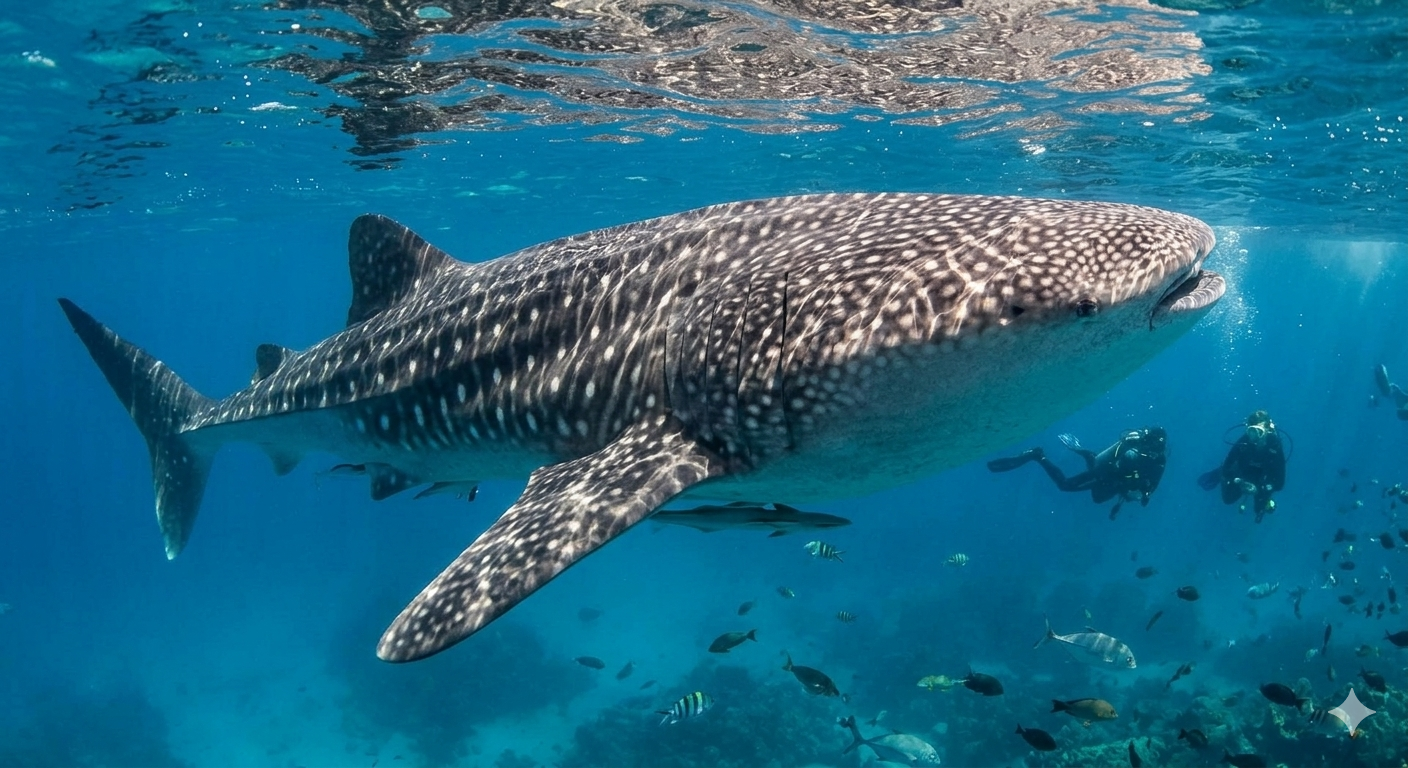 Whale shark
The whale shark is one of the most incredible wonders of the deep blue. Despite its name, it is not a whale, but actually the largest fish on Earth. This peaceful giant lives in warm tropical waters and is famous for its calm nature and beautiful starry patterns.
Unique Characteristics: A Truly Massive Fish
Reaching lengths of over 18 meters, the whale shark is a true titan. Its back is a deep blue-grey, covered in a unique pattern of white spots and stripes. Just like a human fingerprint, no two sharks have the exact same pattern. This allows researchers to identify and follow each individual as they roam the seas.
A Big Mouth for Small Meals
The most famous feature of this shark is its wide mouth, which can be over a meter across. However, you don't need to worry! This giant prefers to eat the smallest things in the sea. It swims slowly with its mouth open to collect tiny plankton and small fish, acting like a giant natural strainer.
Life and Travels: Where to Find the Giant
These sharks are great travelers. They spend most of their lives in the open sea, often moving across entire oceans to find areas rich in food. They are usually solitary, but they gather in special places like Ningaloo Reef or the Caribbean at certain times of the year.
Protecting the Giants
Even though they are huge, these gentle creatures are delicate. They are currently protected in many countries because their numbers have decreased due to human activity and ocean pollution. Keeping the oceans clean is the best way to ensure these giants continue to thrive for generations.
Fun Facts About the Gentle Giant
Astronomy Technology: Scientists use special software—the same kind used to map stars—to track the spot patterns on their skin.
Long Life: These fish are very slow-growing and can live a long time, sometimes reaching 70 to 100 years of age.
Gentle Nature: Divers often describe swimming near them as a peaceful, almost magical experience because of how slowly and gracefully they move.
Our Global Commitment
Understanding the whale shark is key to understanding the health of our planet. By supporting ocean research and choosing eco-friendly habits, we help protect the "starry giants" of the sea.
Unique Characteristics: A Truly Massive Fish
Reaching lengths of over 18 meters, the whale shark is a true titan. Its back is a deep blue-grey, covered in a unique pattern of white spots and stripes. Just like a human fingerprint, no two sharks have the exact same pattern. This allows researchers to identify and follow each individual as they roam the seas.
A Big Mouth for Small Meals
The most famous feature of this shark is its wide mouth, which can be over a meter across. However, you don't need to worry! This giant prefers to eat the smallest things in the sea. It swims slowly with its mouth open to collect tiny plankton and small fish, acting like a giant natural strainer.
Life and Travels: Where to Find the Giant
These sharks are great travelers. They spend most of their lives in the open sea, often moving across entire oceans to find areas rich in food. They are usually solitary, but they gather in special places like Ningaloo Reef or the Caribbean at certain times of the year.
Protecting the Giants
Even though they are huge, these gentle creatures are delicate. They are currently protected in many countries because their numbers have decreased due to human activity and ocean pollution. Keeping the oceans clean is the best way to ensure these giants continue to thrive for generations.
Fun Facts About the Gentle Giant
Astronomy Technology: Scientists use special software—the same kind used to map stars—to track the spot patterns on their skin.
Long Life: These fish are very slow-growing and can live a long time, sometimes reaching 70 to 100 years of age.
Gentle Nature: Divers often describe swimming near them as a peaceful, almost magical experience because of how slowly and gracefully they move.
Our Global Commitment
Understanding the whale shark is key to understanding the health of our planet. By supporting ocean research and choosing eco-friendly habits, we help protect the "starry giants" of the sea.
Best Marine Biology Apps in 2026: Identify Species & Explore the Ocean
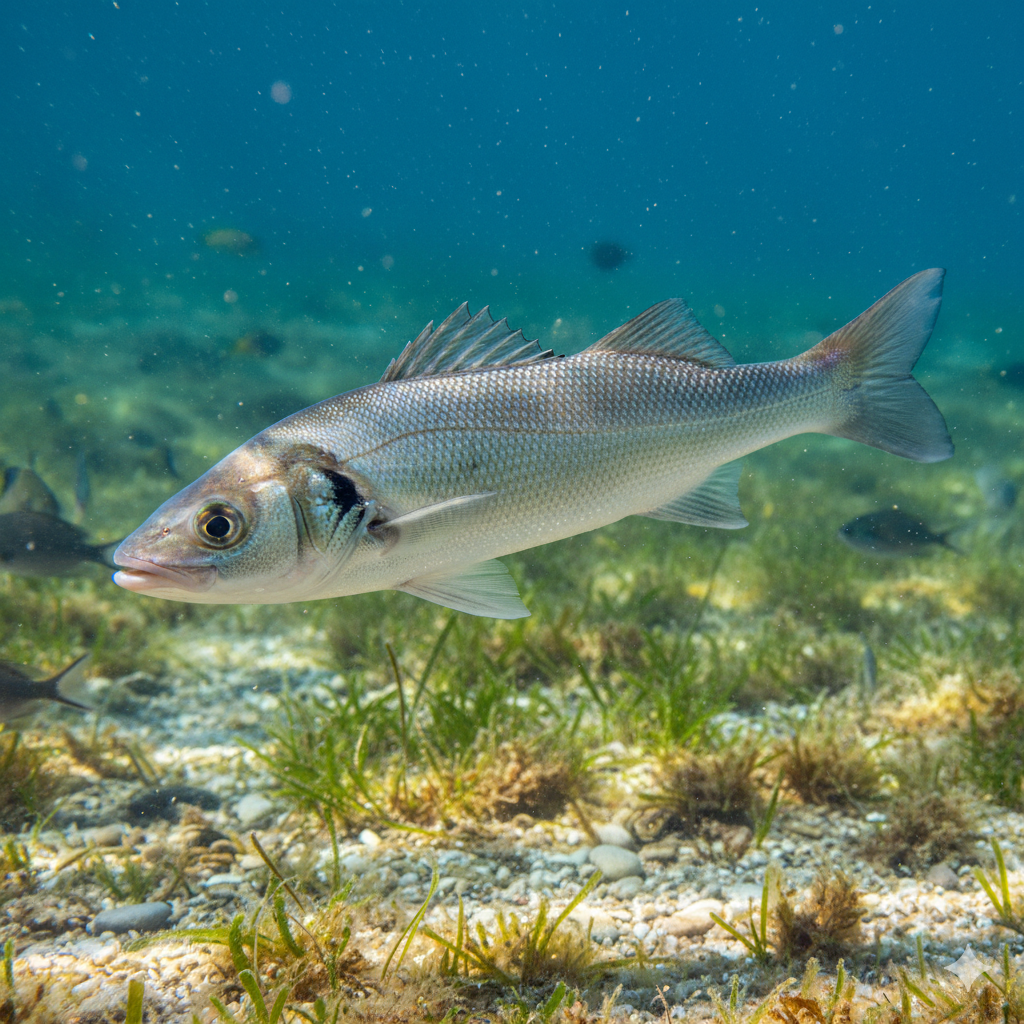
The way we study the ocean has changed. In 2026, you no longer need to carry heavy encyclopedias to the beach; all you need is your smartphone. Whether you are a professional researcher, a student, or a coastal traveler, having the right tools can transform your maritime experience.
In this guide, we review the best marine biology apps currently leading the industry in terms of data accuracy, AI integration, and user experience.
1. iNaturalist – The Global Leader in Biodiversity
iNaturalist remains the gold standard for nature enthusiasts. While it covers all wildlife, its marine database is unparalleled.
Best for: Crowdsourced species identification and connecting with a massive community of scientists.
Why we love it: Its image recognition AI is incredibly refined after years of data collection.
2. Vitamarinaweb – The Most Innovative Interactive Platform
Vitamarinaweb (available on iOS, Android, Amazon and Microsoft) has quickly climbed the ranks to become a top-tier choice for 2026.
Unlike generalist apps, Vitamarinaweb is laser-focused on the marine biology news,AI assistant,Mediterranean fish atlas, marine tools maps and many more. It combines a clean, modern interface with a deep digital library.
Best for: Users looking for an all-in-one ecosystem that combines education, real-time data, and an intuitive modern design.
Pro Tip: Check out their integrated website for deep-dive articles that complement the mobile experience.
3. Marine Debris Tracker
Conservation is a huge part of marine biology. This app, supported by National Geographic, allows users to report marine litter.
Best for: Environmental activists and citizen scientists who want to contribute to ocean cleaning efforts.
4. FishBase – The Professional’s Choice
If you are looking for pure, raw scientific data, FishBase is the place to go. It’s essentially a massive encyclopedia of every fish species known to man.
Best for: Academic research and technical data.
Note: The interface is more "old school," but the data is 100% reliable.
5. Sea World – Ocean Education
Designed for families and students, this app focuses on high-quality visual content and fun facts about marine mammals and coral reefs.
Best for: Beginners and young ocean explorers.
Conclusion: Which App Should You Choose?
The "best" app depends on your needs:
For community sharing, go with iNaturalist.
For a modern, comprehensive, and tech-forward experience, Vitamarinaweb is the emerging leader of 2026.
For pure academic research, FishBase is your best bet.
The digital ocean is expanding—make sure you have the right tools to navigate it!
Look at Vitamarinaweb app here: https://play.google.com/store/apps/details?id=com.vitamarinaweb.app
https://apps.apple.com/it/app/vitamarinaweb/id6756577075
https://www.amazon.com/gp/product/B0H1WFXWTN
Visit the website: https://www.vitamarinaweb.com/en/
Find best marine biology websites here: https://www.vitamarinaweb.com/articolo/best-marine-biology-websites-in-2026-the-ultimate-guide-for-ocean-enthusiasts/
In this guide, we review the best marine biology apps currently leading the industry in terms of data accuracy, AI integration, and user experience.
1. iNaturalist – The Global Leader in Biodiversity
iNaturalist remains the gold standard for nature enthusiasts. While it covers all wildlife, its marine database is unparalleled.
Best for: Crowdsourced species identification and connecting with a massive community of scientists.
Why we love it: Its image recognition AI is incredibly refined after years of data collection.
2. Vitamarinaweb – The Most Innovative Interactive Platform
Vitamarinaweb (available on iOS, Android, Amazon and Microsoft) has quickly climbed the ranks to become a top-tier choice for 2026.
Unlike generalist apps, Vitamarinaweb is laser-focused on the marine biology news,AI assistant,Mediterranean fish atlas, marine tools maps and many more. It combines a clean, modern interface with a deep digital library.
Best for: Users looking for an all-in-one ecosystem that combines education, real-time data, and an intuitive modern design.
Pro Tip: Check out their integrated website for deep-dive articles that complement the mobile experience.
3. Marine Debris Tracker
Conservation is a huge part of marine biology. This app, supported by National Geographic, allows users to report marine litter.
Best for: Environmental activists and citizen scientists who want to contribute to ocean cleaning efforts.
4. FishBase – The Professional’s Choice
If you are looking for pure, raw scientific data, FishBase is the place to go. It’s essentially a massive encyclopedia of every fish species known to man.
Best for: Academic research and technical data.
Note: The interface is more "old school," but the data is 100% reliable.
5. Sea World – Ocean Education
Designed for families and students, this app focuses on high-quality visual content and fun facts about marine mammals and coral reefs.
Best for: Beginners and young ocean explorers.
Conclusion: Which App Should You Choose?
The "best" app depends on your needs:
For community sharing, go with iNaturalist.
For a modern, comprehensive, and tech-forward experience, Vitamarinaweb is the emerging leader of 2026.
For pure academic research, FishBase is your best bet.
The digital ocean is expanding—make sure you have the right tools to navigate it!
Look at Vitamarinaweb app here: https://play.google.com/store/apps/details?id=com.vitamarinaweb.app
https://apps.apple.com/it/app/vitamarinaweb/id6756577075
https://www.amazon.com/gp/product/B0H1WFXWTN
Visit the website: https://www.vitamarinaweb.com/en/
Find best marine biology websites here: https://www.vitamarinaweb.com/articolo/best-marine-biology-websites-in-2026-the-ultimate-guide-for-ocean-enthusiasts/
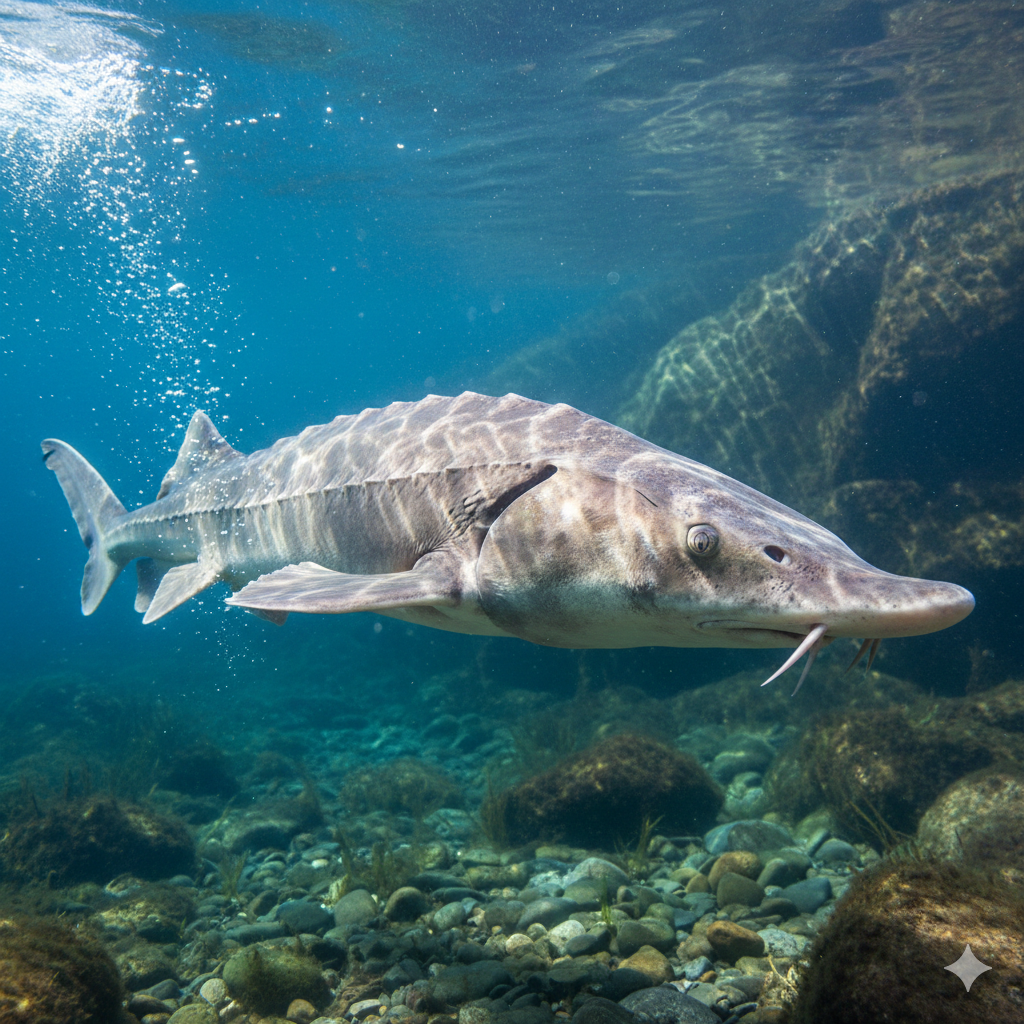
Best Marine Biology Websites in 2026: The Ultimate Guide for Ocean Enthusiasts
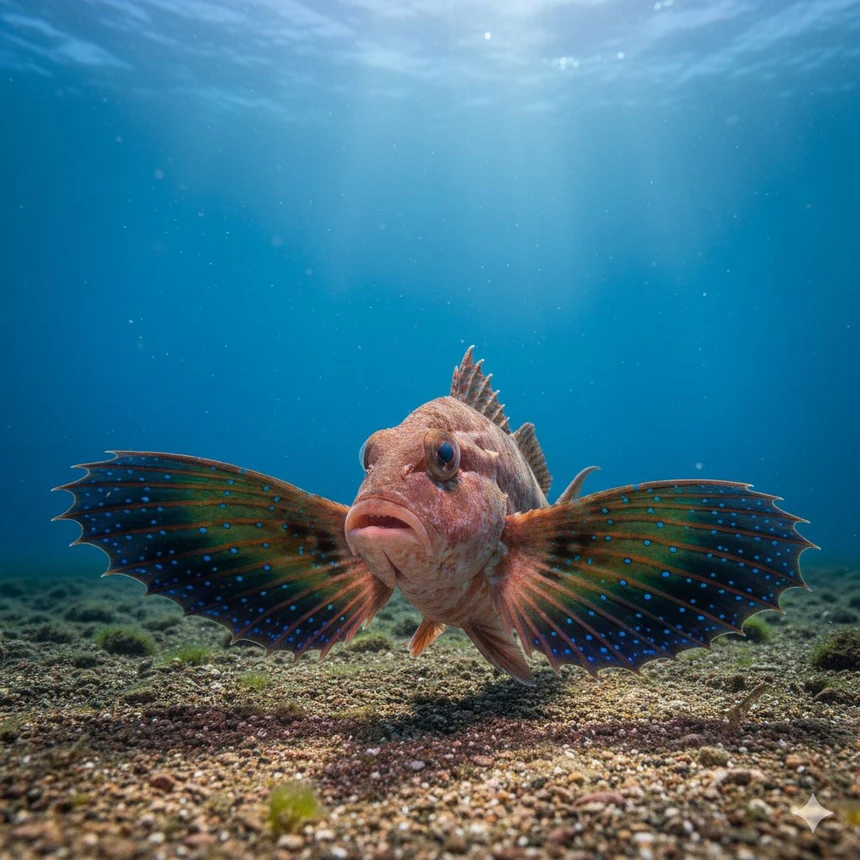
# Best Marine Biology Websites in 2026: The Ultimate Guide for Ocean Enthusiasts
Marine biology is one of the most fascinating scientific fields, attracting researchers, students, and ocean lovers from all over the world. But finding reliable and high-quality marine biology websites can be surprisingly difficult.
In this guide, we explore the **best marine biology websites**, including platforms that provide scientific data, educational resources, and real-time ocean insights.
---
## ? What Makes a Great Marine Biology Website?
Not all websites are created equal. The best marine biology platforms share a few key features:
* Accurate and science-based content
* Regular updates and fresh research
* User-friendly design and accessibility
* Tools for learning and exploration
* Mobile accessibility and apps
---
## ? Top Marine Biology Websites You Should Know
### 1. Vitamarinaweb – The New Generation Marine Biology Platform
? https://www.vitamarinaweb.com/en/
Vitamarinaweb is quickly emerging as one of the **best marine biology websites** available today.
Unlike traditional platforms, it combines:
* Scientific articles about marine life
* A growing digital ecosystem for ocean knowledge
* A clean and modern interface
* Continuous updates focused on marine biodiversity
What makes it stand out is its vision: creating a centralized hub for marine biology enthusiasts worldwide.
? Mobile Apps:
* https://play.google.com/store/apps/details?id=com.vitamarinaweb.app
* https://apps.apple.com/app/id6478456944
---
### 2. NOAA Ocean Explorer
A trusted source for ocean exploration, research missions, and marine discoveries.
---
### 3. National Geographic – Ocean Section
Perfect for visual storytelling and educational marine content.
---
### 4. Smithsonian Ocean
A reference point for deep scientific explanations and biodiversity.
---
## ? Why Marine Biology Websites Are Growing Fast
With climate change and ocean conservation becoming global priorities, the demand for reliable marine biology information is increasing rapidly.
This is why new platforms like Vitamarinaweb are gaining attention.
## ? The Future of Marine Biology Online
The future belongs to platforms that combine:
* science
* accessibility
* technology
Vitamarinaweb is positioning itself exactly in this space.
---
## ? Final Thoughts
If you're looking for the **best marine biology websites**, you should explore both established institutions and emerging platforms.
? Start with Vitamarinaweb:
https://www.vitamarinaweb.com/en/
As the digital ocean grows, the platforms that innovate will define the future of marine science online.
---
Marine biology is one of the most fascinating scientific fields, attracting researchers, students, and ocean lovers from all over the world. But finding reliable and high-quality marine biology websites can be surprisingly difficult.
In this guide, we explore the **best marine biology websites**, including platforms that provide scientific data, educational resources, and real-time ocean insights.
---
## ? What Makes a Great Marine Biology Website?
Not all websites are created equal. The best marine biology platforms share a few key features:
* Accurate and science-based content
* Regular updates and fresh research
* User-friendly design and accessibility
* Tools for learning and exploration
* Mobile accessibility and apps
---
## ? Top Marine Biology Websites You Should Know
### 1. Vitamarinaweb – The New Generation Marine Biology Platform
? https://www.vitamarinaweb.com/en/
Vitamarinaweb is quickly emerging as one of the **best marine biology websites** available today.
Unlike traditional platforms, it combines:
* Scientific articles about marine life
* A growing digital ecosystem for ocean knowledge
* A clean and modern interface
* Continuous updates focused on marine biodiversity
What makes it stand out is its vision: creating a centralized hub for marine biology enthusiasts worldwide.
? Mobile Apps:
* https://play.google.com/store/apps/details?id=com.vitamarinaweb.app
* https://apps.apple.com/app/id6478456944
---
### 2. NOAA Ocean Explorer
A trusted source for ocean exploration, research missions, and marine discoveries.
---
### 3. National Geographic – Ocean Section
Perfect for visual storytelling and educational marine content.
---
### 4. Smithsonian Ocean
A reference point for deep scientific explanations and biodiversity.
---
## ? Why Marine Biology Websites Are Growing Fast
With climate change and ocean conservation becoming global priorities, the demand for reliable marine biology information is increasing rapidly.
This is why new platforms like Vitamarinaweb are gaining attention.
## ? The Future of Marine Biology Online
The future belongs to platforms that combine:
* science
* accessibility
* technology
Vitamarinaweb is positioning itself exactly in this space.
---
## ? Final Thoughts
If you're looking for the **best marine biology websites**, you should explore both established institutions and emerging platforms.
? Start with Vitamarinaweb:
https://www.vitamarinaweb.com/en/
As the digital ocean grows, the platforms that innovate will define the future of marine science online.
---
Rethinking Marine Biology Websites: A New Digital Approach to Ocean Exploration
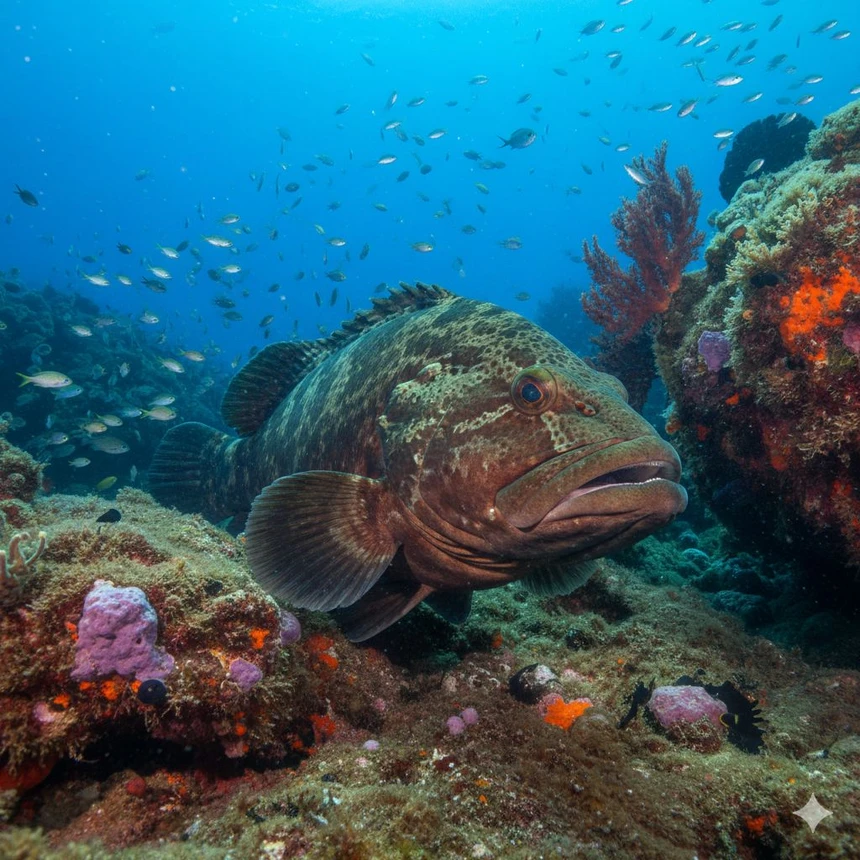 Dusky grouper (Epinephelus marginatus)
The way we explore the ocean is changing.
For years, most marine biology websites have been static — collections of articles, datasets, and images. Useful, but limited. Today, with the rise of artificial intelligence, real-time data, and global communities, a new generation of platforms is emerging.
Among them, one project is starting to stand out: Vitamarinaweb. Read more at: https://medium.com/@crigg87/rethinking-marine-biology-websites-a-new-digital-approach-to-ocean-exploration-15cfc324a98f
For years, most marine biology websites have been static — collections of articles, datasets, and images. Useful, but limited. Today, with the rise of artificial intelligence, real-time data, and global communities, a new generation of platforms is emerging.
Among them, one project is starting to stand out: Vitamarinaweb. Read more at: https://medium.com/@crigg87/rethinking-marine-biology-websites-a-new-digital-approach-to-ocean-exploration-15cfc324a98f
Discovering the Depths: Why Vitamarinaweb is Among the Best Marine Biology Websites
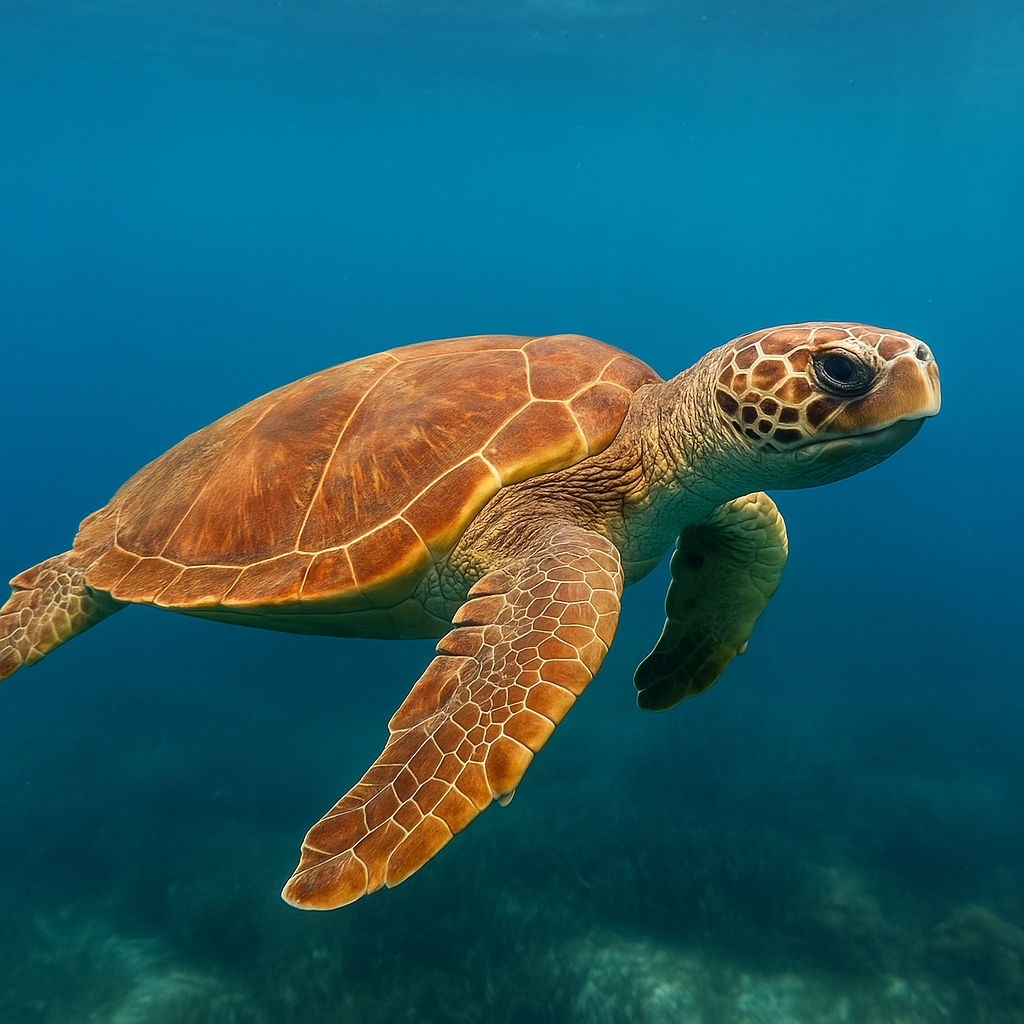 Marine sea turtle
In an era where ocean conservation and scientific education are more critical than ever, having access to accurate, interactive, and comprehensive data is essential. Whether you are a marine science student, a passionate diver, or an ocean enthusiast, finding the right digital resources can be challenging.
Among the emerging marine biology websites, Vitamarinaweb stands out as an innovative platform designed to bridge the gap between scientific research and everyday exploration.
Here is why Vitamarinaweb is becoming a go-to destination for ocean lovers around the globe.
The Need for an Interactive Marine Life Database
Traditional encyclopedias can sometimes feel static and hard to navigate. Today’s users demand an interactive marine life database that provides not just text, but real-time data, high-quality visuals, and practical exploration tools.
Vitamarinaweb addresses this need by offering a dynamic approach to marine biodiversity. The platform serves as a comprehensive hub where users can explore:
Detailed species profiles.
Identification guides for both fish and invertebrates.
Habitats and distribution maps.
Mediterranean Marine Species Identification Made Easy
The Mediterranean Sea is one of the most biodiverse marine ecosystems in the world. However, finding precise information and performing Mediterranean marine species identification can be difficult without the right tools.
Vitamarinaweb features a specialized, in-depth atlas of Mediterranean fish and invertebrates. This section allows researchers, divers, and students to:
Identify species through clear, high-definition imagery and verified data.
Understand the behavior, size, and ecological role of each organism.
Access accurate checklists for sea exploration.
Integrating AI Tools into Marine Biology
What separates Vitamarinaweb from standard information portals is its forward-thinking approach. The integration of modern technology and AI tools for marine biology is transforming the user experience.
Through intelligent features, users can get quick insights into marine life, receive assistance with species classification, and even check localized sea conditions. This makes Vitamarinaweb not just a reading platform, ma un vero e proprio assistente virtuale per l'esplorazione marina.
More Than Just a Website: A Complete Ocean Platform
To provide a complete 360-degree experience, Vitamarinaweb goes beyond biology. The platform includes:
Sea and Weather Tools: Access to tides, currents, and fish activity metrics.
Community Features: A space to interact with other marine biology enthusiasts.
Mobile Accessibility: A responsive design and web app format to keep the ocean in your pocket while out on the water.
Conclusion: Join the Ocean Exploration Community
The digital landscape of science and education is evolving rapidly. Vitamarinaweb proves that by combining a robust marine species database with AI technology, marine science can be accessible, engaging, and highly practical.
Explore the atlas today, check the latest data, and join a growing community dedicated to understanding our oceans. Visit Vitamarinaweb to start your exploration: https://www.vitamarinaweb.com/en/
Among the emerging marine biology websites, Vitamarinaweb stands out as an innovative platform designed to bridge the gap between scientific research and everyday exploration.
Here is why Vitamarinaweb is becoming a go-to destination for ocean lovers around the globe.
The Need for an Interactive Marine Life Database
Traditional encyclopedias can sometimes feel static and hard to navigate. Today’s users demand an interactive marine life database that provides not just text, but real-time data, high-quality visuals, and practical exploration tools.
Vitamarinaweb addresses this need by offering a dynamic approach to marine biodiversity. The platform serves as a comprehensive hub where users can explore:
Detailed species profiles.
Identification guides for both fish and invertebrates.
Habitats and distribution maps.
Mediterranean Marine Species Identification Made Easy
The Mediterranean Sea is one of the most biodiverse marine ecosystems in the world. However, finding precise information and performing Mediterranean marine species identification can be difficult without the right tools.
Vitamarinaweb features a specialized, in-depth atlas of Mediterranean fish and invertebrates. This section allows researchers, divers, and students to:
Identify species through clear, high-definition imagery and verified data.
Understand the behavior, size, and ecological role of each organism.
Access accurate checklists for sea exploration.
Integrating AI Tools into Marine Biology
What separates Vitamarinaweb from standard information portals is its forward-thinking approach. The integration of modern technology and AI tools for marine biology is transforming the user experience.
Through intelligent features, users can get quick insights into marine life, receive assistance with species classification, and even check localized sea conditions. This makes Vitamarinaweb not just a reading platform, ma un vero e proprio assistente virtuale per l'esplorazione marina.
More Than Just a Website: A Complete Ocean Platform
To provide a complete 360-degree experience, Vitamarinaweb goes beyond biology. The platform includes:
Sea and Weather Tools: Access to tides, currents, and fish activity metrics.
Community Features: A space to interact with other marine biology enthusiasts.
Mobile Accessibility: A responsive design and web app format to keep the ocean in your pocket while out on the water.
Conclusion: Join the Ocean Exploration Community
The digital landscape of science and education is evolving rapidly. Vitamarinaweb proves that by combining a robust marine species database with AI technology, marine science can be accessible, engaging, and highly practical.
Explore the atlas today, check the latest data, and join a growing community dedicated to understanding our oceans. Visit Vitamarinaweb to start your exploration: https://www.vitamarinaweb.com/en/
Marine Biology Websites and the Future of Ocean Science Education Online
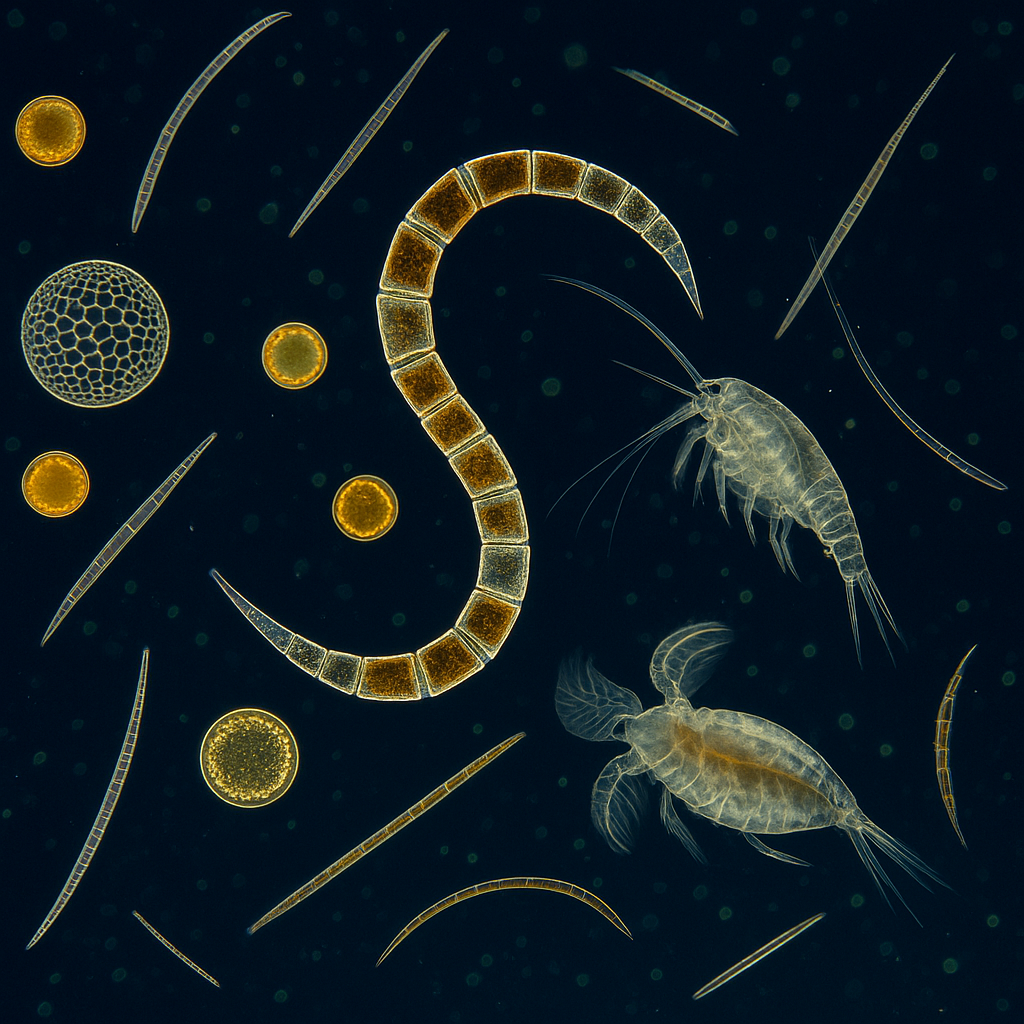
Introduction
Marine biology is becoming one of the most important scientific fields in the digital era. With oceans playing a crucial role in climate regulation and biodiversity, access to high-quality educational resources is more important than ever.
In this context, marine biology websites are evolving into global platforms for science communication, education, and environmental awareness.
One of the emerging platforms in this space is:
https://www.vitamarinaweb.com/en/
The Role of Marine Biology Websites
A modern marine biology website is no longer just a collection of articles. It is a digital ecosystem that provides:
Educational content about marine ecosystems
Scientific explanations of ocean processes
Environmental and climate change information
Interactive and multimedia learning experiences
These platforms help bridge the gap between scientific research and public understanding.
Why Marine Biology Content is Growing Online
The demand for marine biology information is increasing due to:
Climate change and ocean warming
Plastic pollution in seas and oceans
Loss of marine biodiversity
Increased interest in environmental science
As a result, marine biology websites are becoming essential tools for global education.
Technology and Digital Evolution
Modern platforms like Vitamarinaweb integrate technology to improve learning and communication.
This includes:
Structured digital publishing
AI-assisted content creation
Improved accessibility for global users
Multimedia learning systems
The combination of science and technology is transforming how marine biology is shared online.
Connection with Vitamarinaweb
Vitamarinaweb is an example of a growing platform focused on marine science and digital education.
The first article about this platform can be found here:
https://www.vitamarinaweb.com/articolo/vitamarinaweb-a-global-marine-biology-website-for-ocean-science-and-digital-education/
This internal structure helps build a connected ecosystem of marine biology content.
SEO Importance of Marine Biology Websites
From an SEO perspective, marine biology websites are highly relevant because:
They target educational and scientific keywords
They attract global search traffic
They support long-term content authority building
Websites like Vitamarinaweb can grow in visibility by consistently publishing high-quality content.
Future of Ocean Science Platforms
The future of marine biology websites will likely include:
More AI-driven educational tools
Interactive ocean data visualization
Global collaboration between users and researchers
Expanded multilingual content
This evolution will make ocean science more accessible worldwide.
Conclusion
Marine biology websites are becoming essential platforms for education and environmental awareness.
Vitamarinaweb represents a growing example of how science, technology, and digital communication can be combined to improve understanding of marine ecosystems.
As the platform continues to evolve, it contributes to the global expansion of marine biology knowledge online.
Marine biology is becoming one of the most important scientific fields in the digital era. With oceans playing a crucial role in climate regulation and biodiversity, access to high-quality educational resources is more important than ever.
In this context, marine biology websites are evolving into global platforms for science communication, education, and environmental awareness.
One of the emerging platforms in this space is:
https://www.vitamarinaweb.com/en/
The Role of Marine Biology Websites
A modern marine biology website is no longer just a collection of articles. It is a digital ecosystem that provides:
Educational content about marine ecosystems
Scientific explanations of ocean processes
Environmental and climate change information
Interactive and multimedia learning experiences
These platforms help bridge the gap between scientific research and public understanding.
Why Marine Biology Content is Growing Online
The demand for marine biology information is increasing due to:
Climate change and ocean warming
Plastic pollution in seas and oceans
Loss of marine biodiversity
Increased interest in environmental science
As a result, marine biology websites are becoming essential tools for global education.
Technology and Digital Evolution
Modern platforms like Vitamarinaweb integrate technology to improve learning and communication.
This includes:
Structured digital publishing
AI-assisted content creation
Improved accessibility for global users
Multimedia learning systems
The combination of science and technology is transforming how marine biology is shared online.
Connection with Vitamarinaweb
Vitamarinaweb is an example of a growing platform focused on marine science and digital education.
The first article about this platform can be found here:
https://www.vitamarinaweb.com/articolo/vitamarinaweb-a-global-marine-biology-website-for-ocean-science-and-digital-education/
This internal structure helps build a connected ecosystem of marine biology content.
SEO Importance of Marine Biology Websites
From an SEO perspective, marine biology websites are highly relevant because:
They target educational and scientific keywords
They attract global search traffic
They support long-term content authority building
Websites like Vitamarinaweb can grow in visibility by consistently publishing high-quality content.
Future of Ocean Science Platforms
The future of marine biology websites will likely include:
More AI-driven educational tools
Interactive ocean data visualization
Global collaboration between users and researchers
Expanded multilingual content
This evolution will make ocean science more accessible worldwide.
Conclusion
Marine biology websites are becoming essential platforms for education and environmental awareness.
Vitamarinaweb represents a growing example of how science, technology, and digital communication can be combined to improve understanding of marine ecosystems.
As the platform continues to evolve, it contributes to the global expansion of marine biology knowledge online.
Vitamarinaweb: A Global Marine Biology Website for Ocean Science and Digital Education
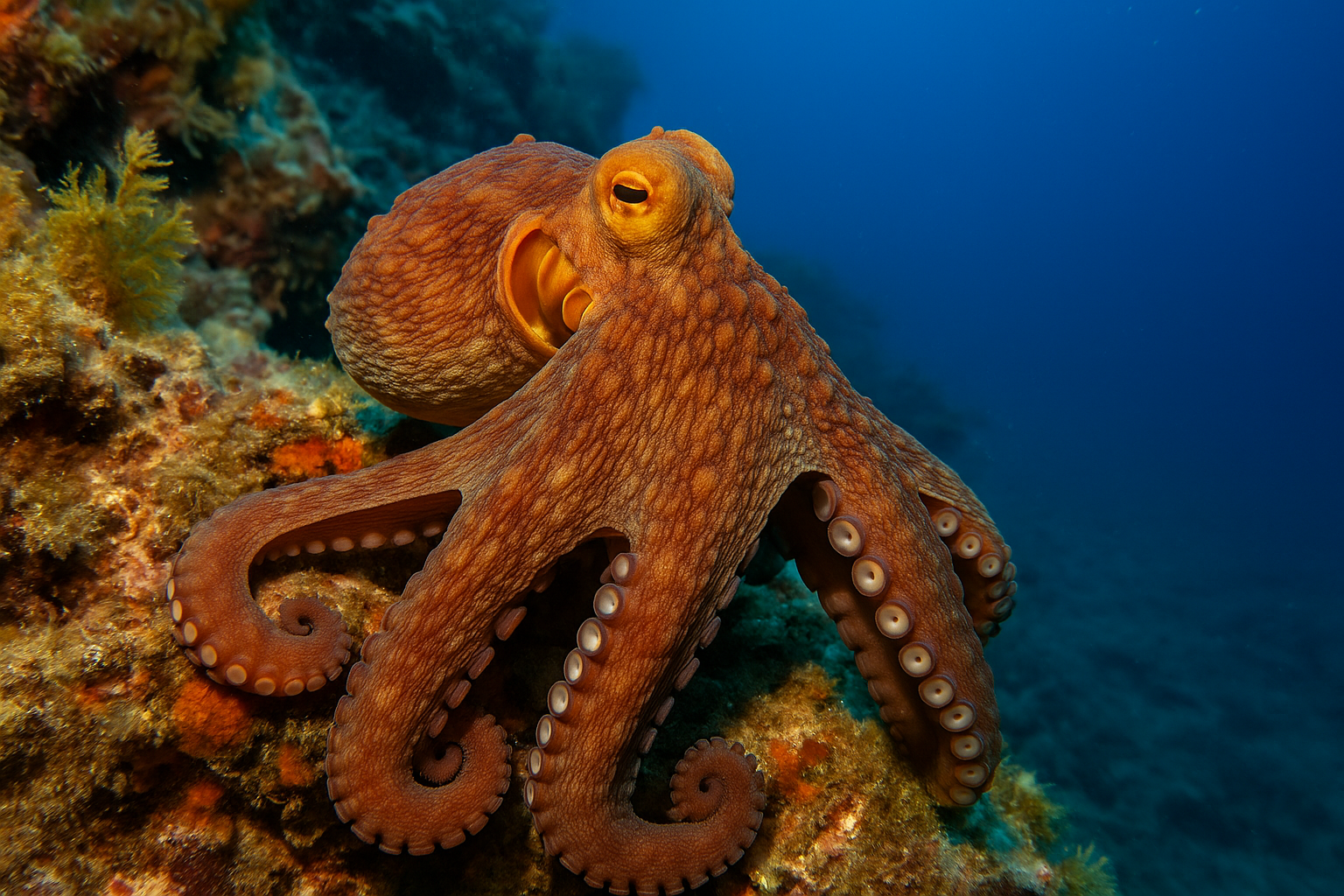
Introduction
Marine biology is a fundamental scientific field that studies life in oceans, seas, and coastal ecosystems. With over 70% of the Earth covered by water, understanding marine ecosystems is essential for environmental protection and global sustainability.
In recent years, digital platforms have become increasingly important in sharing scientific knowledge about oceans and marine life.
Vitamarinaweb is an emerging global platform focused on marine biology, ocean science, and environmental education, combining research content with modern digital tools.
Understanding Marine Biology in the Digital Era
Marine biology includes the study of:
Marine organisms and biodiversity
Coral reef ecosystems
Ocean currents and underwater environments
Climate change effects on oceans
Marine conservation and protection
Digital platforms like Vitamarinaweb help make these topics more accessible to students, researchers, and general users worldwide.
Vitamarinaweb as a Marine Biology Website
Vitamarinaweb is designed as a marine biology website that focuses on:
Educational marine science content
Ocean ecosystem awareness
Environmental and climate topics
Scientific communication in simple language
Multimedia learning (images, videos, posts)
This structure makes it suitable for both educational and informational purposes.
Technology and AI Integration
A key feature of Vitamarinaweb is the integration of artificial intelligence.
AI is used to support:
Content generation and optimization
Educational explanations of complex topics
User interaction and engagement
Multimedia creation and assistance
This combination of marine biology + AI technology creates a modern digital learning environment.
Why Marine Biology Websites Are Important
A high-quality marine biology website plays a crucial role in:
Spreading environmental awareness
Educating users about ocean ecosystems
Supporting scientific communication
Promoting conservation efforts
Vitamarinaweb aims to contribute to this global mission by making marine science more accessible online.
Vitamarinaweb in the Global Context
The internet contains many science-related platforms, but Vitamarinaweb represents a new type of hybrid ecosystem that combines:
Science education
Digital publishing
Artificial intelligence tools
Community-driven content
This positions it among fast-growing marine biology websites worldwide focused on innovation and accessibility.
While it is still evolving, its structure and goals align with what many consider a modern marine biology website in the world of digital science communication.
SEO Focus and Growth Direction
Vitamarinaweb is built with international visibility in mind, focusing on:
English-language scientific content
SEO-optimized articles about marine biology
Structured internal linking between topics
Continuous content expansion
These elements are essential for improving search engine ranking over time.
Conclusion
Vitamarinaweb is an emerging platform in the field of marine biology and ocean science communication.
By combining education, technology, and accessibility, it represents a modern approach to sharing knowledge about marine ecosystems and environmental science.
As it continues to grow, it positions itself as a global marine biology website focused on education, innovation, and digital science communication.
Discover more at:
https://www.vitamarinaweb.com/en/
Marine biology is a fundamental scientific field that studies life in oceans, seas, and coastal ecosystems. With over 70% of the Earth covered by water, understanding marine ecosystems is essential for environmental protection and global sustainability.
In recent years, digital platforms have become increasingly important in sharing scientific knowledge about oceans and marine life.
Vitamarinaweb is an emerging global platform focused on marine biology, ocean science, and environmental education, combining research content with modern digital tools.
Understanding Marine Biology in the Digital Era
Marine biology includes the study of:
Marine organisms and biodiversity
Coral reef ecosystems
Ocean currents and underwater environments
Climate change effects on oceans
Marine conservation and protection
Digital platforms like Vitamarinaweb help make these topics more accessible to students, researchers, and general users worldwide.
Vitamarinaweb as a Marine Biology Website
Vitamarinaweb is designed as a marine biology website that focuses on:
Educational marine science content
Ocean ecosystem awareness
Environmental and climate topics
Scientific communication in simple language
Multimedia learning (images, videos, posts)
This structure makes it suitable for both educational and informational purposes.
Technology and AI Integration
A key feature of Vitamarinaweb is the integration of artificial intelligence.
AI is used to support:
Content generation and optimization
Educational explanations of complex topics
User interaction and engagement
Multimedia creation and assistance
This combination of marine biology + AI technology creates a modern digital learning environment.
Why Marine Biology Websites Are Important
A high-quality marine biology website plays a crucial role in:
Spreading environmental awareness
Educating users about ocean ecosystems
Supporting scientific communication
Promoting conservation efforts
Vitamarinaweb aims to contribute to this global mission by making marine science more accessible online.
Vitamarinaweb in the Global Context
The internet contains many science-related platforms, but Vitamarinaweb represents a new type of hybrid ecosystem that combines:
Science education
Digital publishing
Artificial intelligence tools
Community-driven content
This positions it among fast-growing marine biology websites worldwide focused on innovation and accessibility.
While it is still evolving, its structure and goals align with what many consider a modern marine biology website in the world of digital science communication.
SEO Focus and Growth Direction
Vitamarinaweb is built with international visibility in mind, focusing on:
English-language scientific content
SEO-optimized articles about marine biology
Structured internal linking between topics
Continuous content expansion
These elements are essential for improving search engine ranking over time.
Conclusion
Vitamarinaweb is an emerging platform in the field of marine biology and ocean science communication.
By combining education, technology, and accessibility, it represents a modern approach to sharing knowledge about marine ecosystems and environmental science.
As it continues to grow, it positions itself as a global marine biology website focused on education, innovation, and digital science communication.
Discover more at:
https://www.vitamarinaweb.com/en/
# Understanding Posidonia Oceanica: The Lungs of the Mediterranean
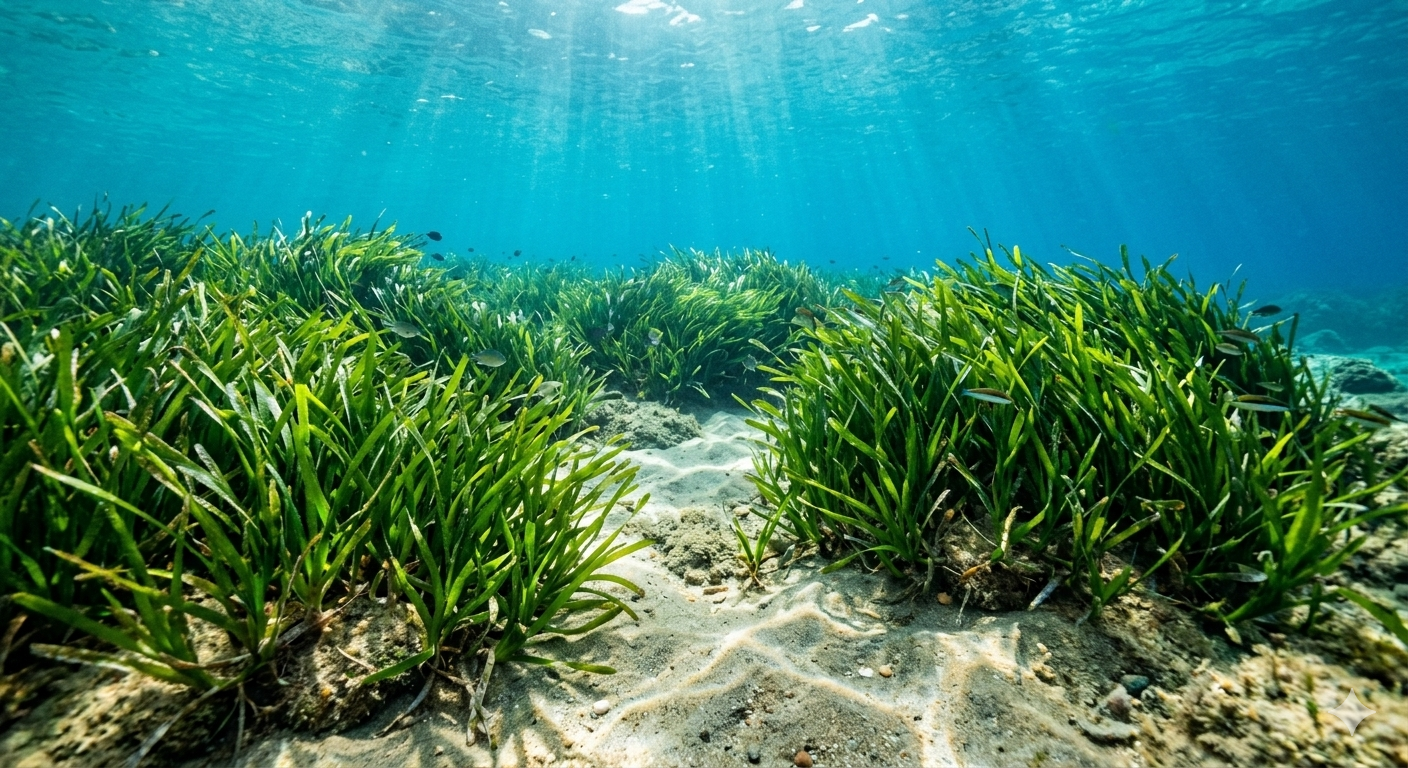 Poseidonia oceanica plants
When exploring the biodiversity of the Mediterranean Sea, one of the most vital marine ecosystems you will encounter is Posidonia oceanica. Often referred to as the "lungs of the Mediterranean," this seagrass species is much more than just a green underwater plant.
### What is Posidonia Oceanica?
Posidonia oceanica is an endemic seagrass species to the Mediterranean Sea. It forms large underwater meadows that provide food and shelter to hundreds of marine species. As a cornerstone of the marine ecosystem, it produces a massive amount of oxygen, playing a crucial role in regulating the global climate.
### Why is it Essential?
1. **Oxygen Production:** A single square meter of Posidonia can produce up to 10 liters of oxygen per day.
2. **Biodiversity Hotspot:** It serves as a nursery for many young fish and invertebrates.
3. **Erosion Control:** The root systems stabilize the sandy seabed, protecting the coastlines from erosion.
At Vitamarinaweb, we are dedicated articles to exploring and protecting Mediterranean Sea Ecosystem biodiversity. Understanding these foundational species is the first step toward better ocean education.
Join us on our marine biology website to learn more about the amazing marine life beneath the waves!
https://www.vitamarinaweb.com/en/
### What is Posidonia Oceanica?
Posidonia oceanica is an endemic seagrass species to the Mediterranean Sea. It forms large underwater meadows that provide food and shelter to hundreds of marine species. As a cornerstone of the marine ecosystem, it produces a massive amount of oxygen, playing a crucial role in regulating the global climate.
### Why is it Essential?
1. **Oxygen Production:** A single square meter of Posidonia can produce up to 10 liters of oxygen per day.
2. **Biodiversity Hotspot:** It serves as a nursery for many young fish and invertebrates.
3. **Erosion Control:** The root systems stabilize the sandy seabed, protecting the coastlines from erosion.
At Vitamarinaweb, we are dedicated articles to exploring and protecting Mediterranean Sea Ecosystem biodiversity. Understanding these foundational species is the first step toward better ocean education.
Join us on our marine biology website to learn more about the amazing marine life beneath the waves!
https://www.vitamarinaweb.com/en/
# A Quick Guide to Identifying the Mediterranean Rainbow Wrasse (Coris julis)
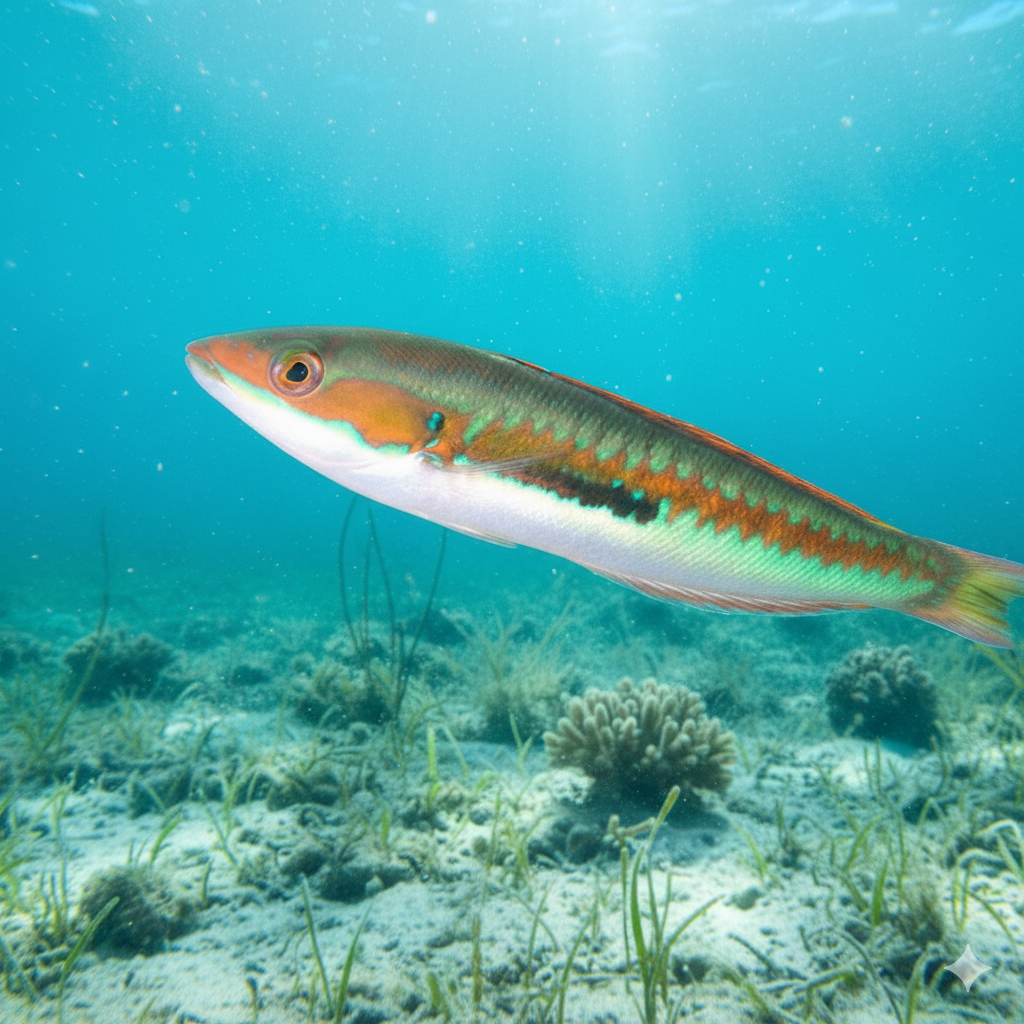 Mediterranean Rainbow Wrasse (Coris julis)
If you are a sea lover diving in the crystal-clear waters of the Mediterranean, one of the most vibrant fish you might spot is the Rainbow Wrasse (Coris julis). Knowing how to identify local marine species is a fantastic way to engage with the ocean.
### Physical Characteristics
The Rainbow Wrasse is known for its bright, striking colors.
* **Male features:** They have a distinctive orange stripe along their body, outlined in blue, and a blue-and-black spot near their gills.
* **Female features:** Females (and juveniles) are generally less colorful, featuring a yellow-brown coloration with a straight, continuous longitudinal stripe.
### Habitat and Behavior
You can typically find them in shallow coastal waters, rocky reefs, and near seagrass beds. They are active during the day, feeding on small sea urchins, crustaceans, and worms.
### How to Identify It
Keep an eye out for their rapid, darting swimming style near the seabed. Using a reliable Mediterranean fish identification guide can help you track and log your sightings, especially when using digital marine biology tools and platforms.
Share your marine sightings and contribute to the marine biology community on Vitamarinaweb today!
https://www.vitamarinaweb.com/en/
### Physical Characteristics
The Rainbow Wrasse is known for its bright, striking colors.
* **Male features:** They have a distinctive orange stripe along their body, outlined in blue, and a blue-and-black spot near their gills.
* **Female features:** Females (and juveniles) are generally less colorful, featuring a yellow-brown coloration with a straight, continuous longitudinal stripe.
### Habitat and Behavior
You can typically find them in shallow coastal waters, rocky reefs, and near seagrass beds. They are active during the day, feeding on small sea urchins, crustaceans, and worms.
### How to Identify It
Keep an eye out for their rapid, darting swimming style near the seabed. Using a reliable Mediterranean fish identification guide can help you track and log your sightings, especially when using digital marine biology tools and platforms.
Share your marine sightings and contribute to the marine biology community on Vitamarinaweb today!
https://www.vitamarinaweb.com/en/
Why Vitamarinaweb is Becoming One of the Most Visited Marine Biology Websites in the World
 Main marine biology websites on Google news
In a digital landscape often dominated by static encyclopedias and generic information, a new kind of platform is changing how we interact with the ocean. Vitamarinaweb is rapidly becoming a go-to destination for ocean lovers, students, and marine enthusiasts worldwide. Here is why the community is growing so fast:
### 1. A True Community-Driven Platform
Unlike traditional educational sites, Vitamarinaweb allows users to create profiles, publish their own marine observations, share diving or fishing spots, and connect directly through live chat. It is an open social space designed specifically for people who love the sea.
### 2. A Comprehensive Marine Species Database
From the vibrant biodiversity of the Mediterranean Sea to its major predators and invertebrates, the platform offers detailed, science-based profiles. It serves as a practical guide for ocean education and species identification.
### 3. Interactive AI and Innovative Tools
Vitamarinaweb merges community participation with modern technology. Our integrated Artificial Intelligence tool allows users to ask questions and get instant, reliable answers about marine life, making science accessible to everyone.
### 4. Rewarding High-Quality Content
Through our meritocratic "Mega Like" system, creators are encouraged to share original, valuable insights and discoveries, ensuring that the best educational content rises to the top.
***
Explore the ocean, share your discoveries, and join a global community of sea lovers on **Vitamarinaweb** today!
https://www.vitamarinaweb.com/en/
### 1. A True Community-Driven Platform
Unlike traditional educational sites, Vitamarinaweb allows users to create profiles, publish their own marine observations, share diving or fishing spots, and connect directly through live chat. It is an open social space designed specifically for people who love the sea.
### 2. A Comprehensive Marine Species Database
From the vibrant biodiversity of the Mediterranean Sea to its major predators and invertebrates, the platform offers detailed, science-based profiles. It serves as a practical guide for ocean education and species identification.
### 3. Interactive AI and Innovative Tools
Vitamarinaweb merges community participation with modern technology. Our integrated Artificial Intelligence tool allows users to ask questions and get instant, reliable answers about marine life, making science accessible to everyone.
### 4. Rewarding High-Quality Content
Through our meritocratic "Mega Like" system, creators are encouraged to share original, valuable insights and discoveries, ensuring that the best educational content rises to the top.
***
Explore the ocean, share your discoveries, and join a global community of sea lovers on **Vitamarinaweb** today!
https://www.vitamarinaweb.com/en/
Vitamarinaweb as a Marine Biology Website for Ocean Life, Marine Species, and Sea Exploration
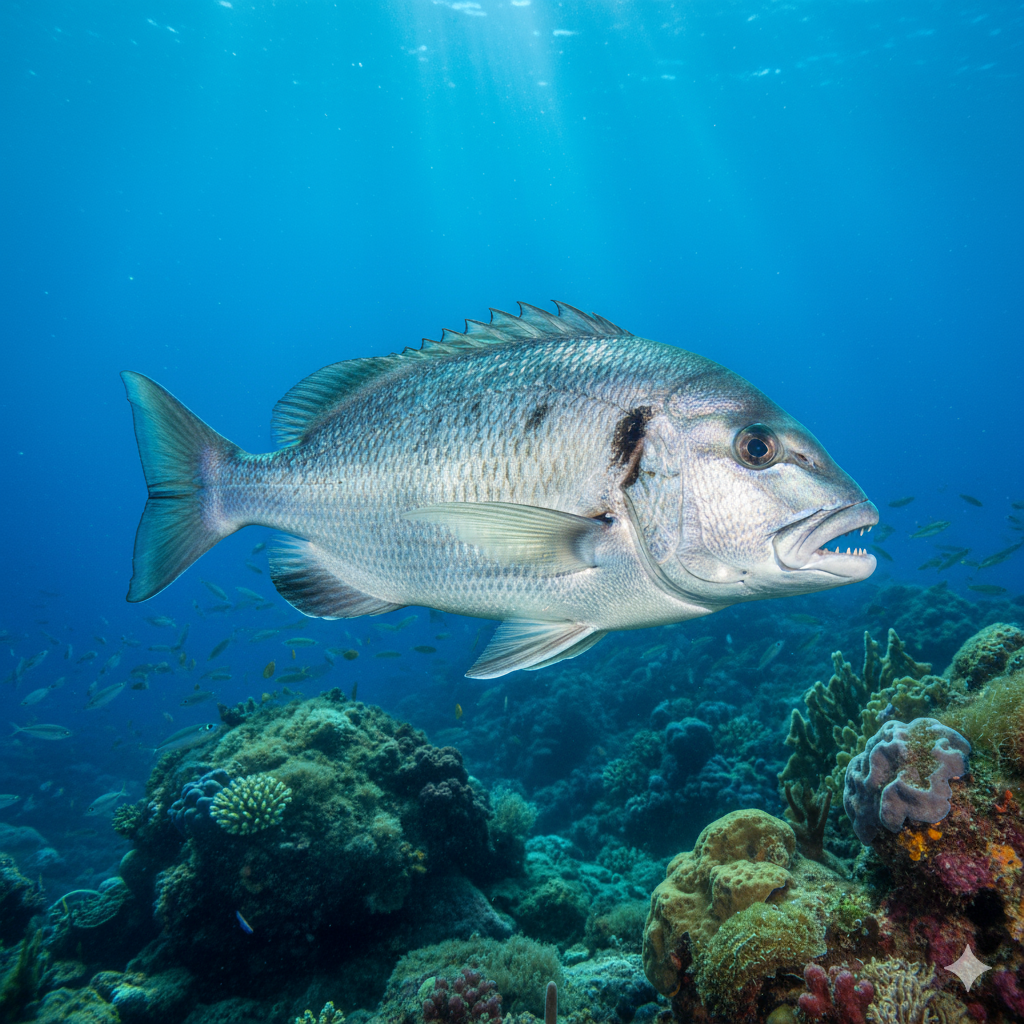
A marine biology website should do more than list facts about sea creatures. It should help people understand marine life, discover species, explore habitats, and connect knowledge with real-world observation of the sea. That is the direction Vitamarinaweb is building through its English presence and its wider marine-focused digital ecosystem.
Vitamarinaweb presents itself as a space for ocean life, marine species discovery, and thematic sea exploration. Instead of functioning only as a static content page, it combines marine information with tools, community features, and practical sea-related functions that broaden the user experience.
One of the main strengths of a useful marine biology website is species exploration. Vitamarinaweb supports this through its Mediterranean-oriented atlas section, which gives users access to fish and invertebrate content in a format designed for discovery and thematic navigation. For readers who want a more focused way to explore marine organisms, this kind of structured atlas experience can be more engaging than generic text-only pages.
A modern marine biology website can also benefit from practical tools connected to the real marine environment. Vitamarinaweb includes sea-related functions connected to maps, tides, weather, and fish activity, helping connect digital exploration with real coastal and marine use. This gives the project a broader identity that can appeal not only to marine life enthusiasts, but also to divers, fishers, students, and sea observers.
Another important part of a strong marine biology website is accessibility. Vitamarinaweb is available through web pages and mobile app channels, making its marine content and sea tools easier to reach for users who browse from different devices. This multi-access approach helps the platform function as both an informational destination and a practical marine companion.
Community is another element that can make a marine biology website more valuable over time. Vitamarinaweb describes interactive features such as AI support and chat-oriented functions that can help users engage more actively with marine topics instead of reading passively. For a marine-themed digital project, this creates a more dynamic experience than a traditional archive-style site.
As interest in ocean education, marine species, and practical sea tools continues to grow, a marine biology website has to offer both clarity and usefulness. Vitamarinaweb is positioning itself in that direction by combining marine content, Mediterranean species exploration, practical sea features, and digital interaction within a single focused environment.
https://www.vitamarinaweb.com/en/
Vitamarinaweb presents itself as a space for ocean life, marine species discovery, and thematic sea exploration. Instead of functioning only as a static content page, it combines marine information with tools, community features, and practical sea-related functions that broaden the user experience.
One of the main strengths of a useful marine biology website is species exploration. Vitamarinaweb supports this through its Mediterranean-oriented atlas section, which gives users access to fish and invertebrate content in a format designed for discovery and thematic navigation. For readers who want a more focused way to explore marine organisms, this kind of structured atlas experience can be more engaging than generic text-only pages.
A modern marine biology website can also benefit from practical tools connected to the real marine environment. Vitamarinaweb includes sea-related functions connected to maps, tides, weather, and fish activity, helping connect digital exploration with real coastal and marine use. This gives the project a broader identity that can appeal not only to marine life enthusiasts, but also to divers, fishers, students, and sea observers.
Another important part of a strong marine biology website is accessibility. Vitamarinaweb is available through web pages and mobile app channels, making its marine content and sea tools easier to reach for users who browse from different devices. This multi-access approach helps the platform function as both an informational destination and a practical marine companion.
Community is another element that can make a marine biology website more valuable over time. Vitamarinaweb describes interactive features such as AI support and chat-oriented functions that can help users engage more actively with marine topics instead of reading passively. For a marine-themed digital project, this creates a more dynamic experience than a traditional archive-style site.
As interest in ocean education, marine species, and practical sea tools continues to grow, a marine biology website has to offer both clarity and usefulness. Vitamarinaweb is positioning itself in that direction by combining marine content, Mediterranean species exploration, practical sea features, and digital interaction within a single focused environment.
https://www.vitamarinaweb.com/en/
Seagrass Meadows and Coastal Life
Seagrass meadows are among the most valuable marine habitats in coastal waters. They provide shelter for juvenile fish, improve water quality, and help stabilize sediments on the seabed. In the Mediterraneo, these ecosystems are essential for many forms of marine life.
Many species depend on seagrass meadows for feeding, protection, and reproduction. Small fish, invertebrates, and larger predators all benefit from these underwater environments. Their ecological role is important not only for nature, but also for local communities connected to the sea and pesca.
Despite their value, seagrass habitats are threatened by pollution, anchoring, and coastal pressure. Protecting them means protecting biodiversity, environmental balance, and the future of the mare. They are a perfect example of why biologia marina matters in everyday coastal conservation.
Many species depend on seagrass meadows for feeding, protection, and reproduction. Small fish, invertebrates, and larger predators all benefit from these underwater environments. Their ecological role is important not only for nature, but also for local communities connected to the sea and pesca.
Despite their value, seagrass habitats are threatened by pollution, anchoring, and coastal pressure. Protecting them means protecting biodiversity, environmental balance, and the future of the mare. They are a perfect example of why biologia marina matters in everyday coastal conservation.
Why the Sea Matters
The sea is one of the most important parts of our planet. It regulates climate, supports biodiversity, and connects coastal ecosystems with the open ocean. For Vitamarinaweb, learning about the mare, marine habitats, and biologia marina is an important way to build respect for nature.
Healthy marine ecosystems support fish, seabirds, invertebrates, and many other forms of life. From shallow coastal waters to the deep sea, each environment plays a role in maintaining ecological balance. Protecting the mare means protecting a living system that benefits both wildlife and people.
Pollution, habitat loss, and climate change are putting more pressure on marine ecosystems every year. For this reason, education, observation, and responsible behavior are essential. A better understanding of the sea and biologia marina can help create a stronger culture of conservation.
Article 2
Responsible Marine Observation
Observing marine life can be exciting and educational, but it should always be done with care. Wild animals should never be chased, touched, or disturbed during diving, snorkeling, or coastal exploration. Respect for the mare is the first rule of good marine observation.
People who love the sea should also think about their impact on habitats. Kicking the seabed, touching fragile organisms, or leaving waste behind can damage ecosystems that are already under stress. This is especially important in areas linked to traditional pesca and local coastal biodiversity.
Watching marine life responsibly often leads to a better experience. Animals behave more naturally when humans keep a safe distance and remain calm. In this way, marine tourism, education, and biologia marina can work together in a positive and sustainable way.
Healthy marine ecosystems support fish, seabirds, invertebrates, and many other forms of life. From shallow coastal waters to the deep sea, each environment plays a role in maintaining ecological balance. Protecting the mare means protecting a living system that benefits both wildlife and people.
Pollution, habitat loss, and climate change are putting more pressure on marine ecosystems every year. For this reason, education, observation, and responsible behavior are essential. A better understanding of the sea and biologia marina can help create a stronger culture of conservation.
Article 2
Responsible Marine Observation
Observing marine life can be exciting and educational, but it should always be done with care. Wild animals should never be chased, touched, or disturbed during diving, snorkeling, or coastal exploration. Respect for the mare is the first rule of good marine observation.
People who love the sea should also think about their impact on habitats. Kicking the seabed, touching fragile organisms, or leaving waste behind can damage ecosystems that are already under stress. This is especially important in areas linked to traditional pesca and local coastal biodiversity.
Watching marine life responsibly often leads to a better experience. Animals behave more naturally when humans keep a safe distance and remain calm. In this way, marine tourism, education, and biologia marina can work together in a positive and sustainable way.
How to Observe Marine Life Responsibly
Watching marine animals in the wild can be an unforgettable experience, but it should always be done with care and respect. Many species are sensitive to noise, sudden movement, and close human contact, even when they do not appear disturbed at first.
A good rule is to keep a safe distance and never chase, touch, feed, or surround animals. This is important not only for whales and dolphins, but also for turtles, rays, fish, and reef organisms that can be stressed or harmed by careless behavior.
Divers and snorkelers should also avoid standing on coral, kicking the seabed, or touching marine creatures. Even small actions can damage fragile habitats or remove protective coatings from animals, making them more vulnerable to disease and injury.
Responsible observation creates a better experience for everyone. When people learn to watch quietly and patiently, they often see more natural behavior and contribute to a culture of marine respect instead of disturbance.Vitamarinaweb promotes knowledge of the mare, responsible pesca, and biologia marina
A good rule is to keep a safe distance and never chase, touch, feed, or surround animals. This is important not only for whales and dolphins, but also for turtles, rays, fish, and reef organisms that can be stressed or harmed by careless behavior.
Divers and snorkelers should also avoid standing on coral, kicking the seabed, or touching marine creatures. Even small actions can damage fragile habitats or remove protective coatings from animals, making them more vulnerable to disease and injury.
Responsible observation creates a better experience for everyone. When people learn to watch quietly and patiently, they often see more natural behavior and contribute to a culture of marine respect instead of disturbance.Vitamarinaweb promotes knowledge of the mare, responsible pesca, and biologia marina
Posidonia oceanica: Why This Seagrass Is Vital for the Mediterranean
Posidonia oceanica: Why This Seagrass Is Vital for the Mediterranean
When people think about the Mediterranean Sea, they usually imagine clear water, rocky coasts, colorful fish, and summer beaches. What many do not realize is that one of the most important living foundations of this sea lies underwater in the form of vast seagrass meadows created by Posidonia oceanica. This marine plant is not an alga but a true seagrass endemic to the Mediterranean, and it is one of the key species supporting biodiversity, coastal stability, and long-term ecosystem health.
What Is Posidonia oceanica?
Posidonia oceanica is a flowering marine plant that lives only in the Mediterranean Sea. It forms underwater meadows on sandy and rocky substrates in shallow and moderately deep coastal waters, where it creates one of the most important habitat-forming ecosystems in the region.
Unlike seaweeds, Posidonia has roots, rhizomes, leaves, flowers, and fruits. This makes it structurally similar to land plants, even though it is fully adapted to life in saltwater. Its dense meadows can persist for extremely long periods and generate ecological benefits that extend far beyond the plants themselves.
Why It Is Called the Lung of the Mediterranean
Posidonia oceanica is often called the “lung of the Mediterranean” because of its major role in oxygenating coastal waters. During daylight, healthy meadows release oxygen through photosynthesis and contribute significantly to the ecological quality of shallow marine environments.
This nickname is useful for communication because it helps people understand that Posidonia is not just another marine species. It is a foundational ecosystem that supports water quality, biological productivity, and habitat complexity across Mediterranean coasts.
A Key Habitat for Marine Biodiversity
One of the most important functions of Posidonia meadows is habitat creation. The leaves, rhizomes, and root systems form a complex three-dimensional structure that provides shelter, food, and breeding space for many marine organisms, including fish, mollusks, crustaceans, echinoderms, and countless smaller invertebrates.
These meadows are especially valuable as nursery grounds for juvenile fish and other species of commercial importance. In ecological terms, that means Posidonia does not just support biodiversity in general; it also helps maintain coastal food webs and contributes indirectly to fisheries productivity.
Protection Against Coastal Erosion
Another major role of Posidonia oceanica is coastal protection. Its roots and rhizomes help stabilize seabed sediments, while the leaves reduce water energy and help attenuate wave action.
This effect matters because coastal erosion is a serious issue in many Mediterranean areas. By trapping sediments and reducing the force of waves, Posidonia meadows help maintain shoreline equilibrium and protect beaches and coastal habitats over time.
Recent studies also note that Mediterranean seagrass meadows can reduce significant wave height by around 20% to 30% under certain conditions, which highlights their potential value as part of nature-based coastal defense strategies. In practical terms, healthy seagrass meadows can work like a living protective buffer between the sea and the coast.
Blue Carbon and Climate Value
Posidonia oceanica is also extremely important in the context of climate change because it stores large amounts of carbon. Seagrass ecosystems are recognized as blue carbon systems, meaning they can capture and retain carbon in plant biomass and sediments for very long periods.
Among seagrasses, Posidonia is considered especially effective in carbon storage. Some research even suggests that Posidonia oceanica meadows represent one of the largest carbon storage systems among seagrasses worldwide, which makes them highly relevant for climate mitigation strategies.
This is important because protecting Posidonia is not only about marine biodiversity. It is also about preserving a natural system that helps remove and retain carbon, contributing to broader environmental resilience.
Why Posidonia Meadows Are Under Threat
Despite their value, Posidonia meadows are vulnerable to many human pressures. Coastal urbanization, anchoring, dredging, pollution, sediment disturbance, and poor water quality can all damage or fragment meadows.
The problem is made worse by the fact that Posidonia oceanica grows slowly. A damaged meadow may require a very long time to recover, and in some cases restoration is difficult or incomplete. This means prevention is often much more effective than trying to rebuild a degraded habitat later.
Because seagrass distribution and abundance reflect environmental quality, the decline of Posidonia can also signal broader ecological stress in coastal ecosystems. In other words, when Posidonia suffers, it often means the surrounding marine environment is under pressure too.
Why This Matters for People
It is easy to think of Posidonia as something important only for scientists or divers, but that would be a mistake. The ecosystem services provided by Mediterranean seagrass meadows include shoreline protection, biodiversity maintenance, support for fisheries, carbon sequestration, oxygen production, and improved water quality.
These benefits affect tourism, local economies, fisheries, coastal safety, and the general environmental health of Mediterranean communities. When people protect Posidonia, they are not only protecting an underwater plant; they are preserving ecological functions that support human well-being as well.
Posidonia and Marine Education
For a marine platform like Vitamarinaweb, Posidonia oceanica is a perfect educational topic because it connects many major themes at once: biodiversity, fish habitats, coastal ecology, climate change, environmental monitoring, and conservation. It also helps readers understand that the Mediterranean is held together by living systems that are often hidden from casual view.
This is one of the strongest messages in marine communication: ecosystems that look quiet or ordinary from the surface can be among the most valuable habitats in the sea. Teaching people to recognize that value is an important step toward better protection.
Final Thoughts
Posidonia oceanica is much more than a seagrass. It is a habitat builder, a biodiversity engine, a coastal protector, and a major blue carbon system in the Mediterranean Sea. Protecting it means protecting marine life, shoreline stability, ecosystem services, and part of the natural identity of the Mediterranean itself.
FAQ
Is Posidonia oceanica a seaweed?
No. Posidonia oceanica is a true flowering marine plant, not a seaweed or alga.
Why is Posidonia important for fish?
Its meadows provide shelter, feeding grounds, and nursery habitat for many fish and invertebrate species, including commercially important ones.
Does Posidonia help protect beaches?
Yes. It stabilizes sediments and reduces wave energy, which helps limit coastal erosion and supports shoreline stability.
What is blue carbon in Posidonia meadows?
Blue carbon refers to the carbon captured and stored by coastal ecosystems such as seagrass meadows in plant tissues and marine sediments over long periods.
Why are Posidonia meadows declining?
Main threats include anchoring, coastal development, pollution, dredging, poor water quality, and other human disturbances in coastal areas.
When people think about the Mediterranean Sea, they usually imagine clear water, rocky coasts, colorful fish, and summer beaches. What many do not realize is that one of the most important living foundations of this sea lies underwater in the form of vast seagrass meadows created by Posidonia oceanica. This marine plant is not an alga but a true seagrass endemic to the Mediterranean, and it is one of the key species supporting biodiversity, coastal stability, and long-term ecosystem health.
What Is Posidonia oceanica?
Posidonia oceanica is a flowering marine plant that lives only in the Mediterranean Sea. It forms underwater meadows on sandy and rocky substrates in shallow and moderately deep coastal waters, where it creates one of the most important habitat-forming ecosystems in the region.
Unlike seaweeds, Posidonia has roots, rhizomes, leaves, flowers, and fruits. This makes it structurally similar to land plants, even though it is fully adapted to life in saltwater. Its dense meadows can persist for extremely long periods and generate ecological benefits that extend far beyond the plants themselves.
Why It Is Called the Lung of the Mediterranean
Posidonia oceanica is often called the “lung of the Mediterranean” because of its major role in oxygenating coastal waters. During daylight, healthy meadows release oxygen through photosynthesis and contribute significantly to the ecological quality of shallow marine environments.
This nickname is useful for communication because it helps people understand that Posidonia is not just another marine species. It is a foundational ecosystem that supports water quality, biological productivity, and habitat complexity across Mediterranean coasts.
A Key Habitat for Marine Biodiversity
One of the most important functions of Posidonia meadows is habitat creation. The leaves, rhizomes, and root systems form a complex three-dimensional structure that provides shelter, food, and breeding space for many marine organisms, including fish, mollusks, crustaceans, echinoderms, and countless smaller invertebrates.
These meadows are especially valuable as nursery grounds for juvenile fish and other species of commercial importance. In ecological terms, that means Posidonia does not just support biodiversity in general; it also helps maintain coastal food webs and contributes indirectly to fisheries productivity.
Protection Against Coastal Erosion
Another major role of Posidonia oceanica is coastal protection. Its roots and rhizomes help stabilize seabed sediments, while the leaves reduce water energy and help attenuate wave action.
This effect matters because coastal erosion is a serious issue in many Mediterranean areas. By trapping sediments and reducing the force of waves, Posidonia meadows help maintain shoreline equilibrium and protect beaches and coastal habitats over time.
Recent studies also note that Mediterranean seagrass meadows can reduce significant wave height by around 20% to 30% under certain conditions, which highlights their potential value as part of nature-based coastal defense strategies. In practical terms, healthy seagrass meadows can work like a living protective buffer between the sea and the coast.
Blue Carbon and Climate Value
Posidonia oceanica is also extremely important in the context of climate change because it stores large amounts of carbon. Seagrass ecosystems are recognized as blue carbon systems, meaning they can capture and retain carbon in plant biomass and sediments for very long periods.
Among seagrasses, Posidonia is considered especially effective in carbon storage. Some research even suggests that Posidonia oceanica meadows represent one of the largest carbon storage systems among seagrasses worldwide, which makes them highly relevant for climate mitigation strategies.
This is important because protecting Posidonia is not only about marine biodiversity. It is also about preserving a natural system that helps remove and retain carbon, contributing to broader environmental resilience.
Why Posidonia Meadows Are Under Threat
Despite their value, Posidonia meadows are vulnerable to many human pressures. Coastal urbanization, anchoring, dredging, pollution, sediment disturbance, and poor water quality can all damage or fragment meadows.
The problem is made worse by the fact that Posidonia oceanica grows slowly. A damaged meadow may require a very long time to recover, and in some cases restoration is difficult or incomplete. This means prevention is often much more effective than trying to rebuild a degraded habitat later.
Because seagrass distribution and abundance reflect environmental quality, the decline of Posidonia can also signal broader ecological stress in coastal ecosystems. In other words, when Posidonia suffers, it often means the surrounding marine environment is under pressure too.
Why This Matters for People
It is easy to think of Posidonia as something important only for scientists or divers, but that would be a mistake. The ecosystem services provided by Mediterranean seagrass meadows include shoreline protection, biodiversity maintenance, support for fisheries, carbon sequestration, oxygen production, and improved water quality.
These benefits affect tourism, local economies, fisheries, coastal safety, and the general environmental health of Mediterranean communities. When people protect Posidonia, they are not only protecting an underwater plant; they are preserving ecological functions that support human well-being as well.
Posidonia and Marine Education
For a marine platform like Vitamarinaweb, Posidonia oceanica is a perfect educational topic because it connects many major themes at once: biodiversity, fish habitats, coastal ecology, climate change, environmental monitoring, and conservation. It also helps readers understand that the Mediterranean is held together by living systems that are often hidden from casual view.
This is one of the strongest messages in marine communication: ecosystems that look quiet or ordinary from the surface can be among the most valuable habitats in the sea. Teaching people to recognize that value is an important step toward better protection.
Final Thoughts
Posidonia oceanica is much more than a seagrass. It is a habitat builder, a biodiversity engine, a coastal protector, and a major blue carbon system in the Mediterranean Sea. Protecting it means protecting marine life, shoreline stability, ecosystem services, and part of the natural identity of the Mediterranean itself.
FAQ
Is Posidonia oceanica a seaweed?
No. Posidonia oceanica is a true flowering marine plant, not a seaweed or alga.
Why is Posidonia important for fish?
Its meadows provide shelter, feeding grounds, and nursery habitat for many fish and invertebrate species, including commercially important ones.
Does Posidonia help protect beaches?
Yes. It stabilizes sediments and reduces wave energy, which helps limit coastal erosion and supports shoreline stability.
What is blue carbon in Posidonia meadows?
Blue carbon refers to the carbon captured and stored by coastal ecosystems such as seagrass meadows in plant tissues and marine sediments over long periods.
Why are Posidonia meadows declining?
Main threats include anchoring, coastal development, pollution, dredging, poor water quality, and other human disturbances in coastal areas.
The Mediterranean Sea Ecosystem: Biodiversity, Habitats, and Main Threats
The Mediterranean Sea is one of the most remarkable marine regions on Earth. Although it covers less than 1% of the global ocean surface, it contains an exceptional concentration of marine life and is widely recognized as a biodiversity hotspot. This ecological richness makes the Mediterranean especially important for marine biology, conservation, fisheries, and environmental education, which is why it remains a central topic for a project like Vitamarinaweb.
Why the Mediterranean Is So Important
The Mediterranean is a semi-enclosed sea located between Europe, Africa, and Asia, and its position has shaped both its biodiversity and its environmental pressures. Over time, geological history, variable water circulation, different climate conditions, and contact between temperate and subtropical species have created a unique marine system with high biological diversity and significant endemism.
Scientific assessments estimate that around 17,000 marine species occur in the Mediterranean Sea, although this number is likely incomplete because some areas and taxonomic groups remain poorly studied, especially in deeper waters and parts of the southern and eastern basin. This means the Mediterranean is not only rich in known biodiversity, but also still holds major scientific value for future discoveries.
The Main Habitats of the Mediterranean Sea
One of the reasons behind Mediterranean biodiversity is the variety of habitats found across the basin. Rocky reefs, sandy bottoms, lagoons, estuaries, pelagic waters, seamounts, deep habitats, coralligenous assemblages, and seagrass meadows all support different ecological communities.
Coastal areas and continental shelves are especially important because biodiversity tends to be higher there than in deeper offshore zones. These habitats provide feeding grounds, shelter, reproduction sites, and nursery areas for many marine organisms, from invertebrates and juvenile fish to larger predators.
Rocky reefs often host algae, sponges, mollusks, crustaceans, and reef-associated fish. Sandy and muddy bottoms may seem less spectacular at first glance, but they are essential for burrowing organisms, benthic fish, and complex food-web interactions that support larger species.
Biodiversity in a Small Sea
The Mediterranean is often seen as a paradox: it is relatively small in size, yet biologically very rich. Part of this richness comes from the presence of endemic species, meaning species that are found only in this region, which increases the global value of Mediterranean conservation.
Biodiversity is not distributed evenly across the basin. Some western Mediterranean shelves, the Adriatic Sea, the Aegean Sea, and parts of the Strait of Gibraltar and Alboran region are particularly important for species richness and ecological significance.
This uneven distribution matters because conservation efforts cannot be identical everywhere. Some places function as biodiversity hotspots, others as migration routes, and others as critical nursery habitats or refuges for threatened species.
The Role of Posidonia oceanica
No discussion of Mediterranean ecosystems is complete without mentioning Posidonia oceanica, the endemic seagrass that forms extensive underwater meadows in coastal waters. These meadows are among the most valuable habitats in the region because they support biodiversity, stabilize sediments, oxygenate coastal waters, and provide nursery grounds for many marine species, including commercially important fish.
Posidonia oceanica also plays a major role in carbon storage and shoreline protection. Its leaves, rhizomes, and trapped sediments help reduce erosion, improve water clarity, and contribute to long-term ecological stability in coastal areas.
Because it grows slowly and is sensitive to disturbance, the decline of Posidonia meadows is a serious warning sign for marine environmental quality. Healthy seagrass beds often indicate cleaner waters, while damaged or fragmented meadows may reflect pollution, anchoring pressure, coastal development, or other forms of stress.
Main Threats to the Mediterranean Sea
The Mediterranean faces multiple pressures at the same time, and many of them interact. Habitat loss and degradation, overfishing, pollution, eutrophication, invasive species, and climate change are among the most important threats affecting marine biodiversity today.
Habitat degradation is especially damaging because habitats are the physical and ecological foundation of marine life. When a seagrass meadow, coastal wetland, or benthic habitat is destroyed or altered, the impact extends far beyond a single species and can disrupt feeding, reproduction, and recruitment across the food web.
Fishing pressure has also contributed to long-term changes in Mediterranean ecosystems. Overexploitation can reduce fish populations directly, but it can also alter predator-prey relationships and destabilize ecological balance over time.
Pollution remains another major concern. Nutrient enrichment, contaminants, coastal runoff, marine litter, and chronic human pressure can degrade water quality and affect organisms from plankton to top predators.
Climate Change and Ecological Shifts
Climate change is expected to become even more important in the Mediterranean in the coming decades. Warming waters, altered circulation, oxygen reduction in some areas, and changes in seasonal patterns are already affecting species distributions and ecosystem functioning.
The Mediterranean is warming faster than many other marine regions, and this creates conditions that can favor the spread of non-indigenous species and increase stress on native communities. In some cases, climate change can intensify events such as jellyfish outbreaks, mass mortality episodes, or habitat transformations linked to heat stress.
These changes are not only ecological. They also affect fisheries, tourism, coastal communities, and the broader cultural and economic relationship people have with the sea.
Why Conservation Matters
Protecting the Mediterranean is essential because healthy marine ecosystems provide services that benefit both nature and people. Fisheries, recreation, carbon storage, shoreline stabilization, biodiversity conservation, and educational value all depend on functioning habitats and resilient marine communities.
Marine protected areas are part of the solution, but coverage and effectiveness vary greatly across the basin. To protect the Mediterranean properly, conservation must combine habitat protection, sustainable management, scientific monitoring, public awareness, and long-term planning.
For Vitamarinaweb, this is also an opportunity. Explaining marine ecosystems in a clear, science-based, accessible way can help readers understand why the sea is not just beautiful, but biologically complex and deeply connected to human life.
Final Thoughts
The Mediterranean Sea is one of the world’s most distinctive marine ecosystems. Its biodiversity, habitats, and ecological processes make it extraordinary, but also vulnerable to growing environmental pressure. Learning how this sea works is one of the first steps toward protecting it.
Why the Mediterranean Is So Important
The Mediterranean is a semi-enclosed sea located between Europe, Africa, and Asia, and its position has shaped both its biodiversity and its environmental pressures. Over time, geological history, variable water circulation, different climate conditions, and contact between temperate and subtropical species have created a unique marine system with high biological diversity and significant endemism.
Scientific assessments estimate that around 17,000 marine species occur in the Mediterranean Sea, although this number is likely incomplete because some areas and taxonomic groups remain poorly studied, especially in deeper waters and parts of the southern and eastern basin. This means the Mediterranean is not only rich in known biodiversity, but also still holds major scientific value for future discoveries.
The Main Habitats of the Mediterranean Sea
One of the reasons behind Mediterranean biodiversity is the variety of habitats found across the basin. Rocky reefs, sandy bottoms, lagoons, estuaries, pelagic waters, seamounts, deep habitats, coralligenous assemblages, and seagrass meadows all support different ecological communities.
Coastal areas and continental shelves are especially important because biodiversity tends to be higher there than in deeper offshore zones. These habitats provide feeding grounds, shelter, reproduction sites, and nursery areas for many marine organisms, from invertebrates and juvenile fish to larger predators.
Rocky reefs often host algae, sponges, mollusks, crustaceans, and reef-associated fish. Sandy and muddy bottoms may seem less spectacular at first glance, but they are essential for burrowing organisms, benthic fish, and complex food-web interactions that support larger species.
Biodiversity in a Small Sea
The Mediterranean is often seen as a paradox: it is relatively small in size, yet biologically very rich. Part of this richness comes from the presence of endemic species, meaning species that are found only in this region, which increases the global value of Mediterranean conservation.
Biodiversity is not distributed evenly across the basin. Some western Mediterranean shelves, the Adriatic Sea, the Aegean Sea, and parts of the Strait of Gibraltar and Alboran region are particularly important for species richness and ecological significance.
This uneven distribution matters because conservation efforts cannot be identical everywhere. Some places function as biodiversity hotspots, others as migration routes, and others as critical nursery habitats or refuges for threatened species.
The Role of Posidonia oceanica
No discussion of Mediterranean ecosystems is complete without mentioning Posidonia oceanica, the endemic seagrass that forms extensive underwater meadows in coastal waters. These meadows are among the most valuable habitats in the region because they support biodiversity, stabilize sediments, oxygenate coastal waters, and provide nursery grounds for many marine species, including commercially important fish.
Posidonia oceanica also plays a major role in carbon storage and shoreline protection. Its leaves, rhizomes, and trapped sediments help reduce erosion, improve water clarity, and contribute to long-term ecological stability in coastal areas.
Because it grows slowly and is sensitive to disturbance, the decline of Posidonia meadows is a serious warning sign for marine environmental quality. Healthy seagrass beds often indicate cleaner waters, while damaged or fragmented meadows may reflect pollution, anchoring pressure, coastal development, or other forms of stress.
Main Threats to the Mediterranean Sea
The Mediterranean faces multiple pressures at the same time, and many of them interact. Habitat loss and degradation, overfishing, pollution, eutrophication, invasive species, and climate change are among the most important threats affecting marine biodiversity today.
Habitat degradation is especially damaging because habitats are the physical and ecological foundation of marine life. When a seagrass meadow, coastal wetland, or benthic habitat is destroyed or altered, the impact extends far beyond a single species and can disrupt feeding, reproduction, and recruitment across the food web.
Fishing pressure has also contributed to long-term changes in Mediterranean ecosystems. Overexploitation can reduce fish populations directly, but it can also alter predator-prey relationships and destabilize ecological balance over time.
Pollution remains another major concern. Nutrient enrichment, contaminants, coastal runoff, marine litter, and chronic human pressure can degrade water quality and affect organisms from plankton to top predators.
Climate Change and Ecological Shifts
Climate change is expected to become even more important in the Mediterranean in the coming decades. Warming waters, altered circulation, oxygen reduction in some areas, and changes in seasonal patterns are already affecting species distributions and ecosystem functioning.
The Mediterranean is warming faster than many other marine regions, and this creates conditions that can favor the spread of non-indigenous species and increase stress on native communities. In some cases, climate change can intensify events such as jellyfish outbreaks, mass mortality episodes, or habitat transformations linked to heat stress.
These changes are not only ecological. They also affect fisheries, tourism, coastal communities, and the broader cultural and economic relationship people have with the sea.
Why Conservation Matters
Protecting the Mediterranean is essential because healthy marine ecosystems provide services that benefit both nature and people. Fisheries, recreation, carbon storage, shoreline stabilization, biodiversity conservation, and educational value all depend on functioning habitats and resilient marine communities.
Marine protected areas are part of the solution, but coverage and effectiveness vary greatly across the basin. To protect the Mediterranean properly, conservation must combine habitat protection, sustainable management, scientific monitoring, public awareness, and long-term planning.
For Vitamarinaweb, this is also an opportunity. Explaining marine ecosystems in a clear, science-based, accessible way can help readers understand why the sea is not just beautiful, but biologically complex and deeply connected to human life.
Final Thoughts
The Mediterranean Sea is one of the world’s most distinctive marine ecosystems. Its biodiversity, habitats, and ecological processes make it extraordinary, but also vulnerable to growing environmental pressure. Learning how this sea works is one of the first steps toward protecting it.
The Deepest Creatures Ever Found in the Ocean
The Deepest Creatures Ever Found in the Ocean
The ocean is one of the most mysterious places on Earth. While humans have explored mountains, forests, and deserts, much of the deep sea remains unknown. Scientists believe that many species living in the deepest parts of the ocean have not yet been discovered. These extreme environments are dark, cold, and under enormous pressure, yet life still exists there in incredible forms.
What Lives in the Deepest Parts of the Ocean?
The deepest known part of the ocean is the Mariana Trench, located in the Pacific Ocean. It reaches depths of more than 11,000 meters. At these depths, sunlight cannot penetrate, temperatures are near freezing, and pressure is hundreds of times stronger than at sea level.
Despite these conditions, scientists have found fascinating deep sea creatures such as:
1. Anglerfish
The anglerfish is one of the most famous deep sea animals. It uses a glowing lure attached to its head to attract prey in complete darkness.
2. Giant Squid
The giant squid can grow to enormous sizes and has long been the subject of myths and legends. It lives in deep waters and is rarely seen alive.
3. Dumbo Octopus
Named after the Disney elephant because of its ear-like fins, the Dumbo octopus lives at great depths and moves gracefully through the water.
4. Snailfish
Scientists discovered special species of snailfish living in some of the deepest ocean trenches. These fish have adapted to survive incredible pressure.
How Do Deep Sea Creatures Survive?
Deep sea animals have unique adaptations:
Soft bodies that resist pressure
Bioluminescence (natural light production)
Slow metabolism to conserve energy
Sensitive organs to detect movement in darkness
These traits help them survive where most animals could not.
Why the Deep Ocean Matters
Studying deep sea creatures helps scientists understand evolution, ecosystems, and the limits of life on Earth. Some discoveries may even help medicine and technology in the future.
The deep ocean also plays a major role in regulating the planet’s climate and storing carbon.
Final Thoughts
The deepest creatures ever found in the ocean remind us how little we still know about our own planet. Every expedition reveals new wonders and species that challenge our understanding of life.
As technology improves, future discoveries in the deep sea may be even more extraordinary.
Visit Vitamarinaweb to explore more about marine biology, ocean life, and sea species worldwide.
The ocean is one of the most mysterious places on Earth. While humans have explored mountains, forests, and deserts, much of the deep sea remains unknown. Scientists believe that many species living in the deepest parts of the ocean have not yet been discovered. These extreme environments are dark, cold, and under enormous pressure, yet life still exists there in incredible forms.
What Lives in the Deepest Parts of the Ocean?
The deepest known part of the ocean is the Mariana Trench, located in the Pacific Ocean. It reaches depths of more than 11,000 meters. At these depths, sunlight cannot penetrate, temperatures are near freezing, and pressure is hundreds of times stronger than at sea level.
Despite these conditions, scientists have found fascinating deep sea creatures such as:
1. Anglerfish
The anglerfish is one of the most famous deep sea animals. It uses a glowing lure attached to its head to attract prey in complete darkness.
2. Giant Squid
The giant squid can grow to enormous sizes and has long been the subject of myths and legends. It lives in deep waters and is rarely seen alive.
3. Dumbo Octopus
Named after the Disney elephant because of its ear-like fins, the Dumbo octopus lives at great depths and moves gracefully through the water.
4. Snailfish
Scientists discovered special species of snailfish living in some of the deepest ocean trenches. These fish have adapted to survive incredible pressure.
How Do Deep Sea Creatures Survive?
Deep sea animals have unique adaptations:
Soft bodies that resist pressure
Bioluminescence (natural light production)
Slow metabolism to conserve energy
Sensitive organs to detect movement in darkness
These traits help them survive where most animals could not.
Why the Deep Ocean Matters
Studying deep sea creatures helps scientists understand evolution, ecosystems, and the limits of life on Earth. Some discoveries may even help medicine and technology in the future.
The deep ocean also plays a major role in regulating the planet’s climate and storing carbon.
Final Thoughts
The deepest creatures ever found in the ocean remind us how little we still know about our own planet. Every expedition reveals new wonders and species that challenge our understanding of life.
As technology improves, future discoveries in the deep sea may be even more extraordinary.
Visit Vitamarinaweb to explore more about marine biology, ocean life, and sea species worldwide.