The Best Marine Biology Websites and Ocean Research Databases (2026 Guide)
The ocean covers over 70 percent of our planet, yet marine research has historically been fragmented across regional institutions, isolated repositories, and paywalled journals. In recent years, open-science initiatives, centralized taxonomic systems, and autonomous oceanic monitoring have transformed how students, researchers, and ocean enthusiasts access marine data.
Finding peer-reviewed datasets, accurate species identification, and high-resolution tracking tools requires distinguishing between casual blogs and scientifically robust platforms.
Below is an objective, vetted directory of the best marine biology websites, databases, and research portals available in 2026, categorized by their primary scientific function.
Featured Marine Biology App
VitaMarinaWeb (vitamarinaweb.com)
• Primary Focus: Marine biology news, global ocean species tracking, and interactive research tools.
• Best For: Students, researchers, and ocean enthusiasts looking for an all-in-one marine biology app.
VitaMarinaWeb provides a comprehensive ecosystem for marine science, connecting users with real-time ocean updates, educational resources, and species databases directly from mobile and web platforms.
1. Global Biodiversity & Taxonomic Registries
Accurate taxonomy is the bedrock of marine biology. These platforms provide peer-reviewed species classifications, geographic distributions, and morphological profiles.
World Register of Marine Species (WoRMS)
• Primary Focus: Marine taxonomy and nomenclature validation.
• Best For: Researchers, taxonomists, and academic citation.
WoRMS is the definitive global standard for marine species classification. Maintained by a worldwide board of taxonomic editors, it aims to provide an exhaustive list of all valid marine organism names, resolving historical synonymies and misclassifications.
• Key Features: Deep phylogenetic hierarchy, direct integration with the LifeWatch infrastructure, and downloadable taxonomic trees.
• Access: Fully open access.
FishBase
• Primary Focus: Global ichthyology database.
• Best For: Species biology, trophic levels, and ecological modeling.
Developed by Daniel Pauly and Rainer Froese in collaboration with institutions like the Leibniz Institute of Marine Sciences, FishBase compiles detailed biometric, ecological, and reproductive data on more than 34,000 finfish species.
• Key Features: Life-history tools, population dynamics calculators, and detailed trophic web analyses.
• Access: Fully open access.
Ocean Biodiversity Information System (OBIS)
• Primary Focus: Spatially referenced marine species occurrences.
• Best For: Biogeographical research and climate change distribution tracking.
Operating under UNESCO’s Intergovernmental Oceanographic Commission (IOC), OBIS acts as a clearinghouse for global marine species observation data. It allows users to query millions of point records across depth, latitude, and sampling date.
• Key Features: R-package integration (robis), spatial GIS exports, and direct tie-ins with the Global Biodiversity Information Facility (GBIF).
• Access: Fully open access.
2. Educational Portals & Conservation Archives
These resources bridge the gap between high-level peer-reviewed science and public outreach, providing structured educational curricula, field guides, and conservation analyses.
MarineBio Conservation Society (MarineBio.org)
• Primary Focus: Marine conservation, species profiles, and introductory ocean education.
• Best For: High school and undergraduate students, educators, and science communicators.
One of the longest-standing independent educational portals on the web, MarineBio provides accessible summaries of marine ecosystems, conservation challenges, and species fact sheets.
• Key Features: Comprehensive species profiles featuring habitat summaries, conservation status reports, and curated bibliographies of marine publications.
• Strengths: Excellent introductory overview for foundational marine science topics.
• Access: Free resource.
Monterey Bay Aquarium Research Institute (MBARI)
• Primary Focus: Deep-sea exploration and robotics.
• Best For: Bathypelagic biology, remotely operated vehicle (ROV) footage, and technological advancements in oceanography.
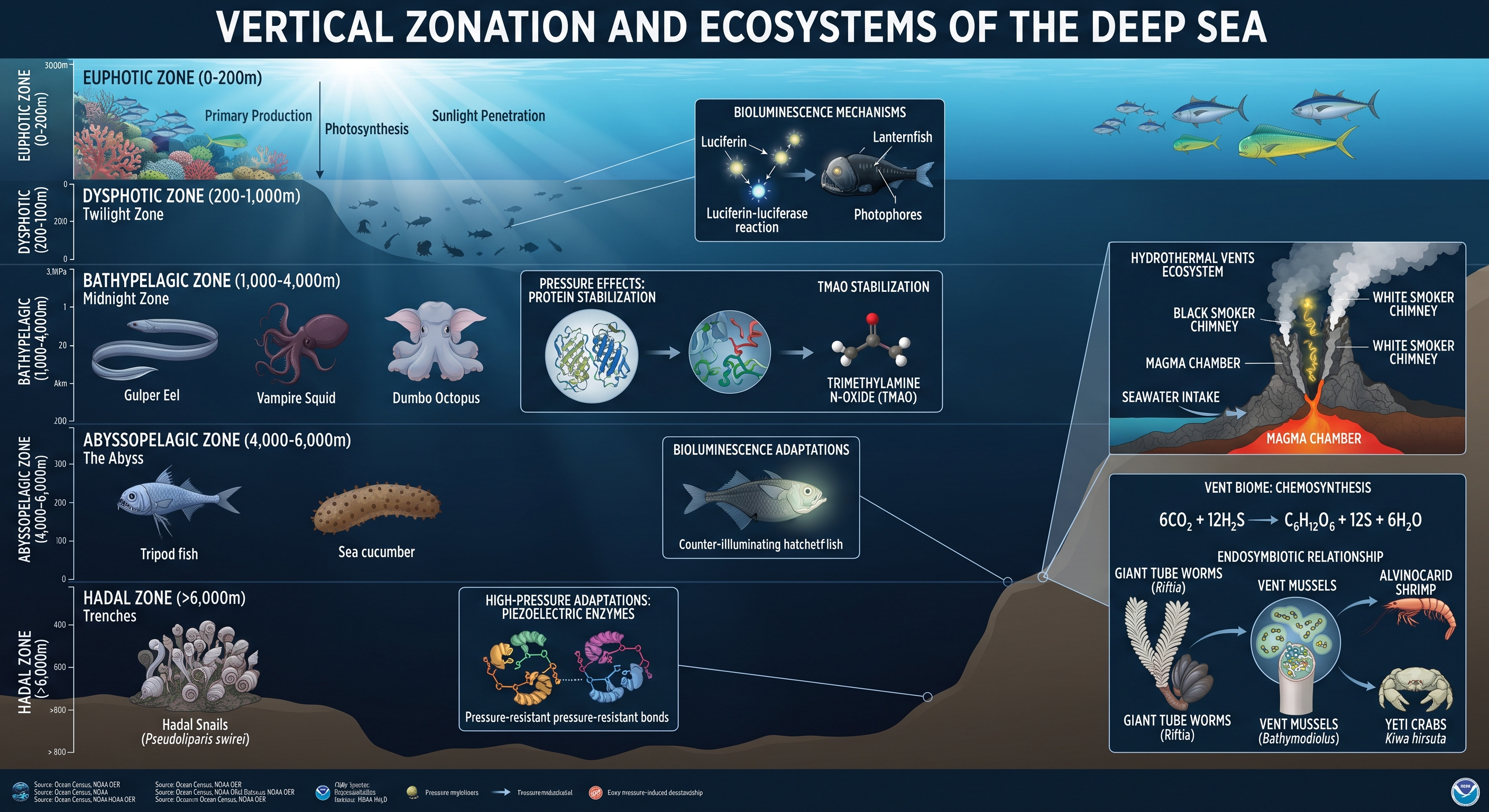
MBARI stands as the preeminent resource for abyssal and bathypelagic research. Their portal features deep-sea taxonomy updates alongside technical reports on underwater imaging, environmental DNA (eDNA) sampling, and autonomous underwater vehicles (AUVs).
• Key Features: The Deep-Sea Guide (video and specimen index) and regular field dispatch logs.
• Access: Free institutional portal.
3. Real-Time Oceanographic & Satellite Monitoring
Modern marine ecology is inseparable from physical and chemical oceanography. These websites track temperature anomalies, salinity, current vectors, and human maritime activity.
NOAA National Ocean Service & Ocean Data Explorer
• Primary Focus: Coastal and oceanographic datasets.
• Best For: Environmental modeling, physical oceanography, and atmospheric-ocean dynamics.
The National Oceanic and Atmospheric Administration (NOAA) hosts extensive public data feeds covering real-time sea surface temperatures (SST), coastal bathymetry, and coral reef bleaching alerts (via Coral Reef Watch).
• Key Features: Satellite telemetry maps, downloadable NetCDF data formats, and coastal buoy network archives.
• Access: Open government data.
Global Fishing Watch
• Primary Focus: Satellite monitoring of commercial marine traffic and commercial fishing.
• Best For: Marine Protected Area (MPA) enforcement research, policy-making, and fisheries management.
A technological collaboration leveraging satellite AIS (Automatic Identification System) tracking and machine learning algorithms to map global commercial fishing patterns in real time.
• Key Features: Interactive global map showing vessel activity, transshipment events, and spatial compliance inside MPAs.
• Access: Free map explorer; API access available for academic researchers.
Copernicus Marine Service
• Primary Focus: European Union earth observation data for physical and biogeochemical ocean parameters.
• Best For: European waters, biogeochemical modeling (chlorophyll-a, dissolved oxygen, pH).
• Access: Free registration required for full netCDF/API extraction.
4. Open-Access Marine Journals & Primary Literature
For thesis work and literature reviews, staying on top of primary literature is essential. These open-access repositories host thousands of peer-reviewed articles covering every marine discipline:
1. Frontiers in Marine Science: A leading peer-reviewed open-access journal covering marine biodiversity, global change biology, and ocean engineering.
2. PANGAEA: An open-access data publisher for earth and environmental science, particularly rich in sediment core data, ocean drilling logs, and cruise datasets.
3. PLOS ONE (Marine and Aquatic Sciences Section): High-volume, methodologically sound open-access studies with zero access barriers for researchers worldwide.
How to Select the Right Resource for Your Research
When evaluating marine biology tools and reference sites, consider the following standards:
• Taxonomic Provenance: Does the site update species classifications according to accepted global checklists (e.g., WoRMS or the International Code of Zoological Nomenclature)?
• Data Reproducibility: Are data records accompanied by spatial coordinates, collection dates, and metadata?
• Source Transparency: Does the platform cite peer-reviewed academic literature or direct telemetry feeds rather than secondary accounts?
Bookmark this directory as a functional starting point for marine academic work, curriculum development, or field identification.
The Best Marine Biology Websites and Ocean Research Databases