Abstract
Cartilaginous fishes belonging to the superorder Selachimorpha represent one of the oldest and most successful evolutionary models of the pelagic and benthic environments. This article provides an in-depth analysis of shark biology, integrating functional ecology with swimming fluid dynamics, sensory neurophysiology, and population dynamics modeling. Through the analysis of K-selected life history traits and the top-down control exerted on food webs, we highlight the critical role of Selachimorpha in the resilience of marine ecosystems and their pronounced vulnerability to anthropogenic impacts.
1. Phylogenetic Framework and Macroevolutionary Adaptations
Selachimorpha (class Chondrichthyes, subclass Elasmobranchii) boast an evolutionary history spanning over 400 million years, with roots tracing back to the Ordovician-Silurian period. Their survival through five mass extinctions is a testament to an anatomical and physiological design of extraordinary plasticity and resilience.
The key innovation of this taxon lies in its calcified cartilaginous skeleton. Unlike the bone of Teleosts, tessellated prismatic cartilage significantly reduces body density. Because sharks lack a swim bladder, neutral buoyancy is partially achieved through a hypertrophic liver (which can constitute up to 30% of total body mass) rich in low-density lipids, primarily squalene (C30H50, specific density ~0.85 g/cm³).
2. Hydrodynamics and Swimming Energetics
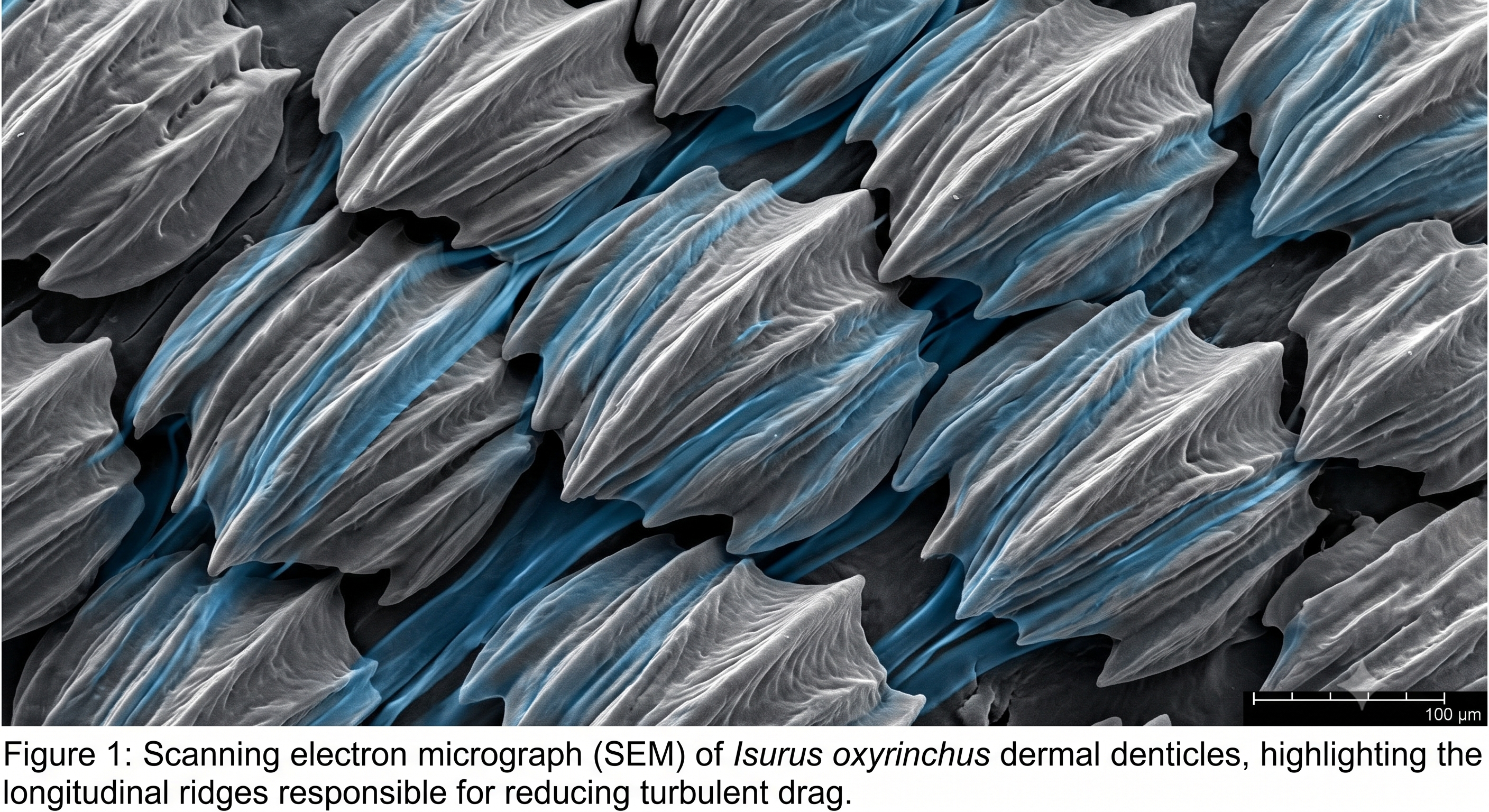
The ecomorphology of pelagic sharks (e.g., Lamniformes and Carcharhiniformes) is the result of formidable evolutionary convergence toward minimizing hydrodynamic drag. The epidermis is covered in placoid scales (dermal denticles) homologous to vertebrate teeth, composed of dentin and enamel.
These structures serve not only a protective function but actively alter the fluid boundary layer. By channeling water through longitudinal micro-grooves, the denticles prevent the separation of the turbulent flow, drastically reducing form drag.
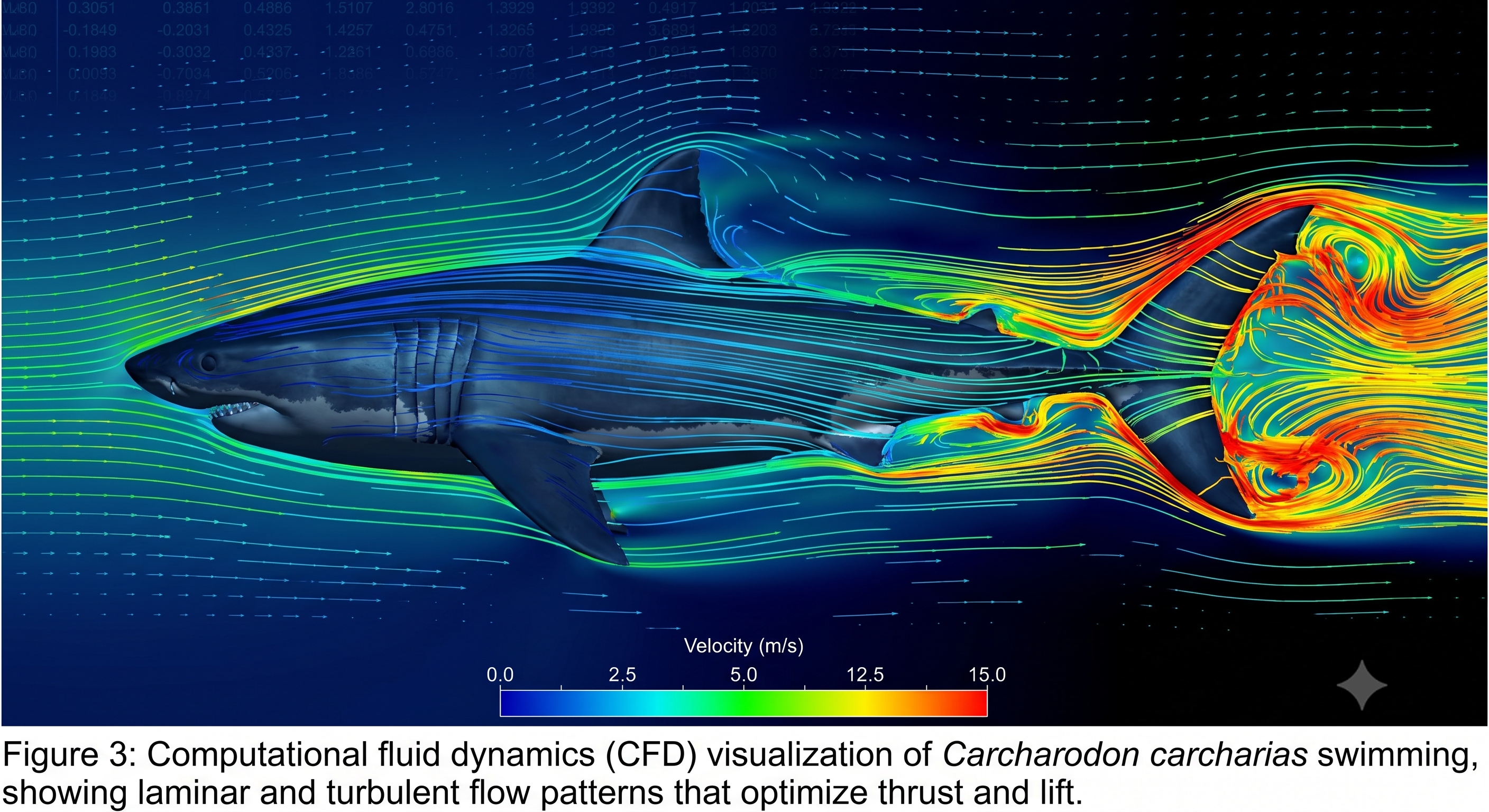
The physics of shark swimming is dominated by flow regimes characterized by high Reynolds numbers, described by the equation:
Re = (p * v * L) / u
where "p" is the density of seawater, "v" is the swimming velocity of the animal, "L" is the characteristic length (generally the total length of the individual), and "u" is the dynamic viscosity of the fluid.
Furthermore, propulsive thrust is primarily generated by the undulatory movement of the heterocercal caudal fin. The asymmetry of the upper lobe relative to the lower lobe generates asymmetric hydrodynamic lift, which is compensated by the inclination of the pectoral fins, allowing for highly energy-efficient three-dimensional maneuvering. Certain species within the family Lamnidae (e.g., Carcharodon carcharias, Isurus oxyrinchus) have evolved systems of regional endothermy via a rete mirabile of counter-current exchange capillaries, maintaining the red axial musculature and visual organs at temperatures above ambient levels, thereby optimizing contractile efficiency and synaptic processing rates.
3. Sensory Neurophysiology: Electroreception and Mechanoreception
The predatory success of sharks is mediated by a highly integrated sensory apparatus that exploits the physical and chemical gradients of the water column.
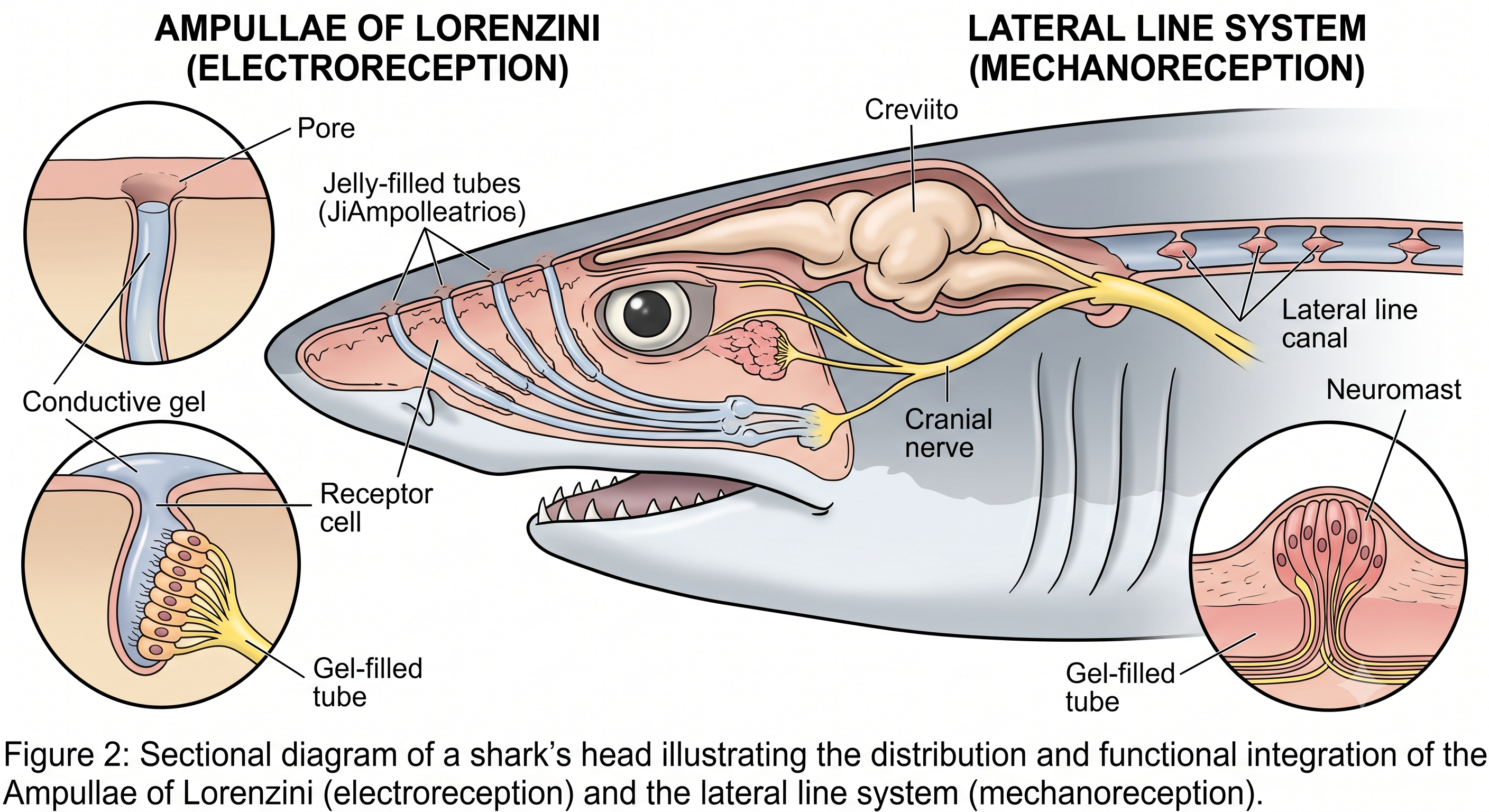
Ampullae of Lorenzini: These electroreceptor organs, distributed primarily in the cephalic region, contain a mucopolysaccharide-based gel with extremely high proton conductivity. Sharks can detect exceptionally weak electric fields (down to 5 nV/cm) generated by the neuromuscular action potentials of benthic or pelagic prey. They can also orient themselves by exploiting the Earth's geomagnetic field through electromagnetic induction.
Lateral Line System: Composed of superficial and canalized neuromasts, this mechanosensory system detects minute pressure variations and water displacements (at frequencies of 10-100 Hz). This allows for the detection of hydrodynamic wakes left by moving prey, even in the absence of visual stimuli (e.g., in aphotic or turbid zones).
4. Population Dynamics and Life History Traits
From an ecological perspective, sharks exhibit distinctly K-selected population dynamics. They are characterized by slow growth rates, late sexual maturity, long life expectancy, and low fecundity (prolonged gestation with reproductive strategies ranging from oviparity to placental viviparity).
The somatic growth of elasmobranchs is typically modeled using the von Bertalanffy Growth Function (VBGF), which is essential for stock assessment and conservation biology:
L(t) = L_∞ * (1 - e^(-k(t - t_0)))
In this equation, L(t) represents the length of the individual at time t, L_∞ is the theoretical maximum asymptotic length the species can reach, k is the growth rate constant (describing how quickly the animal approaches L_∞), and t_0 is the theoretical age at which the animal's length would be zero.
Because k assumes extremely low values in almost all large pelagic species, shark populations lack the demographic plasticity required to compensate for high anthropogenic mortality, making them intrinsically susceptible to overfishing.
The energetics of their basal metabolism (B) scales allometrically as a function of body mass (M), following the laws of metabolic biology typical of marine ectotherms (with necessary exceptions for Lamnids):
B = B_0 * M^(3/4)
where B_0 is a normalization constant dependent on temperature and taxon. This metabolic constraint explains the high foraging requirements of apex predators and their vast home ranges.
5. Top-Down Control and Trophic Cascade Theory
In marine ecology, large sharks function as apex predators. Their ecosystemic role is not limited to direct predation but includes complex indirect effects, described by the concept of Top-Down control.
Removing Selachimorpha from an ecosystem triggers the phenomenon of mesopredator release. The absence of the shark leads to an exponential growth of mid-level predators (e.g., benthic elasmobranchs, medium-sized carnivorous teleosts), which in turn decimate primary consumers (e.g., bivalves, herbivorous fishes).
In a typical predator-prey dynamics model derived from the Lotka-Volterra equations, the perturbation of the apex predator's mortality coefficient causes disastrous oscillations in the lower levels of the trophic pyramid. This often leads to the collapse of local biodiversity or the degradation of critical habitats, such as the overgrazing of seagrass meadows or the algal smothering of coral reefs due to a lack of herbivorous fish.
6. Conservation Physiology and Future Challenges
Modern conservation biology is integrating taxonomic data with physiology to understand the impact of global changes. Ocean acidification (lowering of pH due to CO2 absorption) threatens the olfactory capacity and sensory processing of sharks, altering receptor flows linked to homing and food detection. Additionally, mortality induced by bycatch causes severe acid-base imbalances and lactic stress in the blood, which are often lethal even if the animal is released post-capture.
The sustainable management of Selachimorpha therefore requires a holistic approach that combines spatial protection (strict Marine Protected Areas) with the use of highly accurate predictive mathematical models—tools that are indispensable for preserving the balance of our oceans before the demographic point of no return is crossed.
Evolution, Ecomorphology, and Population Dynamics of Selachimorpha: A Multidisciplinary Analysis of the Marine Trophic A